
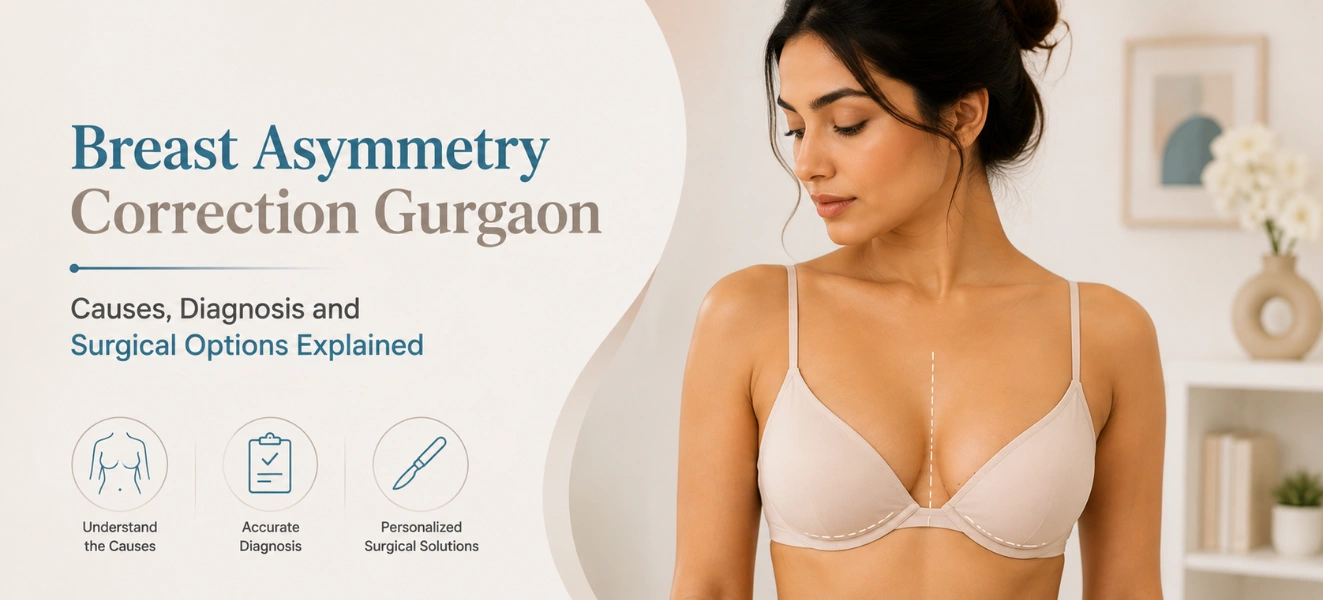
Some degree of breast asymmetry is present in almost every woman. A 2023 population study published in Aesthetic Surgery Journal examining breast measurements in 2,000 women found that 88 per cent had measurable differences in volume, height, or projection between the two breasts, and that only 7 per cent of women had breasts that were symmetric to within 5 per cent of each other in all dimensions. Natural breast asymmetry, in the majority of cases, is neither a medical condition nor something that requires clinical attention.
The minority of cases where breast asymmetry correction in Gurgaon is clinically indicated are those where the degree of asymmetry is significant enough to produce functional problems, psychological distress, or a structural abnormality that does not correct with normal development. This guide explains the causes of breast asymmetry, how significant asymmetry is clinically assessed and classified, what the surgical options for breast asymmetry correction in Gurgaon at Artemis Hospital are, and whether the procedure qualifies for insurance consideration.
To have your breast asymmetry assessed by Dr. Pradeep Kumar Singh, call +91 82879 23924 or arrange a consultation at Artemis Hospital, Gurugram.
Is It Normal to Have Uneven Breasts?
Yes. As the population study cited above demonstrates, measurable breast asymmetry is the norm rather than the exception in the female population. The clinical framework for distinguishing normal from significant asymmetry uses a threshold of greater than one cup size difference between the two breasts as the starting point for consultation, and the presence of associated functional symptoms (musculoskeletal symptoms from compensatory posture, psychological distress, bra and clothing fitting difficulty) as the additional criteria that indicate assessment is warranted.
Many women who present for breast asymmetry correction in Gurgaon are surprised to learn at the consultation that their asymmetry, while visible to them, falls within the range that does not clearly warrant surgical correction. These consultations are still clinically valuable because they establish an accurate assessment of the degree of asymmetry, rule out any structural cause that requires specific management, and give the patient an informed decision framework for whether to proceed with correction or continue without intervention.
What Causes Breast Asymmetry?
Breast asymmetry has several distinct causes that each have different clinical implications:
Developmental Asymmetry
The most common cause. Both breasts are composed of normal breast tissue but developed to different final sizes and positions during puberty. This type of asymmetry is present from the completion of breast development and does not typically progress significantly after breast maturity. Surgical options for developmental asymmetry include augmenting the smaller breast, reducing the larger breast, lifting one or both, or a combination of these approaches, depending on which achieves the best final symmetry from both a size and position perspective.
Tuberous Breast Deformity
Tuberous breast, also called tubular breast, is a structural breast abnormality characterised by a constricted, narrow breast base, herniation of the breast tissue through the areola (producing a puffy or enlarged areola appearance), a high inframammary fold, and a generally conical or tubular breast shape rather than a rounded one. It most commonly affects one breast more than the other, producing asymmetry, though bilateral tuberous breasts do occur. Tuberous breast correction in Gurgaon requires a specific surgical approach that addresses the constricted base (by scoring the tight tissue internally) and reshapes the breast mound through a combination of implant, fat grafting, and areola reduction. Standard augmentation without base release produces a poor result in tuberous breasts because the tight base constricts the lower pole expansion of the implant.
Poland Syndrome
Poland syndrome is a congenital unilateral absence or hypoplasia of the pectoralis major muscle, often associated with underdevelopment of the breast on the same side. The degree of breast underdevelopment ranges from mild to severe, and breast asymmetry correction in these patients typically requires custom implant or fat grafting to restore volume on the affected side, combined with chest wall reconstruction where significant pectoral muscle absence is present. Poland syndrome breast reconstruction is a complex procedure that is planned with 3D imaging at Artemis Hospital to ensure the implant dimensions are matched to the specific volume deficit.
Post-Surgical or Post-Trauma Asymmetry
Asymmetry following a previous breast procedure (augmentation, reduction, or lift with unequal healing or complications) or following breast trauma with tissue injury. This category includes secondary asymmetry following cancer surgery where a lumpectomy or segmental resection has produced a tissue defect on one side. Fat grafting is particularly well-suited to correcting volume deficits from previous surgery without adding an implant, and is the first-line approach for moderate post-surgical volume asymmetry where the overall breast size does not require additional volume beyond what fat grafting can provide.
How Is Breast Asymmetry Surgery Planned in Gurgaon?
Breast asymmetry correction surgery in Gurgaon at Artemis Hospital is planned through a systematic process that begins with quantifying the asymmetry before any surgical option is discussed:
- Clinical measurement: Both breasts are measured for base width, projection, nipple-to-fold distance, nipple height from the clavicle, and areola diameter. These measurements establish the specific dimensional differences between the two sides and identify which dimensions require correction.
- Volume estimation: The volume difference between the two breasts is estimated by measurement and, where available, by 3D imaging. Volume difference is the most surgically relevant parameter for planning whether augmentation, reduction, or a combination is required.
- Surgical approach decision: The operative plan for breast asymmetry correction in Gurgaon is developed to bring both breasts to a shared target, not simply to make one side look like the other. The target is agreed with the patient at the consultation and drives the choice of whether the smaller breast is brought up, the larger breast is brought down, or both are modified to meet at a mutually agreed size and position.
- 3D simulation: At Artemis Hospital, 3D imaging is used where available to preview the expected result of the planned surgical approach on the patient’s own anatomy before the procedure date is agreed. This is particularly valuable for asymmetry cases where the surgical plan involves modifications on both sides simultaneously, and where a visual preview helps the patient understand the expected result before committing.
Patients from Sector 40 and New Gurgaon who consult at Artemis Hospital, Sector 51, Gurugram, for breast asymmetry correction in Gurgaon receive this full assessment process at the initial consultation before any surgical approach is proposed.
Is Breast Asymmetry Correction Covered by Insurance in India?
Insurance coverage for breast asymmetry correction surgery in Gurgaon depends on the underlying cause. Developmental asymmetry correction is generally considered cosmetic and is not covered by health insurance in India. Tuberous breast deformity correction may qualify for coverage in some policies where the structural abnormality is documented and the surgery is performed for reconstructive rather than cosmetic indication. Post-cancer surgery asymmetry correction, where a lumpectomy has produced a volume deficit on the treated side, is covered under the same medically necessary reconstructive surgery provisions that apply to mastectomy reconstruction under the 2019 IRDAI standardisation. Poland syndrome reconstruction is covered as a medically necessary procedure under most policies that cover congenital anomaly correction.
Frequently Asked Questions
Is it normal to have uneven breasts?
Yes. Published research shows that 88 per cent of women have measurable breast asymmetry. A difference of less than one cup size is considered within the normal range and does not typically indicate a need for surgical correction. Breast asymmetry correction in Gurgaon is indicated where the size difference is greater than one cup size, particularly where functional symptoms or a structural abnormality are present alongside the asymmetry.
What causes breast asymmetry?
The most common cause is developmental asymmetry, where both breasts are normal but developed to different sizes. Other causes include tuberous breast deformity (a structural abnormality of the breast base), Poland syndrome (congenital pectoral muscle absence with associated breast underdevelopment), and post-surgical or post-trauma tissue changes. The cause determines the appropriate surgical approach.
Can breast asymmetry be corrected without implants?
Yes, in cases where fat grafting can provide the required volume increase. Fat transfer can be used to add volume to the smaller breast where the volume difference is within the range achievable by fat grafting (typically half to one cup size). For larger volume differences, or where the skin envelope of the smaller breast also requires expansion, an implant is typically the more reliable approach. Asymmetry involving both size and position differences frequently requires a combination of augmentation, reduction, or lift procedures applied to one or both sides.
How is breast asymmetry surgery planned in Gurgaon?
Planning begins with clinical measurements of both breasts: base width, projection, nipple height, and volume estimation. A target is agreed with the patient at the consultation. The surgical approach, whether augmenting the smaller side, reducing the larger, or modifying both, is then designed to bring both breasts to the agreed target. Three-dimensional imaging at Artemis Hospital previews the expected result before the surgery date is confirmed.
Is breast asymmetry correction covered by insurance in India?
Coverage depends on the cause. Developmental asymmetry correction is cosmetic and is not covered. Tuberous breast deformity, Poland syndrome, and post-cancer lumpectomy asymmetry may qualify for medically necessary coverage under IRDAI-regulated policies. Post-mastectomy asymmetry correction is covered under the same provisions as breast reconstruction. The Artemis Hospital team documents the clinical indication for insurance consideration where appropriate.
Can fat transfer correct breast asymmetry in Gurgaon?
Yes. Fat transfer is an appropriate option for breast asymmetry correction in Gurgaon where the volume difference is within the range achievable by fat grafting (typically half to one cup size). It uses the patient’s own fat, requires no implant, and leaves no additional breast scar. For larger volume differences, or where the skin envelope of the smaller breast requires expansion beyond what fat grafting supports, an implant provides more reliable correction. The clinical assessment at Artemis Hospital determines which approach is appropriate for the specific asymmetry dimensions.
Breast asymmetry correction in Gurgaon is most precisely planned from clinical measurement, not from photographs. Call +91 82879 23924 or visit Artemis Hospital, Sector 51, Gurugram, Haryana 122001.
Reviews: Dr. Pradeep Kumar Singh on Google.
Dr. Pradeep Kumar Singh: MCh Plastic Surgery, Fellowship Paris, APSI Member: Head of Plastic Surgery, Artemis Hospital, Sector 51, Gurugram.