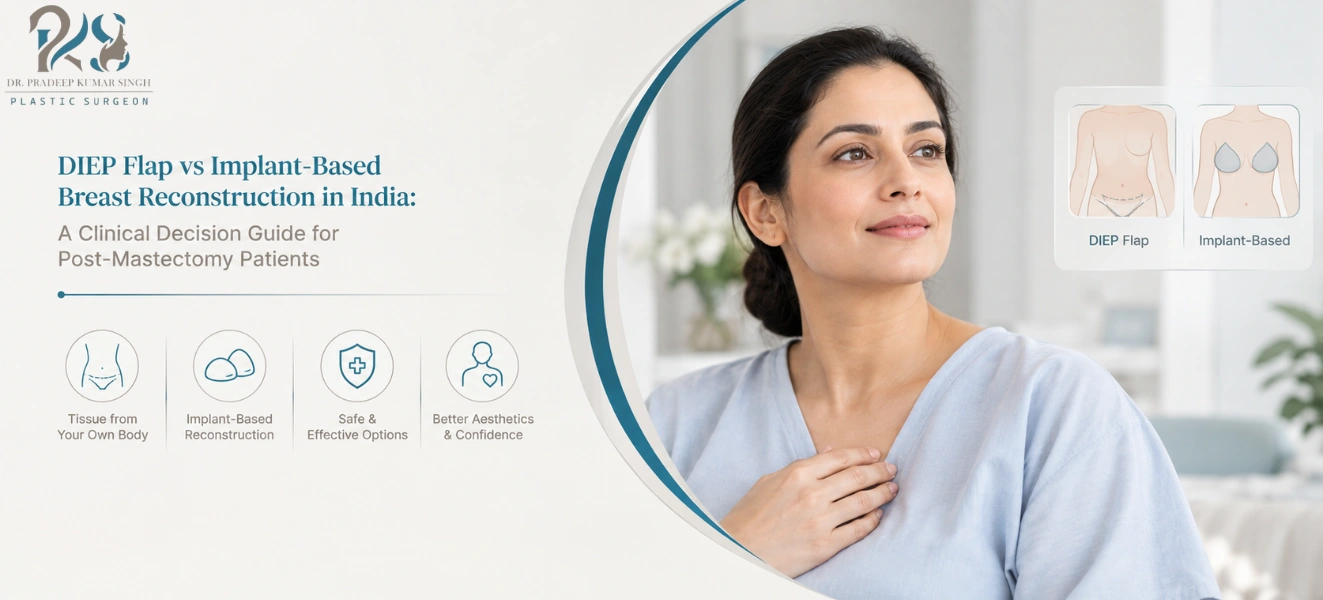
After mastectomy, patients and surgeons face a central reconstructive decision: rebuild the breast using the patient’s own tissue transferred from elsewhere in the body, or use a breast implant to recreate volume. Both paths lead to completed reconstruction. They differ substantially in surgical complexity, recovery duration, long-term result characteristics, and candidacy requirements.
This decision guide is built around the clinical factors that determine which approach is appropriate for each individual patient. It is not a ranking of one technique above the other. It is a framework for understanding which question to ask, and which answer points to which option, at the breast reconstruction surgery consultation in Gurgaon at Artemis Hospital.
Call +91 82879 23924 to arrange a post-mastectomy reconstruction assessment with Dr. Pradeep Kumar Singh, MCh Plastic Surgery, Fellowship Paris, APSI Member, Head of Department of Plastic Surgery, Artemis Hospital.
Important Read: Breast Reconstruction Surgery in Gurgaon After Cancer: Restoring Hope and Wholeness
What Is the DIEP Flap?
The DIEP flap (Deep Inferior Epigastric Perforator flap) is an autologous reconstruction technique that transfers a segment of the patient’s own abdominal skin and fat to the chest to create the breast mound after mastectomy. The tissue is transferred on its own blood supply through the deep inferior epigastric perforating blood vessels, which are dissected free from the underlying rectus abdominis muscle and anastomosed (joined) to blood vessels in the chest under a surgical microscope. The muscle itself is preserved, which distinguishes the DIEP flap from the older TRAM flap technique that sacrificed the rectus muscle during transfer.
The surgical team requirement for DIEP flap reconstruction in Gurgaon includes a microsurgery-trained plastic surgeon who can perform the vascular anastomosis under magnification, as well as an experienced anaesthesia and theatre team familiar with the extended operative duration. At Artemis Hospital, DIEP flap reconstruction is performed by Dr. Pradeep Kumar Singh, whose Fellowship training in Paris included dedicated microsurgery and free flap reconstruction alongside aesthetic surgery training.
Step 1: Is the Patient Medically Fit for a Long Procedure?
DIEP flap breast reconstruction surgery in Gurgaon takes six to nine hours under general anaesthesia. Implant-based reconstruction can be completed in two to three hours. The extended duration and the physiological demand of free flap surgery make DIEP flap an appropriate choice only for patients who are medically fit for a prolonged general anaesthetic.
Patients with significant cardiovascular disease, poorly controlled diabetes, obesity above BMI 35, or active smoking are higher-risk candidates for DIEP flap surgery. For these patients, implant-based reconstruction offers the same oncological outcome with significantly lower procedural risk. At Artemis Hospital, the anaesthesia team reviews every DIEP flap candidate at a dedicated pre-operative assessment before the reconstruction type is confirmed.
Step 2: Is There Adequate Abdominal Tissue?
The DIEP flap uses tissue from the lower abdomen. An adequate donor site requires sufficient abdominal fat volume to recreate the breast mound after transfer. Very lean patients, those who have had previous abdominoplasty, and those with prior abdominal surgery that may have disrupted the perforating blood vessels are less reliable DIEP flap candidates. Doppler ultrasound assessment of the abdominal perforating vessels is performed pre-operatively at Artemis Hospital to confirm vessel anatomy before DIEP flap reconstruction in Gurgaon is planned.
Step 3: What Does the Patient Value Most in the Result?
| Factor | DIEP Flap | Implant-Based |
| Tissue type | Patient’s own living tissue | Synthetic prosthesis |
| Feel and warmth | Natural; same temperature as body | Slightly firmer; slightly different temperature |
| Longevity | Permanent; ages naturally with body | Implant lifespan 10 to 20 years; may need replacement |
| Radiation tolerance | Better tolerated by natural tissue | Implants in radiated tissue: higher complication rate |
| Abdominal result | Effectively a tummy tuck side benefit | No change to abdomen |
| Recovery duration | 6 to 8 weeks; longer hospital stay (4 to 5 days) | 2 to 4 weeks; shorter hospital stay (1 to 2 days) |
| Revision risk | Low once flap is viable | Higher at 10 years due to implant-related changes |
| Immediate vs delayed | Can be immediate or delayed | Both; immediate more common |
Step 4: Will Radiation Be Part of the Treatment Plan?
Radiation after mastectomy significantly affects the long-term behaviour of implant-based breast reconstruction surgery in Gurgaon. Published literature reports capsular contracture rates of 30 to 50 per cent in radiated implant pockets at five years, compared with 10 to 15 per cent in non-radiated pockets. Radiation also causes skin changes that make subsequent revision surgery more demanding.
DIEP flap tissue, being the patient’s own vascularised living tissue, tolerates radiation better than implants. Several published series report acceptable complication rates for DIEP flap in the post-radiation field, although the radiation changes in the chest wall skin do increase the technical complexity of the flap inset. For patients who will definitely receive post-mastectomy radiation therapy, the case for DIEP flap reconstruction is significantly stronger than for patients who will not.
Important Read: Breast Reduction for Back Pain Relief: Life-Changing Surgery
The Decision Summary
DIEP flap is strongly preferred when: radiation is planned or has been given; the patient values permanence and natural tissue; abdominal donor tissue is adequate; the patient is medically fit for extended surgery; and the patient accepts a longer recovery in exchange for a more durable long-term result.
Implant-based reconstruction is preferred when: no radiation is planned; the patient prioritises shorter recovery; abdominal donor tissue is insufficient; medical fitness for extended general anaesthesia is limited; or the patient’s personal preference is for a less complex procedure with a quicker return to normal activity.
Neither is universally superior. The correct choice depends on the individual patient’s oncological plan, anatomy, medical fitness, values, and priorities, assessed at the consultation.
Frequently Asked Questions
What is a DIEP flap and how is it different from implant reconstruction?
A DIEP flap uses the patient’s own abdominal skin and fat, transferred on its perforating blood vessels via microsurgery, to rebuild the breast mound after mastectomy. Implant-based reconstruction uses a silicone gel prosthesis. The DIEP flap produces a breast of natural living tissue that ages with the body; implants require monitoring and potential replacement over time. DIEP flap surgery takes significantly longer and has a longer recovery, but produces a more durable result, particularly in patients who receive radiation therapy.
Who is a good candidate for DIEP flap reconstruction in Gurgaon?
Good candidates for DIEP flap breast reconstruction surgery in Gurgaon are medically fit for extended general anaesthesia, have adequate lower abdominal tissue volume, have not had previous abdominoplasty that might have disrupted the perforating blood vessels, and particularly those who will receive post-mastectomy radiation therapy. Pre-operative Doppler ultrasound confirms vessel anatomy before the procedure is confirmed.
Is DIEP flap reconstruction better than implants?
DIEP flap reconstruction is not universally better, but it is more appropriate for specific patients. In women who will receive radiation therapy, who prioritise a permanent natural result, or who have had implant complications previously, DIEP flap offers clear advantages. For women who prefer a shorter recovery, have insufficient abdominal tissue, or are not medically fit for prolonged surgery, implant-based reconstruction is the more appropriate choice. Both approaches produce satisfactory breast reconstruction outcomes at Artemis Hospital.
How long does DIEP flap recovery take in Gurgaon?
DIEP flap breast reconstruction surgery in Gurgaon requires a four to five day hospital stay, compared with one to two days for implant reconstruction. Most patients return to light activity at four to six weeks and to full activity at eight to twelve weeks. The abdominal donor site also requires four to six weeks of restricted movement. The total recovery is longer than implant reconstruction, but the majority of patients report that the result justifies the extended recovery period.
Is DIEP flap reconstruction available at Artemis Hospital Gurgaon?
Yes. DIEP flap breast reconstruction is performed at Artemis Hospital, Sector 51, Gurugram, by Dr. Pradeep Kumar Singh, MCh Plastic Surgery, who holds a Fellowship in Advanced Aesthetic Surgery from St. Louis Hospital, Paris, which included training in microsurgery and free flap reconstruction. Artemis Hospital is JCI and NABH accredited and has the microsurgery theatre infrastructure required for safe free flap reconstruction.
What is the cost of DIEP flap vs implant reconstruction in Gurgaon?
DIEP flap breast reconstruction surgery in Gurgaon has a higher cost than implant-based reconstruction, reflecting the longer operative time, the two-team surgical approach, the extended hospital stay, and the microsurgery infrastructure required. Both approaches may qualify for insurance coverage where reconstruction follows mastectomy for breast cancer, under the IRDAI medically necessary reconstructive surgery provisions. A personalised cost estimate for both options is provided at the consultation. Contact Artemis Hospital to arrange an assessment.
Breast reconstruction surgery in Gurgaon that fits your specific oncological plan, anatomy, and goals. Call +91 82879 23924 or visit Artemis Hospital, Sector 51, Gurugram, Haryana 122001.
Patient reviews: Dr. Pradeep Kumar Singh on Google.
Dr. Pradeep Kumar Singh: MCh Plastic Surgery, Fellowship Paris, APSI Member: Head of Plastic Surgery, Artemis Hospital, Sector 51, Gurugram.