
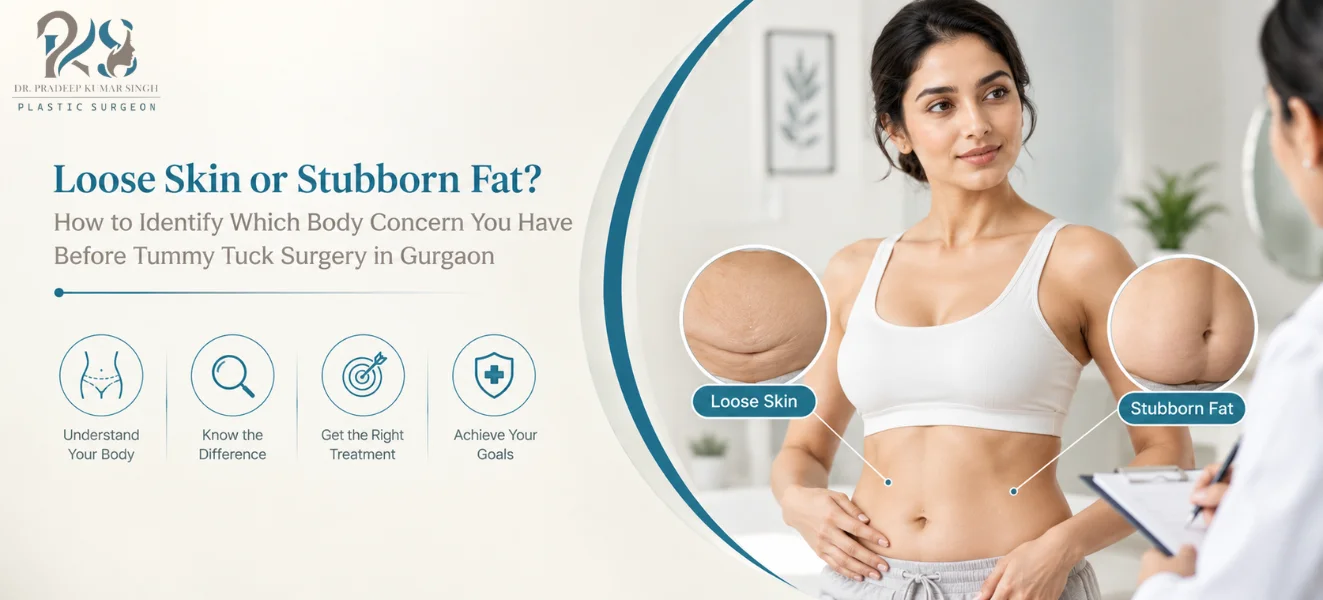
Two patients present at a tummy tuck surgery consultation in Gurgaon with what sounds like the same complaint: a stomach that does not respond to diet or exercise. One of them needs liposuction. The other needs abdominoplasty. The third, the one nobody talked about, needs both, plus internal muscle repair.
Performing liposuction on the patient who needs skin excision leaves them with a flatter fat layer beneath skin that now has even less support beneath it, making the laxity more visible than before surgery. Performing abdominoplasty on the patient who primarily has fat produces an appropriate result that could have been achieved with a less extensive operation. Addressing neither when the underlying problem is separated abdominal muscles means the central protrusion that brought the patient to the consultation remains entirely unchanged, regardless of how much fat or skin is removed above it.
The clinical assessment that distinguishes these presentations takes approximately ten minutes. It is not optional. It is the entire basis of a correct treatment plan.
Dr. Pradeep Kumar Singh, MCh Burns and Plastic Surgery, Fellowship in Aesthetic Surgery from St. Louis Hospital Paris, and Head of Department of Plastic Surgery at Artemis Hospital, brings an additional dimension to this assessment that most cosmetic surgeons cannot: he has performed DIEP flap breast reconstructions, in which the deep inferior epigastric perforating blood vessels that supply the abdominal skin are the operative foundation. He knows the vascular anatomy of the abdominal wall with a precision that comes from using it as both a reconstructive tool and an aesthetic one. That knowledge determines how safely and completely tummy tuck surgery in Gurgaon can be performed for each patient’s specific anatomy.
Test 1: The Pinch Test, Measuring the Fat Component
Stand in front of a mirror. Using your thumb and two fingers, pinch the tissue in the area of concern and compress it gently.
If you can pinch a meaningful volume of soft, compressible tissue, the dominant component is subcutaneous fat. The amount you can pinch between thumb and forefinger represents approximately twice the fat layer thickness at that point. A pinch of more than 2.5 centimetres indicates a subcutaneous fat deposit that may respond to liposuction in patients with adequate skin elasticity.
If the tissue compresses very little but the area looks prominent, the concern is not primarily fat. It may be skin laxity, muscle separation, or intra-abdominal fat, which is located inside the abdominal cavity, not under the skin, and cannot be removed by any external surgical technique. A prominent abdomen that resists the pinch in the supraumbilical zone (above the navel) is frequently intra-abdominal fat, not subcutaneous. Liposuction does not address intra-abdominal fat.
The distinction between subcutaneous and intra-abdominal fat is one of the most clinically important assessments at any tummy tuck surgery or liposuction consultation in Gurgaon. Patients who have received liposuction targeting what was actually intra-abdominal fat report no change in abdominal prominence after the procedure, because the procedure correctly removed subcutaneous fat while leaving the actual cause of the protrusion untouched.
Important Read: Tummy Tuck Surgery Gurgaon: Mini vs Full Abdominoplasty, Which One Do You Need in 2026?
Test 2: The Elasticity Test, Measuring Skin Quality
Pinch the skin in the area of concern and release it immediately. Observe how quickly it returns to position.
Snap-back in under one second: Good skin elasticity. The skin retains sufficient collagen density and structural integrity to contract after fat removal. Liposuction alone may produce an adequate result if fat is the dominant concern.
Slow return over two to four seconds: Reduced elasticity. The skin will contract partially after liposuction but will not fully retract to the reduced contour. Residual laxity will remain. A combined approach, fat removal alongside skin tightening, may be required.
No meaningful return, or the skin stays gathered or puckered when released: Significantly reduced elasticity. This is the definitive signal that liposuction alone will worsen the visible appearance. Removing the fat that partially fills the lax skin envelope leaves the loose skin with less support underneath it. The laxity becomes more pronounced, not less. Skin excision is required, and tummy tuck surgery in Gurgaon is the appropriate procedure, not liposuction.
The skin elasticity test is particularly important in patients who have had significant weight loss or multiple pregnancies. These are the presentations where skin laxity is almost invariably the dominant component, regardless of how much fat remains. The published guide to tummy tuck surgery after weight loss in Gurgaon addresses the specific anatomical changes that follow bariatric surgery or sustained weight reduction and why these presentations consistently require skin excision rather than fat removal alone.
Test 3: The Curl-Up Test, Checking for Diastasis Recti
This is the test most patients have never performed, and the finding that most frequently changes the entire surgical plan.
Lie flat on your back on a firm surface. Cross your arms over your chest. Slowly curl your head and shoulders off the floor as if beginning a sit-up, and hold the position.
If a vertical ridge or dome appears along the midline of your abdomen, you have diastasis recti, the separation of the paired rectus abdominis muscles along the linea alba. The ridge or dome is the intra-abdominal contents pushing through the weakened midline connective tissue as the flanking muscles contract.
Diastasis recti is common after pregnancy, in which the growing uterus progressively stretches the linea alba, and after significant weight fluctuation. It produces a central abdominal protrusion that is structurally different from fat or skin laxity. No amount of liposuction removes this protrusion, because it is not fat. No amount of skin excision alone resolves it, because the skin is not the structure that is separated. Diastasis recti requires internal repair: the surgical plication (suturing together) of the separated muscles along the midline.
The plication of the rectus abdominis muscles is a standard and essential component of full abdominoplasty. It is not performed during liposuction. It is not performed during mini abdominoplasty, which addresses only the infra-umbilical zone. A patient with significant diastasis recti who receives either of these procedures will see improvement in skin or fat, but will leave with the same central dome that motivated the consultation. Understanding the distinction between a mini tummy tuck and a full abdominoplasty in Gurgaon is directly connected to understanding whether diastasis recti is present.
Important Read: Laser Liposuction Surgery Gurgaon: How Effective Is It for Belly Fat?
Test 4: Location Mapping, Where the Concern Sits Changes Everything
The location and distribution of the abdominal concern is the fourth component of the clinical self-assessment:
Lower abdomen only, below the navel, with an apron or overhang: The classic presentation after pregnancy or significant weight loss. This zone typically contains both loose skin and fat, and the skin excess is the dominant visible component. The apron itself is a skin and fat structure that cannot be treated by liposuction alone, because the skin is load-bearing in its overhanging position and removing the fat without the skin leaves the overhang intact and unsupported.
Upper abdomen, above the navel, not pinchable but prominent: Likely intra-abdominal fat, particularly if the prominence is firm and does not change much with posture. This is the one presentation where neither liposuction nor tummy tuck surgery is the primary solution. Weight management through dietary and metabolic approaches addresses intra-abdominal fat; surgery addresses subcutaneous fat and skin.
Full circumference of the trunk, waist, and flanks: A mixed presentation with both subcutaneous fat and skin components distributed broadly. This may be appropriate for combined body contouring surgery, which addresses multiple zones in a single session. The 360 liposuction and circumferential body contouring guide outlines how VASER liposuction and skin excision are combined for this presentation.
Central midline prominence specifically: Diastasis recti until proven otherwise. The curl-up test above will confirm or exclude it.
The Clinical Decision Framework: Which Procedure Addresses Which Concern?
| Clinical Findings | Dominant Concern | Correct Procedure | Procedure That Will Not Help |
| Pinchable, elastic skin, no midline dome | Subcutaneous fat | Liposuction | Tummy tuck (unnecessary) |
| Pinchable, reduced elasticity | Fat + mild skin laxity | VASER + BodyTite RF, or liposuction with limited skin excision | Liposuction alone (residual laxity) |
| Not pinchable, visible loose skin, elastic test fails | Skin laxity dominant | Tummy tuck surgery Gurgaon, skin excision | Liposuction alone (worsens appearance) |
| Pinchable + loose skin + midline dome on curl-up | Fat + laxity + diastasis recti | Full abdominoplasty with muscle plication | Mini tummy tuck, liposuction alone |
| Lower apron, post-pregnancy or post-weight loss | Skin and fat apron | Full abdominoplasty | Liposuction alone (apron remains) |
| Firm upper prominence, minimal pinch | Likely intra-abdominal fat | Weight management first | Liposuction (cannot reach this fat) |
Why Stable Body Weight Is Not a Formality for Tummy Tuck Surgery in Gurgaon
Every patient presenting for tummy tuck surgery in Gurgaon at Artemis Hospital is asked about current body weight and whether it has been stable for a minimum of six months. This is not an administrative question. It is a clinical requirement that directly affects both the safety and the durability of the result.
Abdominoplasty removes a defined amount of skin and tightens a specific tissue envelope. If the patient gains significant weight after the procedure, the remaining skin and the repaired muscles must accommodate volume they were not left with the capacity to accommodate. The result distorts. Conversely, a patient who plans to lose more weight after surgery will find that the result continues to change as the fat and tissue volume beneath the operated skin reduces further, potentially producing secondary laxity that requires additional correction.
The correct timing for tummy tuck surgery is after stable weight has been maintained for six months, after pregnancy plans are complete (a subsequent pregnancy after abdominoplasty can undo the muscle repair and create new skin excess), and after any medically supervised weight loss programme has reached its endpoint. The rising demand for tummy tuck surgery in Gurgaon in 2026 reflects increasing awareness of these timing principles among Indian patients planning elective body contouring.
Important Read: Love Handles Removal in Gurgaon: Targeted Liposuction Solutions for Stubborn Flank Fat
Frequently Asked Questions: Tummy Tuck Surgery and Body Concerns in Gurgaon
How do I know if I need tummy tuck surgery or liposuction in Gurgaon?
The four-test clinical self-assessment determines this: the pinch test (is the concern compressible fat?), the elasticity snap-back test (will the skin contract after fat removal?), the curl-up test (is there a midline muscle separation?), and location mapping (where does the concern sit?). If the skin does not snap back promptly when pinched and released, tummy tuck surgery in Gurgaon is likely indicated rather than liposuction alone. If a midline ridge appears on the curl-up test, full abdominoplasty with muscle plication is required. The definitive assessment is the clinical examination at the consultation.
What is diastasis recti and does it affect tummy tuck surgery in Gurgaon?
Diastasis recti is the separation of the paired rectus abdominis muscles along the midline linea alba, common after pregnancy and significant weight fluctuation. It produces a central abdominal protrusion that cannot be resolved by liposuction or skin excision alone. Surgical repair, the plication of the separated muscles, is performed as a standard component of full abdominoplasty at Artemis Hospital. Patients with significant diastasis recti who have liposuction or mini tummy tuck surgery in Gurgaon without muscle repair will see no improvement in the central protrusion. The full abdominoplasty is the only outpatient surgical approach that addresses all three components- fat, skin laxity, and muscle separation- simultaneously.
Can liposuction make loose skin worse in Gurgaon?
Yes. In patients with reduced skin elasticity, liposuction removes the subcutaneous fat that was partially filling and supporting the lax skin envelope. The skin, which lacks the elasticity to retract to the new reduced contour, is left with less support underneath it and hangs more visibly than before. This is the most common cause of a liposuction outcome that looks worse than the pre-operative presentation in patients with skin laxity. The elasticity snap-back test, releasing a pinch of skin and timing the return, identifies this risk before any procedure is planned.
What is the difference between a mini and full tummy tuck surgery in Gurgaon?
A mini abdominoplasty addresses skin excess and fat below the navel only, uses a shorter incision, and does not reposition the umbilicus or repair the full length of the midline muscle separation. A full abdominoplasty addresses the entire anterior abdominal skin envelope, includes umbilical repositioning, and repairs the diastasis recti from the xiphoid to the pubis. The correct choice depends on the zone and extent of the concern and the presence of muscle separation. Patients with skin excess above the navel, significant diastasis recti, or a full apron extension require full abdominoplasty. The detailed comparison is in the published guide on mini vs full tummy tuck surgery in Gurgaon.
How much time off work is needed after tummy tuck surgery in Gurgaon?
Return to desk work typically occurs at ten to fourteen days after tummy tuck surgery in Gurgaon. Return to physically demanding work or exercise is at six to eight weeks, following the six-week surgeon review. A compression garment is worn continuously for the first four to six weeks. Driving is not recommended for two to three weeks, as braking and reaching the steering wheel engage the core muscles against which the abdominal repair is healing. A personalised return-to-work timeline is provided at the pre-operative assessment, based on the operative plan and the patient’s specific occupational demands.
Is tummy tuck surgery in Gurgaon appropriate after pregnancy?
Yes, and abdominoplasty after pregnancy is one of the most consistently effective body contouring interventions, addressing the skin laxity, fat distribution changes, and diastasis recti that frequently persist after childbirth regardless of diet and exercise. The correct timing is a minimum of six months after delivery, after breastfeeding is complete, and after the family is complete. Pregnancy after abdominoplasty can stretch the repaired muscles and create new skin excess, reducing the durability of the original result. Patients planning further pregnancies are advised to defer the procedure until after their family is complete.
What makes tummy tuck surgery at Artemis Hospital different from standalone clinic procedures in Gurgaon?
Abdominoplasty at Artemis Hospital, Gurgaon, is performed at a JCI and NABH dual-accredited facility by an MCh-qualified plastic surgeon with specific expertise in abdominal wall anatomy from both reconstructive and aesthetic surgery. The full hospital setting provides 24-hour anaesthesiology cover, post-operative monitoring, and an ICU if recovery requires it. Dr. Pradeep Kumar Singh’s background in DIEP flap reconstruction means the deep inferior epigastric perforating blood vessels that supply the abdominal skin are not approached as an anatomical approximation but as precisely mapped surgical territory. This translates into safer tissue handling, more reliable healing, and lower complication rates than equivalent procedures performed in facilities without this depth of infrastructure or surgical training.
The consultation that correctly identifies your specific combination of concerns- fat, skin laxity, muscle separation, or all three- is the consultation that produces a surgical plan that actually addresses what brought you in.
Call +91 82879 23924 to arrange a tummy tuck surgery assessment at Artemis Hospital in Gurgaon.