Exercise reduces chest fat. It does not reduce gynecomastia.
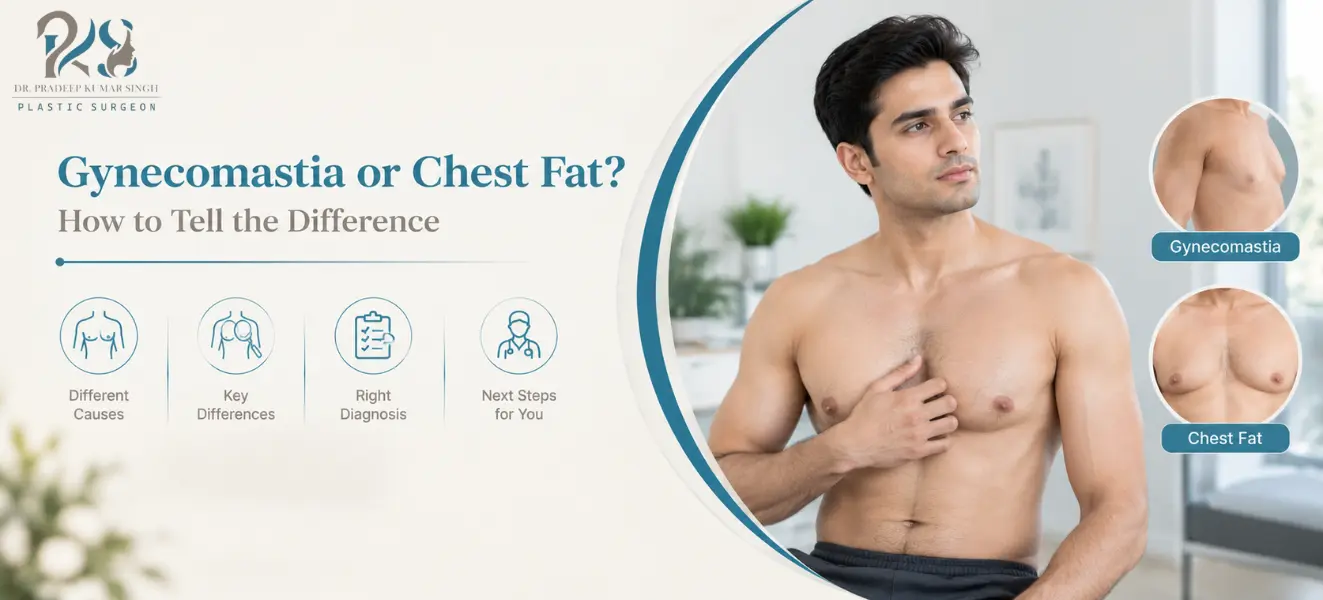
This is the single most important clinical fact for any man presenting with a chest concern that has not responded to training. Chest fat is subcutaneous adipose tissue distributed across the pectoral zone. It responds to a calorie deficit and body fat reduction. Gynecomastia is glandular breast tissue, structurally distinct from fat, located beneath the areola, and entirely unresponsive to any lifestyle intervention. The two conditions are frequently confused, and the confusion leads directly to months or years of training that changes nothing, because the tissue being trained around is not the tissue that exercise affects.
Gynecomastia affects an estimated 40 to 60 per cent of Indian men at some point in their lives. Many of those men have been told at some stage that it will resolve with exercise or weight loss. For established glandular gynecomastia in adults, it will not. Here is how to determine which you have.
The Firmness Test: The Most Reliable Self-Assessment
Lie flat on your back. Using the pads of two fingers, feel directly beneath the areola and apply gradual firm pressure.
Soft, evenly distributed tissue that compresses uniformly: consistent with chest fat. No discrete structure is present beneath the surface.
A firm, rubbery disc or ridge directly beneath the areola, clearly distinct from the surrounding tissue: consistent with glandular gynecomastia. The disc typically measures 2 to 5 centimetres in diameter. It feels categorically different from the surrounding adipose tissue because it is a different tissue type. It does not compress the same way fat does under pressure.
This disc, when present, is the glandular component of gynecomastia. It is the structure that does not reduce with exercise, does not respond to diet, and cannot be aspirated by a liposuction cannula. Its removal requires direct surgical excision through a small periareolar incision. The different presentations and appropriate surgical approaches for each grade are covered in the gynecomastia grades and treatment guide for Gurgaon patients.
Important Read: Gynecomastia Surgery Gurgaon: Grades, Scarless Techniques, Cost and Recovery Guide
The Exercise Response Test: What Changes and What Does Not
If you have maintained a calorie-controlled diet and consistent resistance training for twelve or more weeks without meaningful reduction in the chest fullness beneath the areola, the dominant component is glandular. Fat responds to sustained calorie deficit within this timeframe. Glandular tissue does not move at any point in that process.
The nuanced version of this test: some men with gynecomastia do see reduction in overall chest volume with weight loss, because the fatty component alongside the glandular disc reduces. The disc itself remains unchanged. If training has reduced the size of the chest generally but left a persistent firm prominence beneath the areola, the residual is glandular, and surgery is the only appropriate treatment for that component.
The Location Test: Periareolar vs Distributed
Chest fat distributes across the pectoral zone broadly, extending into the axillary fold and the lateral chest wall. The fullness is diffuse and follows the general body fat distribution pattern.
Gynecomastia is centred directly beneath the areola. The maximum prominence is in the periareolar zone. In lower-grade presentations, the glandular disc does not extend significantly beyond the areola margin. In higher-grade presentations- Grades IIb and III in the Simon classification- the tissue extends further, but the periareolar zone remains the point of maximum density and firmness.
If your chest fullness is greatest directly beneath and around the nipple-areola complex, and the surrounding chest tissue is softer and more distributed, gynecomastia is the more likely dominant component. The specific grade of gynecomastia determines the operative approach, as explained in the complete guide to VASER gynecomastia surgery in Gurgaon.
The Drug and Hormone History
Several common medications and substances cause or exacerbate gynecomastia by altering the androgen-oestrogen balance at the breast tissue level: anabolic steroids, spironolactone, some antipsychotics and antihypertensives, cannabis, and certain antiretroviral medications. If you use any of these and have a firm periareolar disc, the agent is a likely contributor.
At Artemis Hospital, the gynecomastia surgery consultation in Gurgaon includes a hormonal and medication history before any surgical plan is discussed. Where a correctable cause is identified, addressing it first may produce partial resolution that changes the extent of the procedure required.
What About Puffy Nipples Specifically?
Puffy nipples, the presentation in which the areola projects forward as a dome rather than lying flat against the chest, represent a specific variant of Grade I gynecomastia in which the glandular tissue is concentrated in a small subareolar volume and creates areolar projection rather than broad chest fullness. The firmness test directly beneath the areola will identify the subareolar disc in this presentation. The treatment is direct gland excision through a small periareolar incision, and the results are reliable and permanent. The specific approach is covered in the published guide on puffy nipples treatment for men in Gurgaon.
When to Book a Consultation for Gynecomastia Surgery in Gurgaon
If the firmness test identifies a disc, if the chest fullness has not changed with twelve or more weeks of sustained training, and if the concern has been present for more than two years, the probability of spontaneous resolution is negligible. Pubertal gynecomastia that resolves typically does so within one to two years of onset. Established adult gynecomastia that has been present beyond this window is a structural tissue change that does not reverse without surgical intervention.
At Artemis Hospital, gynecomastia surgery in Gurgaon is performed by Dr. Pradeep Kumar Singh using VASER ultrasonic liposuction for the fibrous fatty component alongside direct periareolar gland excision for the glandular disc, producing a smooth, contoured result with minimal visible scarring. The complete guide to gynecomastia surgery for men in Gurgaon covers the full range of presentations, techniques, and outcomes.
Important Read: Gynecomastia Surgery Before Wedding in Gurgaon: The Groom’s Complete Guide
Frequently Asked Questions: Gynecomastia Surgery and Chest Fat in Gurgaon
How do I know if I have gynecomastia or chest fat in Gurgaon?
The firmness test beneath the areola is the most reliable self-assessment. If a firm, rubbery disc is present directly under the areola that feels distinct from the surrounding tissue, this is the glandular component of gynecomastia. If the tissue is uniformly soft and distributed broadly across the chest without a discrete subareolar structure, the concern is more likely chest fat. The exercise response test adds confirmation: if sustained training has not reduced the periareolar fullness, the dominant component is glandular.
Will exercise reduce gynecomastia in Gurgaon?
Exercise does not reduce the glandular component of gynecomastia in Gurgaon or anywhere else. Glandular tissue does not metabolise in response to calorie deficit or exercise stimulus. Training may reduce any surrounding fatty component, but the firm glandular disc beneath the areola is unchanged regardless of exercise intensity or duration. If chest training has produced no reduction in the periareolar firmness after twelve or more weeks, gynecomastia surgery in Gurgaon is the appropriate treatment for the glandular component.
Is gynecomastia surgery in Gurgaon permanent?
Yes. The glandular disc excised during gynecomastia surgery in Gurgaon does not regenerate. Where the condition is idiopathic, and no ongoing hormonal driver is present after surgery, the result is permanent. In patients using anabolic steroids or causative medications, the tissue may re-develop if use continues after the procedure.
What grade of gynecomastia do I have?
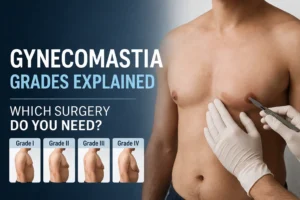
Gynecomastia is graded using the Simon classification: Grade I (minor subareolar enlargement, no skin excess), Grade IIa (moderate enlargement without skin excess), Grade IIb (moderate enlargement with minor skin excess), and Grade III (marked enlargement with significant skin excess). The grade determines the incision pattern and whether skin excision is required alongside gland removal. The grade is confirmed at the clinical examination during the gynecomastia consultation in Gurgaon at Artemis Hospital.
How much does gynecomastia surgery cost in Gurgaon?
Gynecomastia surgery cost in Gurgaon at Artemis Hospital depends on the Simon grade, the technique required- VASER liposuction alone, combined VASER and gland excision, or excision with skin reduction for Grade III- and anaesthesia and facility fees. A personalised cost estimate is provided at the consultation after clinical grading.
Can gynecomastia be mistaken for breast cancer in men?
Yes, and a new unilateral firm mass beneath the male areola that appears suddenly, is tender, has irregular borders, or is accompanied by nipple discharge should be assessed by a clinician to exclude malignancy before any aesthetic surgical plan is made. Bilateral, symmetrical, soft gynecomastia in a young man with a typical hormonal history is not a cancer concern, but any presentation that deviates from this pattern warrants clinical assessment. At Artemis Hospital, the gynecomastia consultation includes clinical examination to identify any features requiring further investigation before surgery is planned.
The distinction between gynecomastia and chest fat determines whether surgery is the answer. The firmness test starts the process. The clinical examination at Artemis Hospital confirms it.
Call +91 82879 23924
Book a Gynecomastia Consultation at Artemis Hospital, Gurgaon