A 2019 study published in Aesthetic Surgery Journal analysed observer ratings of facial age from photographs modified to alter either wrinkle depth or eyebrow position. Eyebrow position independently predicted perceived facial age more strongly than wrinkle severity. Observers consistently rated faces with descended brows as older than their chronological age, regardless of skin quality or the depth of dynamic lines on the forehead.
The clinical implication is direct. For patients who report that they consistently look tired or older than they feel, and whose photographs show a flat, heavy, or descended brow, the brow position itself may be the dominant driver of the age perception, more so than the forehead lines that often preoccupy these same patients. Understanding what causes eyebrow descent, and what distinguishes a brow lift from an eyelid correction, is the prerequisite for planning the right procedure.
Dr. Pradeep Kumar Singh, MCh Burns and Plastic Surgery, Fellowship in Aesthetic Surgery from St. Louis Hospital Paris, and Head of Department at Artemis Hospital, sees a high proportion of patients presenting for brow lift and eyelid surgery in Gurgaon who initially request one procedure and, after the clinical examination, are found to need the other. The manual brow elevation test, described below, is the clinical instrument that prevents this misalignment.
The Three Anatomical Causes of Eyebrow Descent
1. Brow Fat Compartment Atrophy
The eyebrow sits on a specific subcutaneous fat compartment that provides its soft tissue volume support. This compartment undergoes progressive volume loss beginning in the third and fourth decades. As the volume beneath the brow skin reduces, the skin and the underlying orbicularis oculi muscle descend under gravity without the volumetric scaffold that previously maintained their position.
This explains why some patients who appear to have significant brow ptosis actually have brow fat deflation as the primary driver. In these cases, volume restoration, through filler or fat grafting to the brow fat compartment, can produce a meaningful lift effect without surgical tissue repositioning. It is also why younger patients with early brow heaviness respond well to non-surgical approaches that would not be appropriate for patients with structural ligament laxity.
2. Temporal Retaining Ligament Laxity
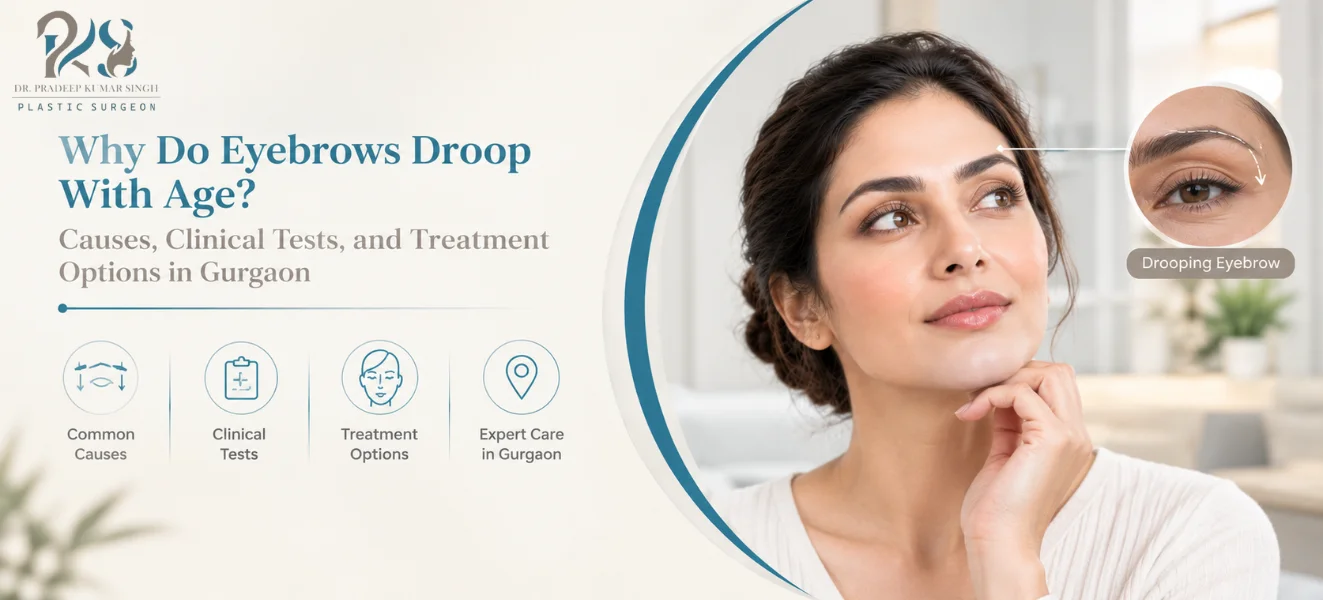
The temporal fusion line, a retaining ligament complex at the lateral forehead, tethers the brow tissue to the temporal bone laterally. As this ligament complex weakens with age, the lateral brow descends more than the medial brow, producing the characteristic lateral droop that gives the appearance of a tired or heavy-lidded expression at rest.
Lateral brow descent is the most common presentation among patients considering brow lift surgery in Gurgaon at Artemis Hospital. The selective heaviness at the outer third of the brow, in contrast to the inner brow which often remains at an appropriate height, is the distinguishing feature. This is also the presentation where non-surgical Botox to the brow depressor muscles can produce a useful temporary elevation specifically of the lateral brow, by reducing the depressor pull that is no longer balanced by the weakened lateral retaining ligament.
Important Read: Eyelid Tightening Surgery Gurgaon: Upper vs Lower Blepharoplasty, Which Addresses Your Concern?
3. Frontalis Compensatory Hyperactivity
As the brow descends, the frontalis muscle contracts more actively to compensate, raising the brow above the level to which it has passively descended. This compensatory activity is what produces the deep horizontal forehead lines that many patients presenting for treatment associate primarily with ageing skin. The lines are not the primary problem. They are the secondary consequence of the brow descent driving chronic frontalis overactivity.
This relationship has a specific clinical implication for Botox treatment. A patient who has Botox to the frontalis to address forehead lines, without the brow descent being assessed first, eliminates the compensatory mechanism that was maintaining the brow above its passive position. The forehead lines improve. The brow position worsens. The outcome is a flatter forehead with a heavier brow, which most patients find unsatisfactory even though each component was addressed individually. The preventative eyelid and brow treatment guide for younger patients in Gurgaon addresses this interaction specifically.
The Critical Clinical Test: Brow Ptosis or Eyelid Skin Excess?
The most consequential clinical distinction in the assessment of upper facial heaviness is between brow ptosis (the brow has descended, and its lower position is crowding the upper eyelid space) and primary upper eyelid skin excess (the eyelid skin itself has accumulated beyond the lid margin independent of the brow position).
These two conditions look similar from the outside. They require different surgical corrections. Performing upper blepharoplasty on a patient whose primary problem is brow descent produces a temporary improvement in upper eyelid crowding, because the skin excision creates space. But because the brow remains in its descended position, the brow continues to press down on the eyelid, and the result gradually recedes as the brow skin re-accumulates against the lid margin. The comparison of brow lift and blepharoplasty for Gurgaon patients details this distinction with clinical specificity.
The manual brow elevation test: place the pads of the index and middle fingers on the eyebrow and lift it gently to the position it occupied ten to fifteen years ago, while looking straight ahead in a mirror.
If the upper eyelid heaviness resolves substantially with brow elevation, the brow position is a significant or dominant contributor. A brow lift addresses the underlying cause.
If the upper eyelid heaviness persists despite brow elevation, the excess skin is arising from the eyelid itself. Upper blepharoplasty is indicated.
If both are true, both are contributing, and a combined procedure addresses both components. This is the most common finding at the examination when the manual elevation test is performed carefully.
Surgical Options for Drooping Eyebrows in Gurgaon
Endoscopic brow lift in Gurgaon: Performed through small incisions within the hairline using an endoscope for visualisation. The brow tissues and periosteum are elevated and fixed in the correct position using resorbable sutures or titanium micro-anchors. No skin is excised. The lift is achieved through tissue repositioning. This is the standard approach for patients with moderate brow descent and adequate forehead skin quality. Recovery is ten to fourteen days for social presentability. Full effect visible at three months.
Temporal brow lift: Addresses lateral brow descent specifically, using a limited incision within the temporal hairline. Appropriate for patients whose primary complaint is lateral brow heaviness rather than global brow descent. A shorter procedure with a more focused result.
Direct brow lift: A small ellipse of skin excised directly above the brow margin, lifting the brow by the amount excised. Leaves a scar at the brow edge, well-suited to patients with prominent brow hair that conceals the scar line. A technically simpler procedure than endoscopic lift, appropriate for specific presentations.
Non-surgical brow lift with Botox: Relaxing the brow depressor muscles- the corrugator, depressor supercilii, and lateral orbicularis- with botulinum toxin allows the frontalis to lift the brow against reduced opposition, producing a mild elevation of 2 to 3 millimetres. Effective for early or mild lateral brow descent. Not appropriate for significant structural brow ptosis where the descent exceeds what neurotoxin compensation can achieve. Botox at Artemis Hospital in Gurgaon is performed after a specific brow position assessment to ensure treatment does not worsen the brow descent by eliminating the frontalis compensation.
The full clinical breakdown of brow lift procedure options, recovery, and expected outcomes is in the published guide on brow lift surgery at Artemis Hospital in Gurgaon. The complementary guide on eyelid surgery and blepharoplasty in Gurgaon addresses the upper and lower eyelid correction options for patients whose primary concern is eyelid skin rather than brow position.
Important Read: Eyelid Surgery Gurgaon: Blepharoplasty Cost, Procedure and Recovery Guide
Frequently Asked Questions: Droopy Eyebrows, Brow Lift Surgery, and Eyelid Surgery in Gurgaon
What causes eyebrows to droop with age?
Eyebrow drooping with age in Gurgaon patients results from three anatomical changes: atrophy of the brow fat compartment (which reduces the soft tissue volume that supports the brow position), laxity of the temporal retaining ligament complex (which allows the lateral brow to descend), and the gravitational pull of the brow depressor muscles against a progressively weakened support structure. The frontalis muscle compensates by contracting more actively, which produces the horizontal forehead lines that typically accompany brow descent.
How do I know if I need a brow lift or eyelid surgery in Gurgaon?
The manual brow elevation test distinguishes the two: place fingers on the eyebrow, lift it to its position fifteen years ago, and observe the upper eyelid while looking straight ahead. If the upper eyelid heaviness resolves significantly with brow elevation, the brow position is the dominant cause and a brow lift is indicated. If the heaviness persists despite elevation, the excess skin is arising from the eyelid itself and upper blepharoplasty is indicated. Both being true indicates a combined approach. This test is performed at every brow and eyelid assessment at Artemis Hospital in Gurgaon.
What is brow lift surgery and how long does recovery take in Gurgaon?
Brow lift surgery in Gurgaon repositions the descended brow tissues to their correct height using a technique suited to the degree and location of descent. The endoscopic brow lift is the standard approach at Artemis Hospital, using small hairline incisions and internal tissue fixation without external scarring. Social presentability is achieved at ten to fourteen days. The full settled brow position is assessable at three months.
Can drooping eyebrows be treated without surgery in Gurgaon?
Mild to moderate lateral brow descent in Gurgaon patients responds to Botox relaxation of the brow depressor muscles, producing 2 to 3 millimetres of elevation for three to four months. Volume deflation of the brow fat compartment responds to filler or fat grafting. These non-surgical approaches are effective for early presentations and younger patients. Significant structural brow ptosis with clear lateral descent and frontalis compensation requires surgical correction to produce durable results.
Does Botox for forehead lines worsen drooping eyebrows in Gurgaon?
It can, if administered without assessing the brow position first. In patients with existing brow descent, the frontalis is actively contracting to maintain the brow above its passive position. Botox to the frontalis eliminates this compensation. The forehead lines improve because the muscle is relaxed, and the brow descends further because the compensatory elevation is removed. Botox at Artemis Hospital in Gurgaon is always preceded by a brow position assessment to identify patients for whom frontalis treatment requires modification or limitation to avoid this outcome.
What is the cost of brow lift surgery in Gurgaon?
Brow lift surgery cost in Gurgaon at Artemis Hospital depends on the technique- endoscopic, temporal, or direct- and whether concurrent upper blepharoplasty is performed in the same session. A personalised cost estimate for brow lift surgery in Gurgaon is provided after the brow position assessment and manual elevation test confirm the appropriate technique. Eyelid surgery in Gurgaon cost, where concurrent blepharoplasty is planned, is assessed at the same appointment.
The manual brow elevation test takes sixty seconds. It determines whether the concern is the brow, the eyelid, or both. Everything else follows from that.
Call +91 82879 23924
Book a Brow and Eyelid Assessment at Artemis Hospital, Gurgaon