
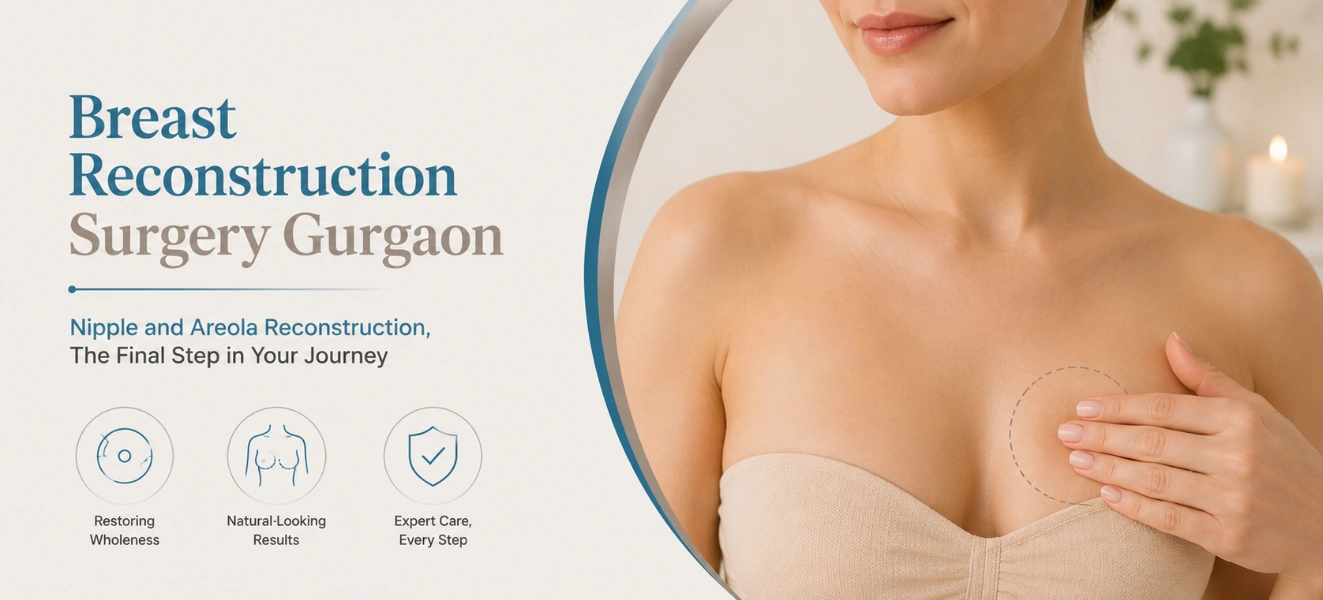
For most women who undergo breast reconstruction surgery in Gurgaon after mastectomy, the process unfolds over twelve to eighteen months in a sequence of planned stages. The breast mound is created, whether through implant-based or autologous flap technique. The mound is allowed to settle and heal over several months. The contralateral breast may be adjusted for symmetry. And then, when all of these stages have been completed, and the reconstructed breast has reached its stable, final form, one component remains that many patients describe as the most personally significant step in the entire journey: the recreation of the nipple and areola.
Nipple-areola reconstruction is the final stage of breast reconstruction surgery in Gurgaon. It is a comparatively small procedure in surgical terms. It takes less time than any of the preceding stages and is typically performed under local anaesthesia. But in psychological terms, it has an outsized significance for many patients, because the nipple is the feature that most clearly completes the breast visually and that most powerfully signals, to the patient, that the reconstruction is finished. Published patient satisfaction studies consistently identify nipple-areola reconstruction as the stage that produces the greatest single improvement in body image satisfaction relative to its surgical complexity. This guide covers what the procedure involves, when it is performed, what it can and cannot restore, and what the options are for patients who prefer tattooing over surgery.
To discuss your specific reconstruction timeline and nipple reconstruction options with Dr. Pradeep Kumar Singh at Artemis Hospital, Gurugram, call +91 82879 23924.
What Is Nipple-Areola Reconstruction and When Is It Done?
Nipple-areola reconstruction (NAR) is the surgical or non-surgical recreation of the nipple-areola complex on the reconstructed breast mound. In the staged reconstruction programme at Artemis Hospital, it is the final planned procedure in the sequence, performed after:
- The breast mound has fully settled: Whether the mound was created with an implant, tissue expander, DIEP flap, or latissimus dorsi flap, it requires three to six months after its creation to reach its stable final position and volume. Performing nipple reconstruction before the mound has settled risks placing the nipple at an incorrect height, which becomes apparent as the mound drops to its final position in the months following.
- Symmetry procedures are complete: Where a contralateral breast symmetrisation, reduction, augmentation, or mastopexy has been performed to match the reconstructed breast, this must also be healed and stable before the nipple is positioned, because the contralateral nipple position is the reference point for placing the reconstructed nipple at the matching height.
- The skin at the nipple site has fully matured: Scar tissue in the flap or implant-covered skin at the nipple site needs to have softened and stabilised before a local flap for nipple reconstruction can be raised. Attempting the procedure on immature, thickened scar tissue increases the risk of partial flap loss and a reduced final nipple projection.
The typical timing for nipple-areola reconstruction at Artemis Hospital is twelve to eighteen months after the initial breast mound procedure. In some cases, where healing has been excellent and the mound has settled quickly, it can be performed at nine to twelve months. The individual timeline is assessed at the follow-up consultations and confirmed before the nipple reconstruction date is scheduled as part of the overall breast reconstruction surgery in Gurgaon programme.
Important Read: Breast Reduction Surgery Gurgaon: Liposuction-Only vs Open Technique, Which Has Faster Recovery in 2026?
What Surgical Techniques Are Used for Nipple Reconstruction in Gurgaon?
Several local flap techniques are available for nipple reconstruction, each using a small area of the skin at the planned nipple site to create a projecting structure. The most commonly used techniques at Artemis Hospital are:
The C-V Flap
The C-V flap, also called the skate flap or star flap in its variants, is one of the most widely used nipple reconstruction techniques globally. It uses two or three small local skin flaps arranged around the nipple site and folded inward to create a cone-shaped projection. The procedure is performed under local anaesthetic, takes thirty to forty-five minutes, and leaves small scars at the nipple site that mature within the pigmented areola tattooing performed in the subsequent stage. Initial projection is typically five to eight millimetres, with some loss of projection expected over the following six to twelve months as the flap heals and the collagen within it contracts. The final stable projection is typically three to five millimetres, which closely resembles the natural resting nipple projection in most patients.
The Cartilage Graft-Supported Nipple
For patients where prolonged projection is a priority, a small autologous cartilage graft, typically harvested from the ear cartilage through a small posterior incision, can be used to support the local flap from within. The cartilage provides a permanent structural scaffold that resists the collagen contraction that causes projection loss in unsupported local flaps. This technique is appropriate for patients who have previously undergone nipple reconstruction with good initial projection that has flattened over time, and is one of the revision options discussed at the consultation if a first nipple reconstruction has not produced a lasting result.
The Nipple-Sharing Technique
Where the contralateral natural nipple is significantly projecting and the patient consents to a minor modification, the nipple-sharing technique harvests a small composite graft of dermis and epidermis from the natural nipple and grafts it to the reconstructed breast mound. This technique produces a reconstructed nipple with skin from the original nipple, which some patients find particularly meaningful. It is appropriate only where the natural nipple is large enough to donate a portion without compromising its own form and where the patient specifically requests this approach.
What Is Nipple-Sparing Mastectomy, and What Does It Mean for Reconstruction?
Nipple-sparing mastectomy (NSM) is a mastectomy technique in which the entire breast parenchyma is removed while the natural nipple-areola complex is preserved on the overlying skin. When oncologically appropriate, NSM eliminates the need for nipple-areola reconstruction entirely, because the patient’s own nipple remains in place on the reconstructed mound.
Nipple-sparing mastectomy in the context of breast reconstruction surgery in Gurgaon is oncologically appropriate when the tumour is not located directly beneath the nipple, when there is no nipple discharge, and when the surgical margin at the retroareolar tissue is confirmed negative intraoperatively. Where these conditions are met, nipple-sparing mastectomy combined with immediate breast reconstruction produces the most complete aesthetic result in breast reconstruction surgery in Gurgaon, because the natural nipple’s skin texture, colour, and architecture are preserved without any reconstructive procedure being required for that component.
At Artemis Hospital, the candidacy for nipple-sparing mastectomy is assessed jointly by the oncological surgeon and Dr. Pradeep Kumar Singh, MCh Plastic Surgery, Fellowship Paris, APSI Member, at the pre-operative multidisciplinary planning meeting. The oncological safety of nipple preservation is confirmed by the intraoperative frozen section of the retroareolar tissue before the reconstruction is planned on that basis.
Important Read: Breast Reduction vs Breast Lift Gurgaon: Key Differences, Which Is Better and Cost Comparison
Areola Reconstruction: Tattooing as the Final Step
The areola, the pigmented skin surrounding the nipple, is recreated through medical tattooing rather than through additional surgery. This is performed as a final outpatient appointment, typically three to four months after the nipple reconstruction has healed and settled, allowing the tattoo to be applied to stable, final skin.
Medical areola tattooing at Artemis Hospital is performed by a specialist trained in medical pigmentation. The process involves:
- Colour matching: The areola pigment is mixed to match the patient’s contralateral natural areola, accounting for the Fitzpatrick skin type and the undertones specific to Indian skin. In bilateral reconstruction where both areolae require tattooing, the target colour is agreed with the patient from reference photographs and pigment samples before the procedure begins.
- Size and position agreement: The areola diameter is agreed before the tattooing session. The average natural areola diameter in Indian women is between 3.5 and 5 centimetres. The reconstructed areola is typically planned to match the contralateral diameter and to be centred on the reconstructed nipple or the nipple projection point.
- The tattooing session: Medical tattooing uses the same fundamental technique as conventional tattooing but with medical-grade pigments designed for skin use, applied with fine needles in the dermal layer. The procedure takes forty-five to ninety minutes. Topical anaesthetic is applied before the session begins. Some patients require two sessions for optimal colour match, particularly where the first session produces lighter pigmentation than intended, as the initial healing period causes some pigment loss.
3D Areola Tattooing
Three-dimensional areola tattooing, a specialist technique that uses shading and highlighting to create the visual impression of a projecting nipple without surgery, has become an increasingly popular option for patients who prefer to avoid the nipple reconstruction surgery entirely. In 3D tattooing, the artist uses multiple pigment shades applied with specific directional techniques to create the shadow and highlight pattern of a natural nipple and areola, producing a result that, from a normal viewing distance, closely resembles a naturally projecting nipple-areola complex. The technique requires a specialist with specific training in medical 3D tattooing and does not add any further surgical recovery. At Artemis Hospital, 3D areola tattooing is available as an alternative to surgical nipple reconstruction for patients who prefer it after a full discussion of both options.
Does the Reconstructed Nipple Have Sensation?
This is the most important question to answer honestly at the nipple reconstruction consultation, and the answer requires distinguishing between different types of reconstruction:
After mastectomy and implant-based reconstruction: The mastectomy severs the sensory nerves supplying the breast skin and nipple. The reconstructed nipple, created from skin that has lost its original innervation, has no sensation in the early period after reconstruction. Over time, some degree of protective sensation (the ability to feel pressure or temperature but not fine touch or erogenous sensation) may return as peripheral nerve regeneration occurs in the skin flap, but this is inconsistent and typically partial.
After nipple-sparing mastectomy: The preserved natural nipple retains some of its original innervation because the skin envelope including the nipple is not removed. Published data on sensation after NSM show that approximately 50 to 70 per cent of patients report some degree of nipple sensation at two years, with sensation returning progressively over twelve to twenty-four months as nerve regeneration occurs beneath the preserved skin. The degree and quality of sensation varies significantly between patients and is not reliably predictable preoperatively.
After autologous flap reconstruction: The DIEP or latissimus dorsi flap skin has no nipple-specific innervation in the early period after reconstruction. The peripheral nerves in the transferred skin undergo gradual regeneration from the recipient site, but the specific sensory pathway of the original nipple is not reconstructed. Some patients report gradual return of protective sensation in the reconstructed nipple area over twenty-four to thirty-six months, but erogenous nipple sensation is generally not restored in full.
At Artemis Hospital, this distinction between protective sensation and erogenous sensation, and the realistic timeline for any return of sensation, is discussed at the breast reconstruction surgery consultation in Gurgaon before the procedure is planned. Setting accurate expectations about sensation is a fundamental component of the informed consent process, because it directly affects how patients interpret their experience in the months after nipple reconstruction is complete.
Patients from Palam Vihar and South Gurgaon who travel to Artemis Hospital, Sector 51, Gurugram, for breast reconstruction consultations receive a dedicated nipple-areola reconstruction planning discussion as part of their follow-up care, typically at the six to nine-month review after the initial mound procedure, when the timing and options for the final stage can be assessed against the current state of the reconstruction.
Important Read: Breast Reduction Surgery Gurgaon: 7 Things to Consider Before You Proceed
Is Nipple Reconstruction Painful?
Nipple-areola reconstruction during breast reconstruction surgery in Gurgaon is performed under local anaesthesia at Artemis Hospital and is not painful during the procedure. The injection of local anaesthetic produces a brief stinging sensation, after which the entire procedure is carried out without discomfort. Post-operatively, most patients describe mild tenderness at the nipple site for three to five days, managed comfortably with paracetamol. There are no activity restrictions beyond avoiding direct pressure on the nipple site for two to three weeks while the flap heals. Most patients are able to return to all activities within a week of the procedure.
How Much Does Nipple-Areola Reconstruction Cost in Gurgaon?
Nipple-areola reconstruction, as the final stage of breast reconstruction surgery in Gurgaon, is costed at Artemis Hospital based on the technique used for the nipple (local flap or cartilage-supported flap), whether medical areola tattooing or 3D tattooing is performed, and whether the procedure is done under local anaesthetic alone or with sedation. Where breast reconstruction is covered by health insurance for documented post-mastectomy indication, the nipple-areola reconstruction stage may also be covered as part of the reconstruction programme. The Artemis Hospital team assists with insurance documentation for the nipple reconstruction stage where the primary reconstruction programme has insurance consideration. A personalised cost estimate is provided at the consultation. Contact Artemis Hospital to arrange an appointment.
Frequently Asked Questions
What is nipple-areola reconstruction and when is it done after breast reconstruction?
Nipple-areola reconstruction is the final stage of breast reconstruction surgery in Gurgaon, creating the nipple from a local skin flap and recreating the areola through medical tattooing. It is performed after the breast mound has fully settled (typically twelve to eighteen months after the initial mound procedure), any symmetrisation of the contralateral breast is complete, and the skin at the nipple site has matured. The timing is assessed at the follow-up consultation and confirmed when all preceding stages are stable.
Is nipple reconstruction surgery painful?
Nipple reconstruction is performed under local anaesthesia and is not painful during the procedure. Post-operatively, mild tenderness at the site lasts three to five days and is managed with paracetamol. There are no significant activity restrictions. Most patients return to all normal activities within one week. The procedure takes thirty to forty-five minutes as a planned outpatient appointment.
Can a nipple be tattooed instead of surgically rebuilt?
Yes. Three-dimensional areola tattooing creates the visual impression of a projecting nipple and areola using shading and highlighting techniques, without any surgery. It is available at Artemis Hospital as a complete alternative to surgical nipple reconstruction for patients who prefer a non-surgical option. Surgical reconstruction and tattooing can also be combined: the flap creates physical projection, and tattooing adds the areola colour and the shadow detail that completes the three-dimensional appearance.
How long after breast reconstruction can nipple surgery be done?
The minimum typical waiting period is nine to twelve months after the breast mound procedure, with twelve to eighteen months being the standard recommendation at Artemis Hospital to ensure the mound is fully settled and the skin at the nipple site has matured. The individual timeline depends on healing quality, whether symmetrisation procedures have been completed, and the assessment of the nipple site skin at the follow-up consultation. There is no maximum time limit; nipple reconstruction can be performed years after the mound procedure.
Does the reconstructed nipple have sensation after breast reconstruction surgery?
A surgically reconstructed nipple, created during breast reconstruction surgery in Gurgaon from a local skin flap, does not retain the original nipple’s innervation. Some protective sensation (pressure, temperature) may return over twelve to twenty-four months as peripheral nerve regeneration occurs in the surrounding skin, but erogenous sensation is generally not restored. Patients who have undergone nipple-sparing mastectomy retain the original nipple and have a better prognosis for sensation recovery, with approximately 50 to 70 per cent of patients reporting some degree of nipple sensation at two years. The sensation prognosis for each patient is discussed honestly at the reconstruction consultation.
What is the difference between nipple-sparing mastectomy and nipple reconstruction?
Nipple-sparing mastectomy (NSM) preserves the patient’s own natural nipple-areola complex during the mastectomy, eliminating the need for nipple reconstruction when oncologically appropriate. Nipple reconstruction is the surgical creation of a new nipple on the reconstructed breast mound in patients who have undergone conventional mastectomy where the nipple was removed. NSM is considered at Artemis Hospital when the tumour location, nipple margin status, and oncological staging allow safe nipple preservation. Where NSM is not appropriate, planned nipple-areola reconstruction at the appropriate stage of the breast reconstruction surgery in Gurgaon programme completes the restoration.
The final step in your reconstruction journey deserves the same care as every stage before it. Call +91 82879 23924 or visit Artemis Hospital, Sector 51, Gurugram, Haryana 122001 to arrange your nipple reconstruction consultation at Artemis Hospital.
Patient reviews: Dr. Pradeep Kumar Singh on Google.
Dr. Pradeep Kumar Singh: MCh Plastic Surgery, Fellowship Paris, APSI Member: Head of Plastic Surgery, Artemis Hospital, Sector 51, Gurugram.