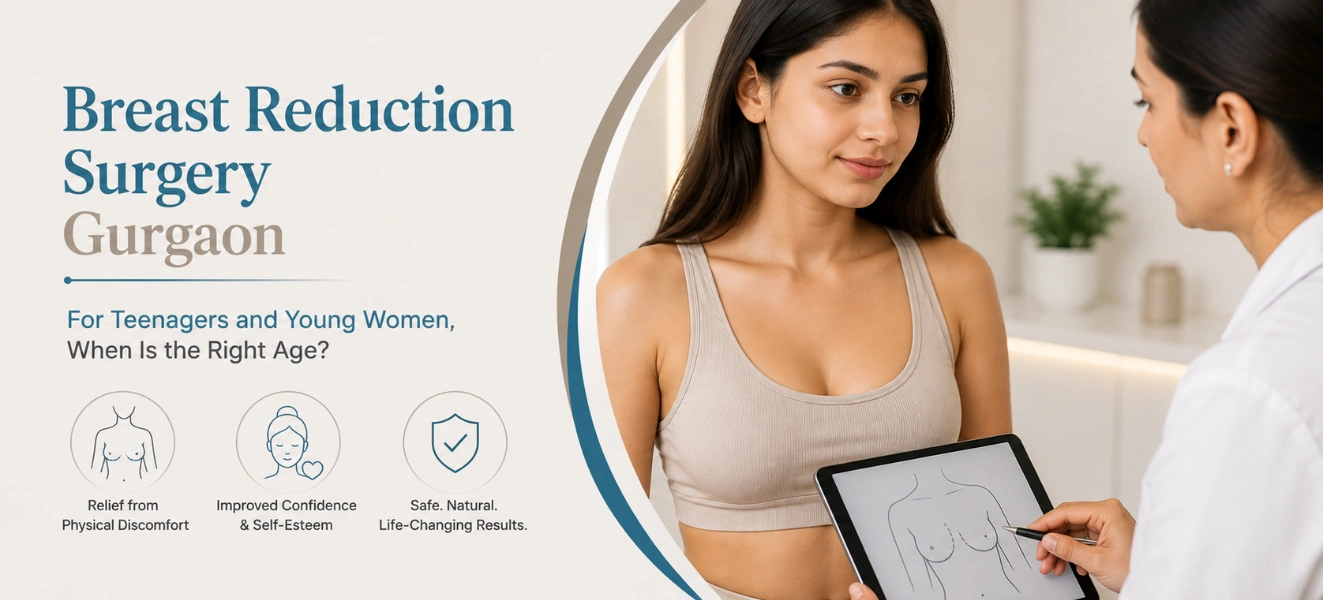
Macromastia in adolescence and young adulthood is not an aesthetic inconvenience. In its significant forms, it is a condition that causes chronic physical pain, limits participation in sport and physical activity, produces postural changes that persist into adulthood, and generates a level of body self-consciousness during the years when confidence is most formatively built that can have long-lasting psychological consequences. Yet breast reduction surgery for teenagers in India remains surrounded by hesitation, partly from the accurate concern that breast development may not be complete, and partly from a broader cultural reluctance to consider any surgical intervention in a young person for a concern that might resolve on its own.
This guide addresses the clinical criteria and the timing question for breast reduction surgery in Gurgaon in teenage and young adult patients with documented macromastia. It explains what the minimum age criteria are, what signs suggest intervention is indicated rather than further waiting, what the evidence shows about breast size change after reduction in young women, whether the procedure affects future breastfeeding, and what the consultation and decision process looks like for patients under eighteen and their parents.
To arrange a consultation for a young patient with symptomatic macromastia, call +91 82879 23924 or contact Artemis Hospital, Gurugram.
What Are the Signs That a Teenager Needs Breast Reduction Surgery?
Breast size alone is not an indication for surgery in a teenager. The clinical indicators that shift the assessment from watchful waiting to active intervention consideration are:
- Chronic musculoskeletal symptoms: Persistent neck, shoulder, and upper back pain that has been present for at least six months and is attributable on clinical examination to the mechanical load of the breast weight. In a teenager with significant macromastia, these symptoms are typically continuous rather than episodic, worsen with physical activity, and are not adequately managed by physiotherapy or supportive bras alone.
- Deep shoulder grooving: Permanent indentation of the shoulder skin from bra strap pressure indicates that the breast weight exceeds what the shoulder girdle can carry without sustained tissue compression. Deep grooving that is present at all times, including when the bra is not worn, is a clinical sign of significant mechanical overload.
- Submammary intertrigo: Chronic skin irritation, rash, or fungal infection in the submammary fold, produced by skin-to-skin contact under the pendulous breast, that recurs despite topical treatment. This is a functional dermatological indication that is well-documented in the literature on macromastia in young women.
- Exercise and activity limitation: Avoidance of sport or physical activity specifically because of breast-related difficulty, discomfort, or embarrassment, documented at the consultation and corroborated by the patient’s history. In teenagers, this has the additional consequence of limiting the physical activity that is important for overall health, bone density, and psychological wellbeing during adolescent development.
- Psychological impact: Clinically significant body image distress attributable to the breast size, assessed at the consultation. This is not a criterion in isolation but contributes to the overall clinical picture when combined with physical symptoms.
What Is the Minimum Age for Breast Reduction Surgery in Gurgaon?
There is no fixed minimum age for breast reduction surgery in Gurgaon, but there is a fundamental candidacy requirement that serves a similar function: the breast size must have been stable for a minimum of twelve months before surgery. This stability criterion exists because performing breast reduction surgery on a breast that is still growing risks an incomplete correction or the need for revision as breast development continues after surgery.
In practice, this stability criterion means that most patients presenting for teenage breast reduction surgery in Gurgaon at Artemis Hospital are at least sixteen to seventeen years old, because breast development in most girls is complete between the ages of fifteen and seventeen. Patients who present earlier than this age are assessed for stability through clinical measurement and a review of the rate of change over the preceding twelve months. Where measurements show no change over twelve months, and symptoms are significant, surgery may be considered before the age of sixteen in exceptional cases with full parental consent and multidisciplinary review.
The American Society of Plastic Surgeons’ position statement on adolescent breast reduction, published in 2024, supports surgery before the completion of full adult development when symptoms are severe and documented, breast size is disproportionate, and conservative management has failed. Dr. Pradeep Kumar Singh, MCh Plastic Surgery, Fellowship Paris, APSI Member, applies these criteria at Artemis Hospital and requires a minimum of twelve months of documented symptom management with conservative measures before recommending surgical intervention in patients under eighteen.
Does Breast Size Change Again After Reduction in Young Women?
This is the most important concern driving the hesitation about teenage breast reduction surgery, and it deserves a precise clinical answer. The risk of recurrent macromastia after breast reduction surgery in young women is real but is not as common as many patients and parents fear:
In patients who have completed breast development and whose weight is stable at the time of surgery, published data show a recurrence rate of significant macromastia requiring re-reduction of approximately 5 to 8 per cent over a ten-year follow-up. The most common cause of recurrence in this group is significant weight gain after surgery. For young patients who maintain a stable weight after breast reduction surgery in Gurgaon, the risk of requiring revision is low.
Pregnancy and breastfeeding after surgery can produce breast volume increase. In some women who have had reduction surgery, the breast enlarges significantly during pregnancy and may not fully return to the post-operative size after breastfeeding is completed. This is a specific risk factor for recurrent enlargement that is discussed at the consultation for young patients who have not yet completed their families.
Juvenile gigantomastia, a rare but clinically distinct condition in which the breast undergoes rapid, disproportionate growth driven by hormonal hypersensitivity, has a higher recurrence rate after reduction than standard macromastia. Patients with juvenile gigantomastia may require pharmacological management with hormonal agents alongside surgical reduction, and recurrence rates without pharmacological adjuncts are substantially higher. At Artemis Hospital, juvenile gigantomastia is distinguished from standard macromastia at the consultation and is managed with a specific protocol that includes hormonal assessment and endocrinology input.
Is Teenage Breast Reduction Surgery Safe?
Breast reduction surgery in Gurgaon for teenage patients is performed under the same general anaesthesia and surgical protocols as in adult patients and carries the same category of risks: wound healing, scarring, haematoma, seroma, asymmetry, and the anaesthesia-related risks that apply to any general anaesthetic. The evidence on outcome quality in teenage compared with adult reduction surgery consistently shows no significant difference in complication rates when the same surgical standards are applied.
The specific safety consideration for teenage patients is the informed consent process. At Artemis Hospital, breast reduction surgery in patients under eighteen requires the following in addition to the standard consent process:
- Parent or guardian co-consent: A parent or legal guardian must be present at the consultation and must sign the consent documents alongside the patient.
- Documented conservative management failure: At least twelve months of documented conservative management, including physiotherapy, properly fitting support bras, and any dermatological management for submammary intertrigo, must be on record before surgical consent is agreed.
- Psychological assessment: For patients presenting with significant psychological distress as a component of their consultation, a psychological or psychiatric review may be recommended before surgical planning proceeds, to ensure the surgical decision is being made with appropriate support structures in place.
Will Breast Reduction Surgery Affect Future Breastfeeding?
This is the question that most commonly generates anxiety for young patients and their parents, and the honest answer is that breast reduction surgery does carry some risk to breastfeeding capacity but that most young women who have had a reduction can breastfeed at least partially, and many breastfeed fully.
The degree of risk to breastfeeding depends on the surgical technique used. The inferior pedicle technique, which is the most commonly used approach for significant macromastia in young patients at Artemis Hospital, preserves the inferior breast tissue and the ductal connections between the areola and the underlying breast parenchyma. This preservation is the key to maintaining breastfeeding capacity. Published studies using the inferior pedicle technique in young women of reproductive age show that approximately 60 to 70 per cent of patients are able to breastfeed at some level after reduction, with full breastfeeding possible in 40 to 50 per cent.
Patients from Vaishali and Indirapuram who consult at Artemis Hospital, Sector 51, Gurugram, for breast reduction surgery in Gurgaon for young patients receive a specific discussion about breastfeeding risk at the consultation. The surgical technique is selected with breastfeeding preservation as an explicit goal where the patient indicates that future breastfeeding is important to them, and the approach is documented in the operative plan.
Frequently Asked Questions
At what age can a teenager get breast reduction surgery in Gurgaon?
There is no fixed minimum age, but the fundamental requirement is twelve months of stable breast size before surgery. In practice, most teenagers presenting for breast reduction surgery in Gurgaon are at least sixteen to seventeen years old. Surgery before this age requires documented significant symptoms, stable breast size for twelve months, conservative management failure, and full parental consent with multidisciplinary review.
What are the signs that a teenager needs breast reduction surgery?
Clinical signs indicating surgery may be appropriate include: chronic neck, shoulder, and upper back pain for at least six months; deep, permanent shoulder grooving from bra strap pressure; recurrent submammary intertrigo despite topical treatment; significant limitation of physical activity; and clinically documented body image distress. Breast size alone is not an indication. A combination of physical symptoms and conservative management failure is required at Artemis Hospital before surgical planning proceeds.
Does breast size change again after reduction in young women?
Recurrence of significant macromastia requiring re-reduction occurs in approximately 5 to 8 per cent of patients at ten years in those who maintain stable weight after surgery. The main risk factors for recurrence are significant weight gain and, in some patients, pregnancy. Juvenile gigantomastia, a distinct hormonal condition, has higher recurrence rates and requires specific management. For most young patients who maintain stable weight, breast reduction surgery in Gurgaon produces long-lasting results.
Is teenage breast reduction surgery safe in Gurgaon?
Yes. Published evidence shows no significant difference in complication rates between teenage and adult breast reduction surgery when equivalent surgical standards are applied. At Artemis Hospital, teenage breast reduction requires parental co-consent, documented conservative management failure over twelve months, and a psychological review where clinically indicated.
Will breast reduction surgery affect future breastfeeding?
Breast reduction surgery carries some risk to breastfeeding capacity. Using the inferior pedicle technique, which preserves the ductal connections between the areola and breast parenchyma, approximately 60 to 70 per cent of patients can breastfeed at some level after reduction, and 40 to 50 per cent can breastfeed fully. The surgical approach at Artemis Hospital is selected with breastfeeding preservation as an explicit goal in young patients who indicate future breastfeeding is important.
What is macromastia, and how is it different from normal breast development?
Macromastia is the clinical term for abnormally large breast size that produces physical symptoms including musculoskeletal pain, skin complications, and activity limitation. It is distinguished from normal breast development by the presence of these functional symptoms and by a breast volume that is disproportionate to the patient’s body size on clinical assessment. Juvenile gigantomastia is a specific, rarer form in which rapid, hormonal-driven breast overgrowth occurs during puberty, often requiring both pharmacological and surgical management.
Symptomatic macromastia in a young patient is a clinical condition, not an aesthetic concern. Call +91 82879 23924 or visit Artemis Hospital, Sector 51, Gurugram, Haryana 122001 to arrange a consultation at Artemis Hospital.
Reviews: Dr. Pradeep Kumar Singh on Google.
Dr. Pradeep Kumar Singh: MCh Plastic Surgery, Fellowship Paris, APSI Member: Head of Plastic Surgery, Artemis Hospital, Sector 51, Gurugram.