
A large proportion of patients who present for rhinoplasty consultations arrive with a photograph of someone else’s nose. It may be a celebrity, a friend, or an image found online, and it is offered as a visual shorthand for the result they want. The photograph captures something the patient cannot yet articulate in anatomical terms: a proportion they find appealing, a tip shape they prefer, a profile line they admire. This is a completely understandable starting point, and a skilled rhinoplasty surgeon will use such photographs as useful information about the patient’s aesthetic preferences.
What the photograph cannot do is specify what is possible for the individual patient’s own anatomy. The nose that looks natural and elegant on one face may look wrong on another because facial harmony depends on the proportional relationship between the nose and the surrounding features, and each face provides a different set of proportions within which the nose must fit. Cosmetic nose surgery in Gurgaon is, above all else, a proportional exercise carried out in three dimensions, and the most important skill the rhinoplasty surgeon brings to the consultation is not the ability to deliver what the patient has requested but the ability to translate what the patient wants into what their specific anatomy can naturally produce. This guide explains what the different types of nose surgery address, how surgeons choose between open and closed approaches, what ethnic rhinoplasty means in a Delhi NCR context, and how to select the right surgeon for a procedure that very rarely offers a straightforward second chance.
Book a rhinoplasty consultation with Dr. Pradeep Kumar Singh at Artemis Hospital, Gurugram, or call +91 82879 23924 to have your nasal anatomy and facial proportions assessed and a realistic, personalised nose surgery plan developed.
Types of Cosmetic Nose Surgery in Gurgaon: What Each Addresses
Bridge Reduction: Addressing the Dorsal Hump
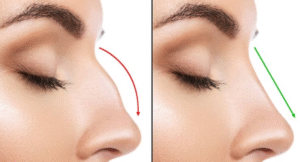
The dorsal hump, the bony and cartilaginous prominence on the bridge of the nose visible in profile, is the single most commonly requested correction in cosmetic rhinoplasty in Gurgaon. Hump reduction involves removing or rasping the bony component of the hump and trimming the cartilaginous component to create a straight or gently curved bridge profile. After hump reduction, the nasal bones are typically brought together through controlled osteotomies because removing the hump widens the space between the nasal bones and requires them to be repositioned to maintain a natural-looking bridge width. The combination of hump reduction and osteotomies is the standard approach for dorsal hump correction in rhinoplasty, and the degree of reduction is planned based on the patient’s facial proportions rather than on a standard template.
Nasal Tip Surgery: Refinement, Rotation, and Projection
The nasal tip is the most technically demanding zone in rhinoplasty, and it is the area where the surgeon’s specific technique and experience show most clearly in the result. Tip surgery in cosmetic nose surgery in Gurgaon may address a bulbous or wide tip, where the lower lateral cartilages are too large or too splayed and require reshaping or suturing to produce a more defined tip shape; a drooping tip, which requires tip rotation to increase the nasolabial angle; or a de-projected tip, which sits too close to the face and requires graft augmentation to increase its forward projection.
The key principle in tip rhinoplasty is that cartilage removed cannot be put back. The surgeon must plan tip modification conservatively enough to produce the desired refinement without over-resecting the structural support that the lower lateral cartilages provide. Over-resection of tip cartilage produces the pinched, narrow tip deformity that is one of the most visible markers of a technically suboptimal rhinoplasty, and it requires revision surgery with cartilage grafting to correct. At Artemis Hospital, tip surgery in cosmetic rhinoplasty in Gurgaon prioritises structural preservation and suture-based reshaping over cartilage removal as the primary technique.
Nostril Correction and Alar Base Reduction
Wide or flaring nostrils disproportionate to the nasal tip and upper lip width are addressed through alar base reduction, where small wedges of tissue are removed from the alar-facial crease, the natural junction between the nostril and the cheek. The incision is placed in the crease and heals to a pale, inconspicuous scar that is well-concealed in the natural skin fold. Alar base reduction is frequently performed in combination with tip surgery, because changing the tip projection or width without simultaneously addressing an overly wide nostril base produces a result that is internally inconsistent. The two components are assessed together at the consultation.
Functional Rhinoplasty: Correcting Breathing Alongside Cosmetics
A meaningful proportion of patients presenting for cosmetic nose surgery in Gurgaon have nasal breathing impairment from a deviated septum, enlarged inferior turbinates, or collapsed internal nasal valves, either as a concurrent concern or as the primary indication for surgery. Septoplasty, the correction of a deviated septum, is performed through internal incisions without any external scar, and is most efficiently combined with cosmetic rhinoplasty in the same session rather than staged separately. The combined procedure, septorhinoplasty, addresses both the aesthetic and the functional dimensions of the nasal anatomy in a single recovery. At Artemis Hospital, every rhinoplasty consultation includes nasal airway assessment alongside the cosmetic assessment, because a nose that looks better but breathes worse is not a successful rhinoplasty.
Open vs Closed Rhinoplasty in Gurgaon: Which Approach and Why
The choice between open and closed rhinoplasty is one of the most commonly asked questions at the nose surgery consultation, and it is a decision that belongs with the surgeon rather than the patient. The two approaches differ in how the surgeon accesses the nasal framework:
- Closed rhinoplasty: All incisions are placed inside the nostrils, leaving no external scar. The skin is elevated internally to provide access to the nasal framework. The limitation of the closed approach is that the skin elevation provides a tunnel view of the underlying cartilage and bone rather than the direct binocular vision that open rhinoplasty offers, making it harder to assess cartilage symmetry precisely in complex presentations.
- Open rhinoplasty: An additional small incision, approximately 4 to 5 millimetres wide, is placed across the columella, the narrow bridge of skin between the two nostrils at the base of the nose. This allows the entire nasal skin to be folded upward, providing complete direct visualisation of the nasal framework and allowing both cartilages to be seen and worked on simultaneously, from the same perspective and with the same spatial orientation. The columellar scar heals to a virtually invisible, pale fine line in the majority of patients.
Open rhinoplasty is preferred for complex presentations: significant tip work, cartilage grafting, secondary rhinoplasty where previous scarring may distort the anatomy, and asymmetric noses where precise bilateral cartilage comparison under direct vision is necessary. Closed rhinoplasty remains appropriate for simpler, more limited corrections, particularly isolated hump reduction where the tip does not require modification. In the hands of a surgeon trained in both approaches, the decision is made on technical grounds for each individual case. At Artemis Hospital, cosmetic nose surgery in Gurgaon for complex tip, asymmetry, or secondary cases is performed through the open approach for the technical precision it provides.
Ethnic Rhinoplasty in Gurgaon: What It Means for Indian Nasal Anatomy
Indian nasal anatomy differs systematically from the Western nasal proportions that have historically dominated rhinoplasty training and reference imagery. The Indian nose typically has a broader dorsum, less tip projection, a rounder and less defined tip shape, and thicker skin than the noses most frequently depicted in rhinoplasty before-and-after galleries from Western surgical practices. These anatomical characteristics have direct implications for the techniques used in cosmetic nose surgery in Gurgaon and for what is achievable as an outcome.
Thick nasal skin is perhaps the most clinically significant characteristic of Indian rhinoplasty. The skin covers the cartilage framework, and its thickness determines how much of the underlying framework refinement becomes visible in the final result. In patients with thick nasal skin, cartilage reshaping at the tip may produce significant structural improvement that is only partially visible through the overlying skin envelope. Communicating this to patients at the consultation is essential because expectations formed from photographs of patients with thin skin will not match what is achievable in a patient with significantly thicker skin. Patients from Anand Niketan, Shanti Niketan, and Jor Bagh who present for rhinoplasty in Gurgaon at Artemis Hospital receive an honest assessment of their skin thickness as part of the consultation, because it is one of the two most important anatomical variables, alongside the cartilage framework, that determines the achievable result.
How to Find the Right Surgeon for Cosmetic Nose Surgery in Gurgaon
Rhinoplasty is among the few aesthetic surgical procedures that is genuinely unforgiving of technical errors, because the nose is the central feature of the face, it is examined at close range in every social interaction, and any asymmetry, irregularity, or unnatural contour is immediately visible. Revision rhinoplasty, performed to correct a suboptimal primary result, is significantly more difficult than primary rhinoplasty because of the scar tissue that forms within the nasal framework after the first operation. The surgeon selection decision for cosmetic nose surgery in Gurgaon deserves the same rigour applied to any irreversible intervention.
Five criteria separate a surgeon appropriately qualified for rhinoplasty from one who is not:
- MCh in Plastic Surgery: The foundational qualification for rhinoplasty in India, covering the anatomy, technique, and complication management that nose surgery requires.
- Specific rhinoplasty volume: A surgeon who performs rhinoplasty regularly maintains the technique-specific judgement that an occasional practitioner does not. Ask how frequently they perform rhinoplasty and whether their practice includes both primary and revision cases.
- Ability to show results across different skin types and presentation types: Results showing thin-skinned patients only, or only profile views, or only the best outcomes from a large series, are not a representative sample. Ask to see results from patients with a similar skin type and the specific correction you require.
- Honest discussion of what your anatomy allows: A surgeon who agrees with every patient’s reference photograph preference without an anatomical explanation is not giving clinical advice. The consultation should include a clear account of what your specific nasal anatomy can produce.
- Facility standard: Rhinoplasty is performed under general anaesthesia in an accredited hospital facility, not in a clinic or day-surgery centre without appropriate anaesthesia team support and monitoring. Confirm JCI or NABH accreditation of the facility before proceeding.
Nose Surgery Cost in Gurgaon: What Determines the Price
Nose surgery cost in Gurgaon varies based on the extent of the rhinoplasty, whether the open or closed approach is used, whether septoplasty is performed simultaneously, whether cartilage grafting from the ear or rib is required, and the anaesthesia and facility fees at Artemis Hospital. A procedure limited to hump reduction via closed approach has a different cost profile from a comprehensive open rhinoplasty with tip refinement, osteotomies, and alar base reduction. A personalised nose surgery cost in Gurgaon estimate is provided at the consultation after the anatomical assessment and surgical plan are completed. Contact Artemis Hospital to schedule a rhinoplasty consultation with Dr. Pradeep Kumar Singh.
Cosmetic Rhinoplasty Surgeon in Gurgaon: Dr. Pradeep Kumar Singh at Artemis Hospital
Dr. Pradeep Kumar Singh performs cosmetic nose surgery in Gurgaon at Artemis Hospital, a JCI and NABH-accredited facility in Sector 51, Gurugram. His MCh in Plastic Surgery from SMS Medical College, Jaipur, and Fellowship in Advanced Aesthetic Surgery from St Louis Hospital, Paris, include training in both open and closed rhinoplasty techniques across a range of presentation types, including ethnic rhinoplasty for Indian nasal anatomy, septorhinoplasty for combined functional and cosmetic correction, and revision rhinoplasty for patients seeking correction of a previous suboptimal result. As Head of the Department of Plastic Surgery and a member of the Association of Plastic Surgeons of India, Dr. Pradeep Kumar Singh, MCh Plastic Surgery, Fellowship Paris, APSI Member, approaches every rhinoplasty consultation with the anatomical honesty that a procedure of this permanence and visibility requires.
Frequently Asked Questions
How much does cosmetic nose surgery cost in Gurgaon?
Nose surgery cost in Gurgaon depends on the extent of the rhinoplasty, the approach used, whether septoplasty is included, and the facility fees at Artemis Hospital. A personalised estimate is provided at the consultation after the surgical plan is agreed. Contact Artemis Hospital to schedule a consultation.
What is the difference between open and closed rhinoplasty?
Open rhinoplasty adds a small columellar incision to allow the nasal skin to be fully elevated and the entire cartilage framework to be viewed under direct binocular vision. It is preferred for complex tip work, cartilage grafting, and asymmetric or revision cases. Closed rhinoplasty performs all incisions inside the nostrils, leaving no external scar, and is appropriate for simpler corrections where limited access is sufficient. The choice of approach is made on technical grounds for each individual case, not on patient preference.
How long does rhinoplasty recovery take?
The external nasal splint is removed at seven to ten days, at which point visible bruising has largely resolved. Most patients are socially presentable within two weeks. Tip swelling, particularly in patients with thicker nasal skin, resolves progressively over three to twelve months. The final result of cosmetic nose surgery in Gurgaon is assessable at twelve months, because the deeper swelling takes this long to fully resolve and the nasal skin to re-drape completely over the new framework.
Is cosmetic nose surgery painful?
Rhinoplasty is performed under general anaesthesia, so there is no discomfort during surgery. The post-operative period involves mild to moderate discomfort, primarily from nasal congestion and the pressure of the splint, rather than significant pain. Oral pain medication manages the discomfort in the first week. Most patients describe the recovery from cosmetic nose surgery in Gurgaon as less uncomfortable than they anticipated.
Can rhinoplasty improve breathing as well as appearance?
Yes. When septoplasty is performed simultaneously with cosmetic rhinoplasty in a procedure called septorhinoplasty, both the aesthetic correction and the breathing impairment from a deviated septum are addressed in a single session. At Artemis Hospital, every cosmetic nose surgery consultation in Gurgaon includes nasal airway assessment, because addressing both dimensions together consolidates recovery and produces a more complete result than addressing them separately.
The Right Result Is the One That Fits Your Face
Cosmetic nose surgery in Gurgaon produces its most satisfying results when the goal is a nose that enhances the individual patient’s own facial proportions rather than one that replicates a reference image from another person’s face. The reference photograph is a useful starting point for a conversation about aesthetic preferences. The consultation at Artemis Hospital translates that preference into an achievable, anatomically appropriate plan based on the patient’s specific nasal framework, skin thickness, and facial proportions. The result is a nose that looks like it was always meant to be there, which is the only result worth pursuing.
Book now or call +91 82879 23924 to schedule your cosmetic nose surgery consultation in Gurgaon with Dr. Pradeep Kumar Singh at Artemis Hospital.
Or visit Artemis Hospital, Sector 51, Gurugram, Haryana 122001.
Read patient reviews at Dr. Pradeep Kumar Singh on Google.
Dr. Pradeep Kumar Singh: MCh Plastic Surgery, Fellowship Paris, APSI Member: Head of Plastic Surgery, Artemis Hospital, Sector 51, Gurugram.