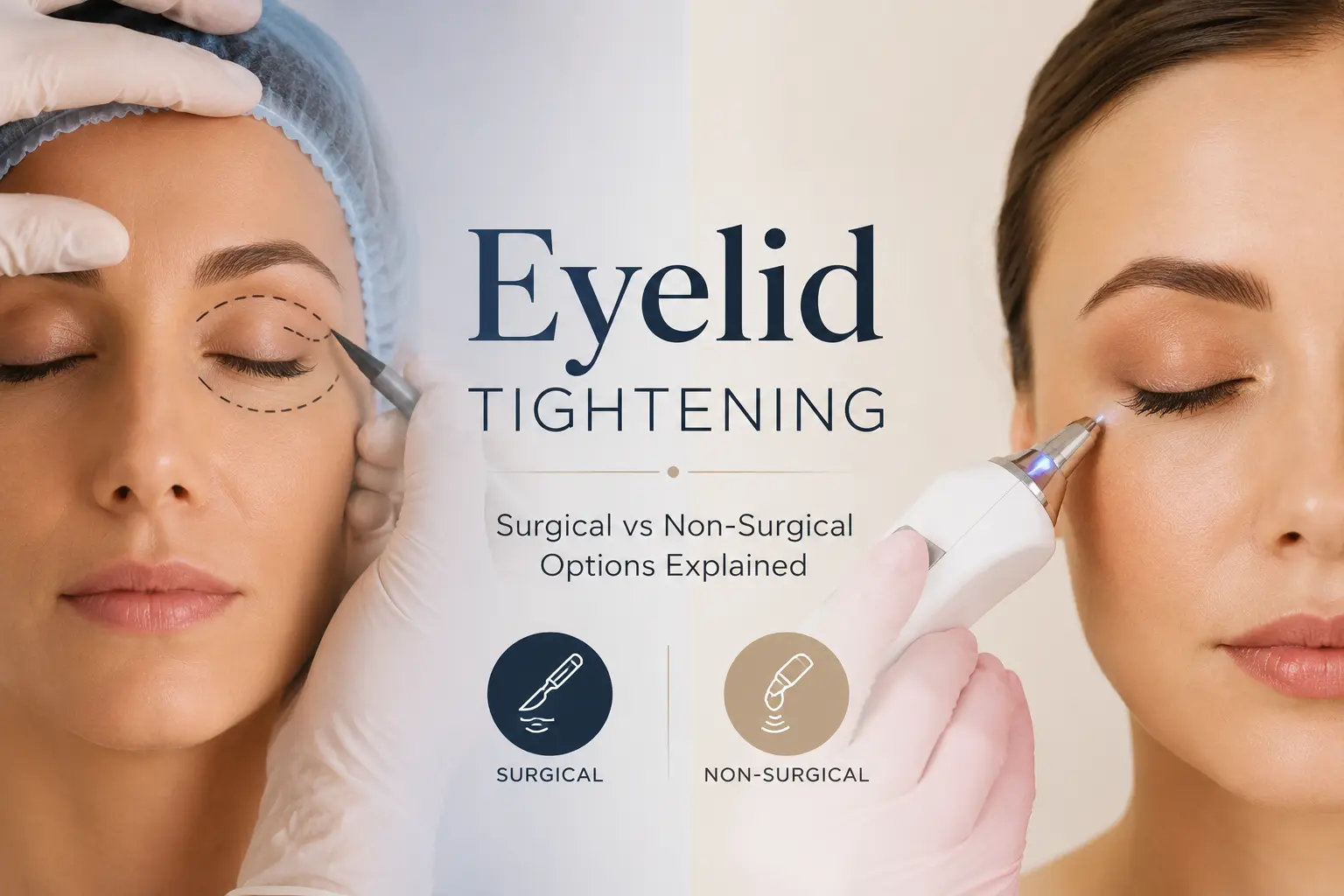
Patients who notice that their upper eyelids have become heavier, that the skin folds over the lash line in photographs, or that their eyes look smaller and more tired than they used to, frequently approach the question of treatment from two opposite directions: some want surgery and are researching what it involves, while others specifically want to avoid surgery and are asking whether non-surgical treatments can produce the same result. The honest answer to both groups is that it depends on the degree of laxity present.
Non-surgical eyelid tightening approaches, including radiofrequency skin tightening, fractional laser resurfacing, and plasma energy treatments, work through thermal stimulation of collagen in the eyelid skin. They produce measurable improvements in skin quality and mild tightening in patients with early, mild upper eyelid laxity, and they do so without downtime, without incisions, and without the recovery that surgical blepharoplasty involves. But they cannot remove excess skin, and they cannot address the volume loss or fat herniation that contributes to eyelid changes in many patients. Eyelid tightening surgery in Gurgaon, performed as a blepharoplasty, removes the excess skin and addresses the underlying anatomical causes with a precision that no non-surgical treatment can replicate.
Book an eyelid tightening consultation with Dr. Pradeep Kumar Singh at Artemis Hospital, Gurugram, or call +91 82879 23924 to have your eyelid laxity assessed and the right approach recommended for your degree of change.
The Spectrum of Eyelid Laxity: Which Treatment Matches Which Degree
Eyelid laxity exists on a spectrum from the earliest visible skin quality changes to significant hooding that compromises the visual field. The appropriate treatment, whether non-surgical or surgical, is determined by where a patient’s presentation sits on this spectrum:
| Degree of Laxity | What Is Visible | Appropriate Treatment |
| Early / Mild | Fine lines, crepey texture, skin slightly less taut than before but no significant fold or hooding | Non-surgical: radiofrequency tightening, fractional laser, or plasma treatment; results are modest and temporary (1 to 2 years) |
| Moderate | A visible fold of skin over the eyelid crease, eyelid appears heavier, partial covering of the crease line | Borderline: non-surgical produces limited improvement; surgical upper blepharoplasty achieves the clean, lasting result |
| Significant | Skin fold hangs over the eyelid crease and may partially cover the lashes; eyelids feel heavy; superior visual field may be obstructed | Surgical blepharoplasty is the only approach that removes the excess skin and addresses the anatomical cause |
| Ptosis (separate condition) | Eyelid margin itself is low, not just the skin; the pupil is partially covered by the eyelid | Requires levator repair, not skin excision; requires specialist assessment to distinguish from skin excess |
The practical implication of this spectrum is that patients in the mild category genuinely benefit from non-surgical eyelid tightening and should not be pushed toward surgery that is not yet needed. Patients in the significant category genuinely need surgical blepharoplasty and will be disappointed with non-surgical treatment results if they choose it, expecting surgical-level improvement. Patients in the moderate category, where the clinical picture is ambiguous, benefit most from an honest consultation that discusses both options, their respective results, and the patient’s own preference for the degree of intervention they are willing to accept.
Non-Surgical Eyelid Tightening in Gurgaon: What the Treatments Actually Do
Radiofrequency Eyelid Tightening
Radiofrequency eyelid tightening delivers controlled thermal energy into the dermis and subdermal layers of the eyelid skin, stimulating fibroblast activity and new collagen production. The immediate effect is a mild tightening from collagen contraction; the longer-term effect, developing over three to six months, is from the new collagen produced in response to the thermal stimulus. Radiofrequency eyelid tightening is the best-evidenced non-surgical eyelid tightening modality for mild upper eyelid skin laxity, with published studies consistently showing improvement in skin texture, mild reduction in fold depth, and high patient satisfaction in appropriately selected patients. The limitation is quantitative: the degree of skin tightening achievable through collagen stimulation is significantly less than what surgical removal of the excess skin achieves, and the results require maintenance every twelve to eighteen months as the collagen produced gradually matures and is eventually remodelled.
Laser Eyelid Tightening and Fractional Resurfacing
Fractional CO2 and Erbium laser resurfacing improve eyelid skin quality by creating controlled micro-injury channels in the skin surface, stimulating collagen remodelling and reducing the crepey texture that is one of the earliest visible signs of eyelid skin ageing. Laser eyelid tightening is more effective for textural improvement than for significant skin tightening or fold reduction, making it well-suited to patients whose primary concern is the appearance of fine lines and surface quality rather than significant skin excess. The periorbital zone requires particular care with ablative laser treatment because of the thinness of the eyelid skin and its proximity to the eye, and only appropriately trained practitioners should perform laser treatments in this area.
Can Non-Surgical Eyelid Tightening Replace Surgery?
Not for significant laxity. Non-surgical eyelid tightening treatments are effective within the range of change they can produce, but they do not remove skin, they cannot reposition fat, and they do not address ptosis. A patient with significant upper eyelid hooding who undergoes a course of radiofrequency eyelid tightening will typically see a modest improvement in skin quality and a very modest improvement in the fold, but the fundamental anatomical excess remains. Setting accurate expectations about what non-surgical eyelid tightening can achieve is the most important service a consultation provides.
Surgical Eyelid Tightening: Blepharoplasty for Definitive Correction
When the degree of eyelid laxity exceeds what non-surgical treatments can meaningfully address, eyelid tightening surgery, Gurgaon, performed as a blepharoplasty, is the definitive approach. Upper blepharoplasty removes the precisely calculated amount of excess skin through an incision placed in the natural upper eyelid crease, where it heals to a virtually invisible line. The result is a cleaner, more open eyelid with the crease restored to its normal definition and position. It is not a stretched or pulled appearance: the excess skin is removed, and the remaining skin is repaired without tension over the natural eyelid anatomy.
The advantages of surgical eyelid tightening over non-surgical alternatives are threefold. First, the degree of correction is substantially greater: surgery removes the excess skin rather than attempting to tighten it through collagen stimulation. Second, the result is lasting: the skin removed does not grow back, and while natural ageing continues after surgery, most patients maintain a significantly improved eyelid appearance for seven to ten years or more without requiring further surgical intervention. Third, surgery is the only option that addresses fat herniation, ptosis, and excess skin simultaneously when all three are present.
Patients from Sushant Lok, Sector 56, and Nirvana Country who attend the consultation at Artemis Hospital for eyelid tightening surgery in Gurgaon typically arrive having already tried skincare, under-eye creams, or a course of radiofrequency tightening, and having found the improvement incomplete. The surgical consultation clarifies honestly whether their remaining laxity is surgically correctable and what the realistic improvement looks like for their specific anatomy.
Upper Eyelid Tightening Cost in Gurgaon: How Pricing Differs Between Approaches
Upper eyelid tightening cost in Gurgaon varies significantly depending on whether the approach is surgical or non-surgical, and on the specific treatment chosen. Non-surgical radiofrequency or laser tightening is typically less expensive per session but requires repeated sessions at regular intervals to maintain results, making the cumulative cost over several years meaningful. Surgical upper blepharoplasty is a single procedure whose result lasts significantly longer, making the per-year cost more favourable over time despite a higher upfront cost.
For surgical eyelid tightening surgery in Gurgaon at Artemis Hospital, the cost depends on whether the upper eyelid alone is addressed or whether lower eyelid surgery is performed simultaneously, the anaesthesia approach, and the facility fees at the JCI and NABH-accredited hospital. A personalised cost estimate is provided at the consultation after the clinical assessment determines which approach is appropriate. Contact Artemis Hospital to schedule a consultation with Dr. Pradeep Kumar Singh.
How Long Does Eyelid Tightening Last?
The longevity of eyelid tightening results depends entirely on whether the approach is surgical or non-surgical. Non-surgical radiofrequency eyelid tightening produces improvements that last approximately twelve to eighteen months before the stimulated collagen matures and is gradually remodelled, after which a maintenance session is needed to sustain the result. Fractional laser resurfacing produces texture improvements that similarly require periodic maintenance.
Surgical eyelid tightening, performed as blepharoplasty, produces results that are long-lasting because the excess skin has been removed rather than temporarily tightened. Most patients maintain a significantly improved upper eyelid appearance for seven to ten years after surgery. Natural ageing continues after blepharoplasty, and the skin will gradually lose additional elasticity over time, but the structural correction provided by surgery means that the patient remains substantially improved relative to their pre-operative appearance for a much longer period than any non-surgical treatment achieves. Whether eyelid tightening surgery in Gurgaon is safe is answered by the same principle as any surgical procedure: it is safe when performed by a qualified plastic surgeon in an accredited facility using appropriate anaesthesia and technique.
Eyelid Tightening Surgeon Gurgaon: Dr. Pradeep Kumar Singh at Artemis Hospital
Dr. Pradeep Kumar Singh performs eyelid tightening surgery in Gurgaon at Artemis Hospital, a JCI and NABH-accredited facility in Sector 51, Gurugram. At every consultation for eyelid tightening in Gurgaon, the assessment begins with an honest evaluation of the degree of laxity present and whether the patient’s concern is better addressed by a non-surgical approach, by surgery, or by both in sequence. Patients are never directed toward surgery when their degree of change is genuinely within the treatable range of non-surgical methods, and they are never offered non-surgical treatment as an equivalent alternative when their laxity clearly requires surgical correction. His MCh in Plastic Surgery from SMS Medical College, Jaipur, and Fellowship in Advanced Aesthetic Surgery from St Louis Hospital, Paris, inform both the surgical technique and the non-surgical treatment planning for eyelid rejuvenation in Gurgaon. As Head of the Department of Plastic Surgery and a member of the Association of Plastic Surgeons of India, Dr. Pradeep Kumar Singh, MCh Plastic Surgery, Fellowship Paris, APSI Member, applies this honest, anatomy-first approach to every eyelid consultation.
Frequently Asked Questions
What is eyelid tightening surgery?
Eyelid tightening surgery, performed as a blepharoplasty, removes excess skin from the upper eyelid through an incision placed in the natural eyelid crease, where it heals to a virtually invisible line. The procedure restores a cleaner, more open upper eyelid appearance by removing the skin that has accumulated and caused hooding or heaviness. It is a definitive, long-lasting correction for significant upper eyelid laxity that non-surgical treatments cannot adequately address.
How long does eyelid tightening last?
Non-surgical eyelid tightening results from radiofrequency or laser treatment last approximately twelve to eighteen months before maintenance is needed. Surgical eyelid tightening, performed as blepharoplasty, produces results that last seven to ten years or more, because the excess skin has been removed rather than temporarily tightened through collagen stimulation. Most patients find that surgical correction is a significantly more durable investment per year than repeated non-surgical treatment over the same period.
Is eyelid tightening surgery safe?
Eyelid tightening surgery in Gurgaon is safe when performed by a qualified plastic surgeon in an accredited hospital facility under appropriate anaesthesia. The risks include temporary bruising and swelling, mild asymmetry in the immediate post-operative period, and very rarely dry eye symptoms from changes in the eyelid blink mechanics, which typically resolve within weeks. Serious complications are uncommon when the procedure is planned and performed with appropriate surgical training and technique.
What is the cost of eyelid tightening in Gurgaon?
Upper eyelid tightening surgery cost in Gurgaon depends on whether the upper eyelid alone or both eyelid zones are addressed, the anaesthesia approach, and the facility fees. Non-surgical eyelid tightening costs less per session but requires periodic repetition. A personalised cost estimate for surgical or non-surgical eyelid tightening in Gurgaon is provided at the consultation at Artemis Hospital after the degree of laxity has been assessed.
Can I tighten my eyelids without surgery?
For early and mild upper eyelid skin laxity, non-surgical radiofrequency eyelid tightening or fractional laser resurfacing can produce genuine improvement in skin quality and mild tightening. These approaches are appropriate for patients whose laxity is at the earlier end of the spectrum and who are not yet candidates for surgery. For moderate to significant laxity, or when the patient wants a definitive, long-lasting result, surgical blepharoplasty is the more appropriate choice because non-surgical treatments cannot remove excess skin.
The Right Treatment Starts With an Honest Assessment of the Change
Eyelid tightening surgery in Gurgaon and non-surgical eyelid tightening in Gurgaon are both legitimate options, and neither is inherently better: the right choice depends on the degree of laxity present and what the patient expects from treatment. At Artemis Hospital, every eyelid consultation provides an honest assessment of where the patient’s presentation sits on the spectrum of eyelid ageing, and a recommendation that matches the treatment to the actual degree of change rather than to a standard protocol or a preference for a particular approach.
Book now or call +91 82879 23924 to schedule your eyelid tightening surgery in Gurgaon consultation with Dr. Pradeep Kumar Singh at Artemis Hospital.
Or visit Artemis Hospital, Sector 51, Gurugram, Haryana 122001.
Read patient reviews at Dr. Pradeep Kumar Singh on Google.
Dr. Pradeep Kumar Singh: MCh Plastic Surgery, Fellowship Paris, APSI Member: Head of Plastic Surgery, Artemis Hospital, Sector 51, Gurugram.