
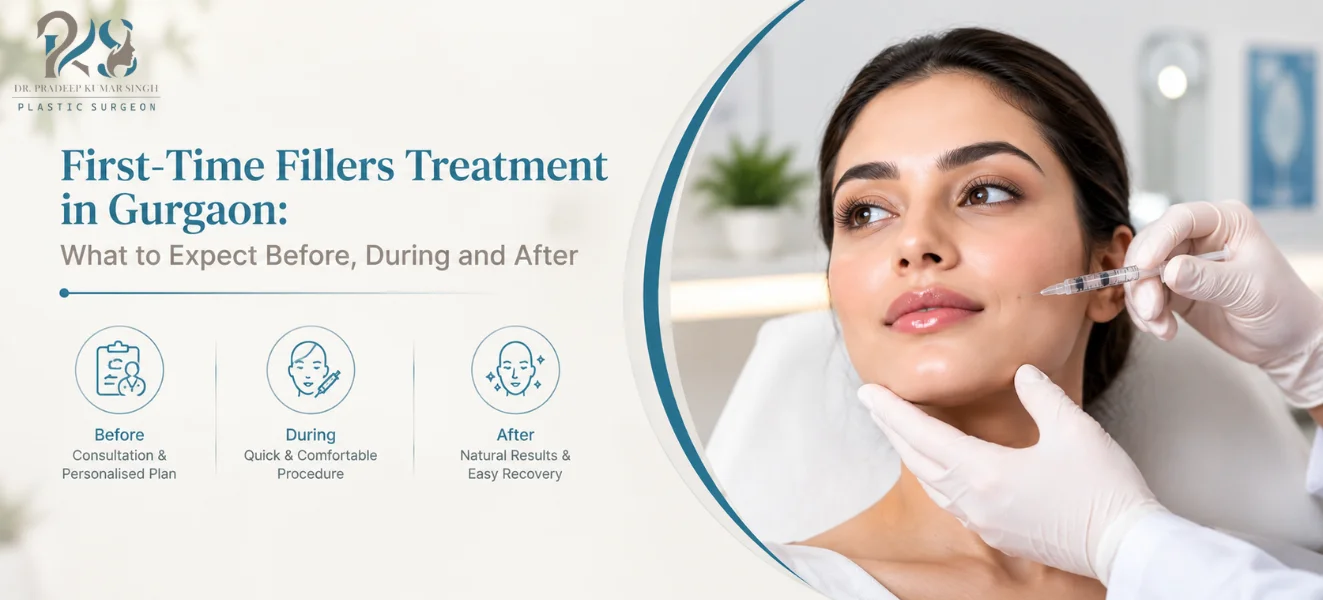
The questions first-time patients ask about fillers treatment in Gurgaon are not the same as the questions experienced patients ask. First-timers want to know what actually happens, not just what is possible. This guide answers the questions that come up most often, in the order that they tend to arise: before the appointment, during the treatment, and after.
What exactly happens during fillers treatment?
Dermal fillers at Artemis Hospital are injected using a fine needle or a blunt-tipped cannula, depending on the zone being treated. Cannulas are preferred for under-eye and cheek areas because the blunt tip cannot pierce blood vessel walls, reducing the bruising risk. Needles are used for more precise placement in areas like the lip border. The filler itself, in most cases, is hyaluronic acid (HA), a naturally occurring sugar molecule that attracts and holds water in the tissue. It is cross-linked to remain at the injection site rather than migrating immediately, and it integrates with the surrounding tissue over the following days.
The session at Artemis Hospital begins with a thorough clinical assessment of the face and a discussion of the specific concern and the desired outcome. Topical anaesthetic cream is applied for 20 to 30 minutes before treatment begins. The injections take 15 to 30 minutes depending on the zones treated. A mirror review is done immediately after each zone is completed, and the amount can be adjusted before you leave the room.
Will fillers treatment hurt in Gurgaon?
Most patients experience less discomfort than they expect. The combination of topical anaesthetic, the lidocaine mixed into most modern HA fillers, and the speed of the individual injections makes the experience manageable for the vast majority of first-time patients. The zones that are most sensitive are the lips and the under-eye, where the skin is thinner and more innervated. The cheeks and jawline are the least uncomfortable zones.
After the treatment, a mild aching or pressure sensation in the treated zones lasts a few hours as the anaesthetic wears off. Over-the-counter paracetamol is adequate for the majority of patients. Aspirin and ibuprofen should not be used in the 48 hours after fillers treatment in Gurgaon because they increase bruising risk.
Important Read: Best Fillers Treatment in Gurgaon – Get Natural, Youthful Volume
How long do fillers last?
Duration varies by zone, filler product, and individual metabolism. As a general guide: lips require replenishment most frequently, typically every six to nine months. Cheek and midface fillers with dense, high-cohesivity products last twelve to twenty-four months. Jawline filler lasts twelve to eighteen months. Under-eye filler with soft, low-cohesivity HA lasts nine to twelve months. These are averages. Patients who metabolise filler more quickly (often those who exercise very intensively) may see shorter durations. Patients who are treated conservatively and then build on the result over successive sessions often find that later sessions require smaller volumes to maintain the result, because the tissue has responded with mild biostimulation.
What if I do not like the result?
Hyaluronic acid filler is reversible. Hyaluronidase, an enzyme that dissolves HA filler, can be injected into the treated area to reverse the result partially or completely within 24 to 48 hours. This is one of the most important clinical advantages of HA filler over other filler types. At Artemis Hospital, hyaluronidase is available for use if a patient is dissatisfied with any aspect of the result or if a vascular complication requires emergency dissolving.
The most common reason patients want to modify a result is asymmetry visible immediately after treatment, before the swelling resolves. It is worth waiting two weeks before requesting any modification, because the result immediately post-treatment reflects swelling, not the settled filler position. At two weeks, the clinical picture is accurate.
What are the warning signs that something is wrong after fillers?
The most serious complication of filler treatment is vascular occlusion: filler entering or compressing a blood vessel, cutting off blood supply to a zone of skin. The warning signs are immediate blanching of the skin in the treated area, increasing pain that does not resolve, or a dusky discolouration developing in the treated zone within the first hour after treatment. These are emergencies that require immediate dissolving with hyaluronidase. At Artemis Hospital, hyaluronidase is always present in the treatment room during fillers treatment in Gurgaon, and the treatment team is trained in vascular occlusion recognition and emergency management.
Less serious but worth knowing: the Tyndall effect is a bluish discolouration caused by filler placed too superficially in thin-skinned areas such as the under-eye. It does not indicate a medical problem but requires dissolving and re-treatment at the correct depth. It is entirely preventable by correct injection depth, which is why under-eye filler specifically requires an experienced injector.
What is the difference between fillers and Botox?
Botox (botulinum toxin) relaxes specific muscles, reducing the wrinkles caused by repeated muscle contraction: forehead lines, glabellar lines, crow’s feet. It does not add volume and does not address skin laxity or tissue descent. Fillers add volume, restore lost tissue fullness, and can lift descended tissue by restoring the structural support beneath it. Many patients benefit from both: Botox for dynamic lines and fillers for volume and structural loss. At Artemis Hospital, the consultation identifies which concern requires which modality, and many patients receive a combination treatment in a single session.
How much filler is too much?
The most reliable indicator of over-treatment with filler is loss of natural facial movement: a face that does not move naturally when the patient talks, smiles, or changes expression has had too much volume placed in structural zones. The appropriate amount of filler is the amount that makes the face look like a better, refreshed version of itself, not a different face with more volume. At Artemis Hospital, conservative volume is the standard: it is always easier to add more at a follow-up session than to dissolve the excess.
Frequently Asked Questions
Is fillers treatment painful in Gurgaon?
Fillers treatment in Gurgaon at Artemis Hospital is not significantly painful for most patients. Topical anaesthetic is applied before treatment, and modern HA fillers contain lidocaine that further numbs the treated area during injection. The lips are the most sensitive zone; cheeks and jawline are the least uncomfortable. Post-treatment aching lasts a few hours and is managed with paracetamol.
How long do dermal fillers last in Gurgaon?
Filler duration depends on the zone: lips last six to nine months, cheek and midface fillers twelve to twenty-four months, jawline twelve to eighteen months, and under-eye nine to twelve months. Duration varies with individual metabolism and exercise intensity. Conservative first-time treatments and successive maintenance sessions can extend effective duration over time as the tissue responds with mild biostimulation.
Can fillers treatment be reversed in Gurgaon?
Yes. Hyaluronic acid filler can be dissolved using hyaluronidase enzyme injection, which reverses the result partially or completely within 24 to 48 hours. This reversibility is a key advantage of HA filler over other permanent or semi-permanent filler types. Hyaluronidase is available at Artemis Hospital for both elective reversal and emergency vascular occlusion management.
What are the risks of fillers treatment in Gurgaon?
Common risks include bruising (most resolves within seven to ten days), swelling, and temporary asymmetry during the settling period. The most serious risk is vascular occlusion: filler compressing a blood vessel, causing skin blanching and, if not treated immediately, tissue damage. This is prevented by the use of cannulas in high-risk zones and managed with immediate hyaluronidase if signs appear. At Artemis Hospital, the treatment team is trained in recognising and treating vascular occlusion, and hyaluronidase is always in the treatment room.
How much does fillers treatment cost in Gurgaon?
Fillers treatment cost in Gurgaon at Artemis Hospital is calculated per millilitre of filler used and varies by the zone treated, the product used, and the volume required. A personalised estimate is provided at the consultation after the clinical assessment and treatment plan are agreed. Call +91 82879 23924.
What should I avoid before and after fillers treatment in Gurgaon?
Before fillers treatment in Gurgaon, avoid aspirin, ibuprofen, naproxen, fish oil, vitamin E supplements, and alcohol for at least 48 hours to minimise bruising risk. After treatment, avoid strenuous exercise, saunas, and facial massage for 48 hours. Do not apply pressure to the treated area in the first 24 hours. Use SPF 50 on the treated skin from the day after treatment. Most other normal activities can resume immediately after fillers treatment in Gurgaon.
Fillers treatment in Gurgaon at Artemis Hospital, assessed and administered by an MCh Plastic Surgery specialist. Call +91 82879 23924 or visit Artemis Hospital, Sector 51, Gurugram, Haryana 122001.
Patient reviews: Dr. Pradeep Kumar Singh on Google.
Dr. Pradeep Kumar Singh: MCh Plastic Surgery, Fellowship Paris, APSI Member: Head of Plastic Surgery, Artemis Hospital, Sector 51, Gurugram.