
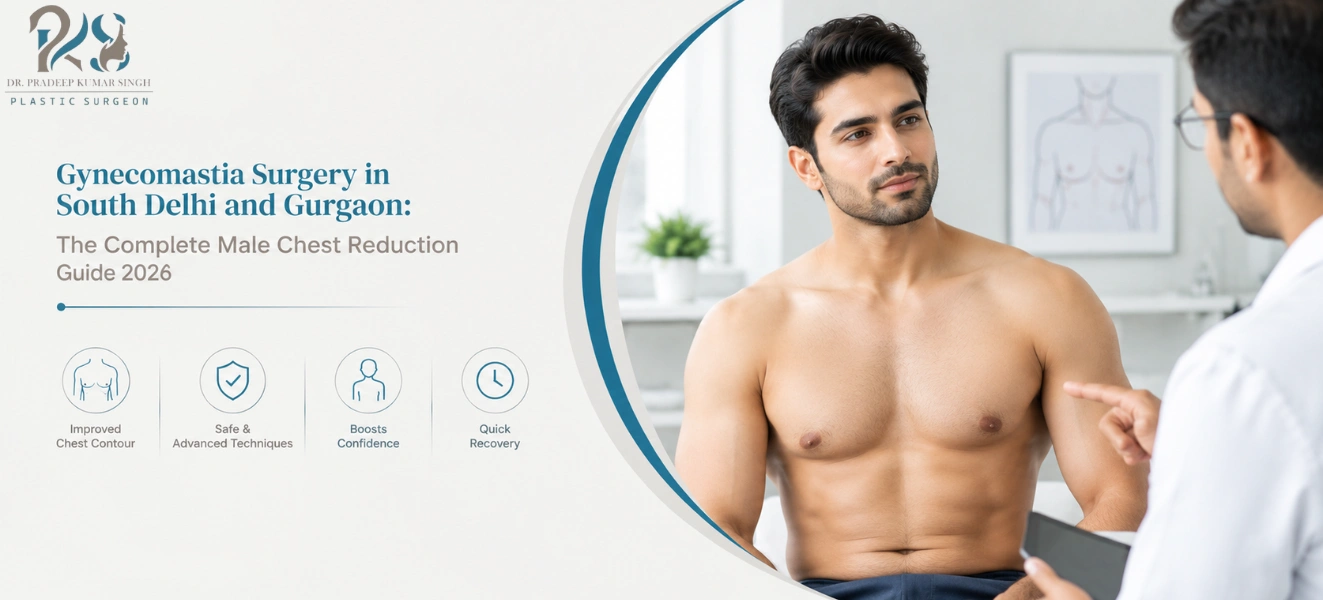
Most men who eventually present for gynecomastia surgery in Gurgaon have been living with the condition for years before they walk through a consultation room door. They have adjusted their wardrobe, avoided certain social situations, chosen gyms with private changing facilities, and built their posture around concealment. They have often been told, at some point, that it is just fat and will go away with exercise. For most of them, it has not.
Gynecomastia, the enlargement of male breast tissue due to an imbalance between oestrogen and androgen activity in the breast, is not fat. It is glandular tissue. It does not respond to diet and exercise the way subcutaneous fat does, because the glandular component is structural rather than metabolic. Understanding this distinction matters because it is why many men with gynecomastia exercise intensively, reduce body fat significantly, and find that the chest prominence that bothers them remains entirely unchanged. The tissue responsible is not the tissue that exercise reduces.
Gynecomastia affects an estimated 40 to 60 per cent of Indian men at some point in their lives, with prevalence highest in adolescence and in middle age. The social and psychological weight of a condition that is both common and rarely discussed openly is significant. A 2020 study in Aesthetic Surgery Journal reported that men presenting for gynecomastia surgery scored significantly below age-matched controls on body image, sexual wellbeing, and social confidence scales, and that scores normalised in 87 per cent of patients at twelve months post-operatively.
This guide addresses gynecomastia surgery in Gurgaon for patients in South Delhi and the broader NCR region, covering grading, technique selection, recovery, the permanence of the result, and what to expect at the consultation at Artemis Hospital. Call +91 82879 23924 to arrange an appointment with Dr. Pradeep Kumar Singh, MCh Plastic Surgery, Fellowship Paris, APSI Member, Head of Department of Plastic Surgery, Artemis Hospital.
Important Read: Gynecomastia Surgery Gurgaon: Grades, Scarless Techniques, Cost and Recovery Guide
Understanding the Grade of Gynecomastia
Gynecomastia is classified using the Simon grading system, which determines the appropriate surgical approach:
Grade I: Minor enlargement of the breast gland without excess skin. The enlarged tissue is palpable as a firm disc beneath the areola, typically 2 to 4 centimetres in diameter. The overlying skin is not stretched or redundant. Grade I gynecomastia is the most common presentation in adolescents and is the most straightforward to treat surgically, with minimal scarring.
Grade IIa: Moderate enlargement without excess skin. The glandular component is more substantial, extending beyond the areola diameter, and may be accompanied by a fatty component in the surrounding tissue. Still amenable to a minimal-incision approach.
Grade IIb: Moderate enlargement with minor skin excess. Some ptosis of the breast skin is present alongside the glandular and fatty enlargement. The areola may have descended or the skin may have slightly stretched.
Grade III: Marked enlargement with significant skin excess, producing a breast that resembles female ptosis. Grade III gynecomastia in adults, most commonly seen after significant weight loss or in long-standing untreated cases, requires skin excision alongside gland and fat removal and typically produces a longer scar than lower-grade cases.
At the gynecomastia surgery consultation in Gurgaon at Artemis Hospital, Dr. Pradeep Kumar Singh grades the presentation clinically and uses the grade to determine which technique and which incision pattern will produce the cleanest result with the smallest scar.
Important Read: Gynecomastia Surgery Before Wedding in Gurgaon: The Groom’s Complete Guide
What Does Gynecomastia Surgery in Gurgaon Involve?
The surgical approach depends on the proportion of glandular and fatty tissue in the presentation, and on the grade.
Where the gynecomastia is primarily fatty (pseudogynecomastia), liposuction through small access ports produces the correction without visible scarring. In most Indian patients, however, a firm glandular disc is present beneath the areola alongside any fatty component. This glandular disc does not liquefy with VASER ultrasonic energy and cannot be aspirated through a cannula. It requires direct excision through a small incision placed at the lower margin of the areola, within the natural pigmentation border, where the scar matures to invisibility within twelve to eighteen months.
In patients with a significant fibrous fatty component alongside the glandular disc, which is the most common presentation in men with long-standing gynecomastia or in older patients, VASER ultrasonic liposuction is used to emulsify and remove the fibrous fatty tissue before the direct gland excision is performed. The ultrasonic energy of VASER disrupts fibrous fat more effectively than standard mechanical liposuction and reduces the risk of contour irregularity in the dense male chest tissue. The combination of VASER liposuction for the peripheral fat and periareolar gland excision for the central disc produces the most complete and smooth result in complex presentations.
How Long Does Gynecomastia Surgery Recovery Take?
Most patients who have gynecomastia surgery in Gurgaon at Artemis Hospital return to desk work within five to seven days. A compression vest is worn continuously for the first four weeks, providing support and accelerating the retraction of the overlying chest skin. Light activity such as walking resumes at one week. Gym work and upper body exercise resume at six weeks.
The chest appearance improves progressively over three to six months as the residual swelling resolves and the skin tightens over the reduced chest contour. The full result is assessable at six months. Patients from South Delhi and the broader Delhi NCR region who travel to Artemis Hospital, Sector 51, Gurugram, for surgery are advised to plan a six-month follow-up into their post-operative schedule, as this is the clinically meaningful assessment point for the final gynecomastia surgery result.
Important Read: Gynecomastia Grades Explained: Which Surgery Do You Need?
Frequently Asked Questions
What is gynecomastia and what causes it?
Gynecomastia is the benign enlargement of male breast glandular tissue caused by an imbalance between oestrogen and androgen activity in the breast. It is not fat. It is glandular tissue that does not respond to diet or exercise. Common causes include pubertal hormonal fluctuation, certain medications (spironolactone, some antipsychotics, anabolic steroids), liver disease, and idiopathic hormonal imbalance in middle-aged men. In the majority of adult cases presenting for gynecomastia surgery in Gurgaon, no correctable hormonal cause is identified and the condition is classified as idiopathic.
Is gynecomastia surgery in Gurgaon permanent?
Yes, for the glandular component. The glandular disc excised during gynecomastia surgery does not regenerate. Where the gynecomastia is idiopathic and no ongoing hormonal driver is present, the result is permanent. In patients using anabolic steroids or medications that cause gynecomastia, recurrence is possible if use continues after surgery. The fatty component removed by liposuction is also permanent in patients who maintain stable body weight after the procedure.
How much does gynecomastia surgery cost in Gurgaon?
Gynecomastia surgery cost in Gurgaon at Artemis Hospital depends on the grade, the technique required (liposuction only, combined VASER and gland excision, or excision with skin reduction for Grade III), and the anaesthesia and facility fees. A personalised cost estimate is provided at the consultation after the grade is determined and the surgical plan is agreed. Call +91 82879 23924.
Can gynecomastia come back after surgery?
Recurrence of gynecomastia after surgical excision of the glandular disc is uncommon in idiopathic cases. The glandular tissue is removed and does not regenerate. Recurrence can occur if a hormonal driver, a medication, steroid use, or a treatable endocrine condition continues after surgery. For this reason, a pre-operative hormonal assessment is performed at Artemis Hospital for patients with suspected hormonal causes, and any correctable cause is addressed before or alongside surgery.
What grade of gynecomastia needs surgery?
All grades of gynecomastia with a firm glandular component benefit from surgery where the patient is motivated to address it. Grade I and IIa cases, the most common, are managed with a small periareolar incision and minimal scarring. Grade IIb and III cases require more extensive approaches. Non-surgical options such as tamoxifen have limited evidence and produce modest, temporary improvement in early cases only. For established gynecomastia with a firm glandular disc, surgery at Artemis Hospital is the only intervention that reliably removes the tissue permanently.
Is gynecomastia surgery done under local or general anaesthesia in Gurgaon?
Grade I and IIa gynecomastia surgery in Gurgaon can be performed under local tumescent anaesthesia with sedation at Artemis Hospital, making it a day-case procedure. Grade IIb and Grade III cases, where skin excision and larger-volume liposuction are required, are performed under general anaesthesia. The appropriate anaesthesia approach is discussed at the consultation and confirmed by the anaesthesiologist at the pre-operative assessment.
Gynecomastia surgery in Gurgaon at Artemis Hospital addresses both the glandular and the fatty component with precision. Call +91 82879 23924 or visit Artemis Hospital, Sector 51, Gurugram, Haryana 122001.
Patient reviews: Dr. Pradeep Kumar Singh on Google.
Dr. Pradeep Kumar Singh: MCh Plastic Surgery, Fellowship Paris, APSI Member: Head of Plastic Surgery, Artemis Hospital, Sector 51, Gurugram.