Facial ageing affects everyone differently, and the solution should match the problem. When considering facial rejuvenation, patients often wonder whether they need a comprehensive facelift or whether a less invasive mini facelift would suffice. Across Gurgaon and South Delhi, from DLF Phase 5 to Vasant Vihar, this question arises frequently during consultations—and the answer depends entirely on individual anatomy and goals.
Dr. Pradeep Kumar Singh, Head of Plastic Surgery at Artemis Hospital, Sector 51, Gurgaon, performs both mini and full facelifts regularly. With his Fellowship in Advanced Aesthetic Surgery from St Louis Hospital, Paris, and over 17 years of surgical expertise, he provides honest assessments about which procedure will genuinely address your concerns—rather than simply recommending the more extensive option.
This comprehensive guide compares both procedures, helping you understand which approach may be right for your facial rejuvenation journey.
Understanding Facial Ageing
Before comparing procedures, understanding how faces age helps clarify why different solutions exist. Facial ageing involves multiple changes occurring simultaneously:
- Skin Laxity: Collagen and elastin breakdown cause the skin to lose firmness and develop wrinkles.
- SMAS Descent: The superficial musculoaponeurotic system (SMAS)—a layer of muscle and connective tissue beneath the skin—weakens and descends, causing jowling and midface sagging.
- Volume Loss: Fat pads in the face shrink and shift downward, creating hollows under the eyes and deepening nasolabial folds.
- Neck Changes: The platysma muscle bands separate, and neck skin loosens, creating bands and a “turkey neck” appearance.
Patients from Golf Course Road, Sushant Lok, and Greater Kailash present with varying degrees of these changes. Dr. Pradeep Kumar Singh evaluates which components dominate your ageing pattern to recommend the most appropriate procedure.
What Is a Mini Facelift?
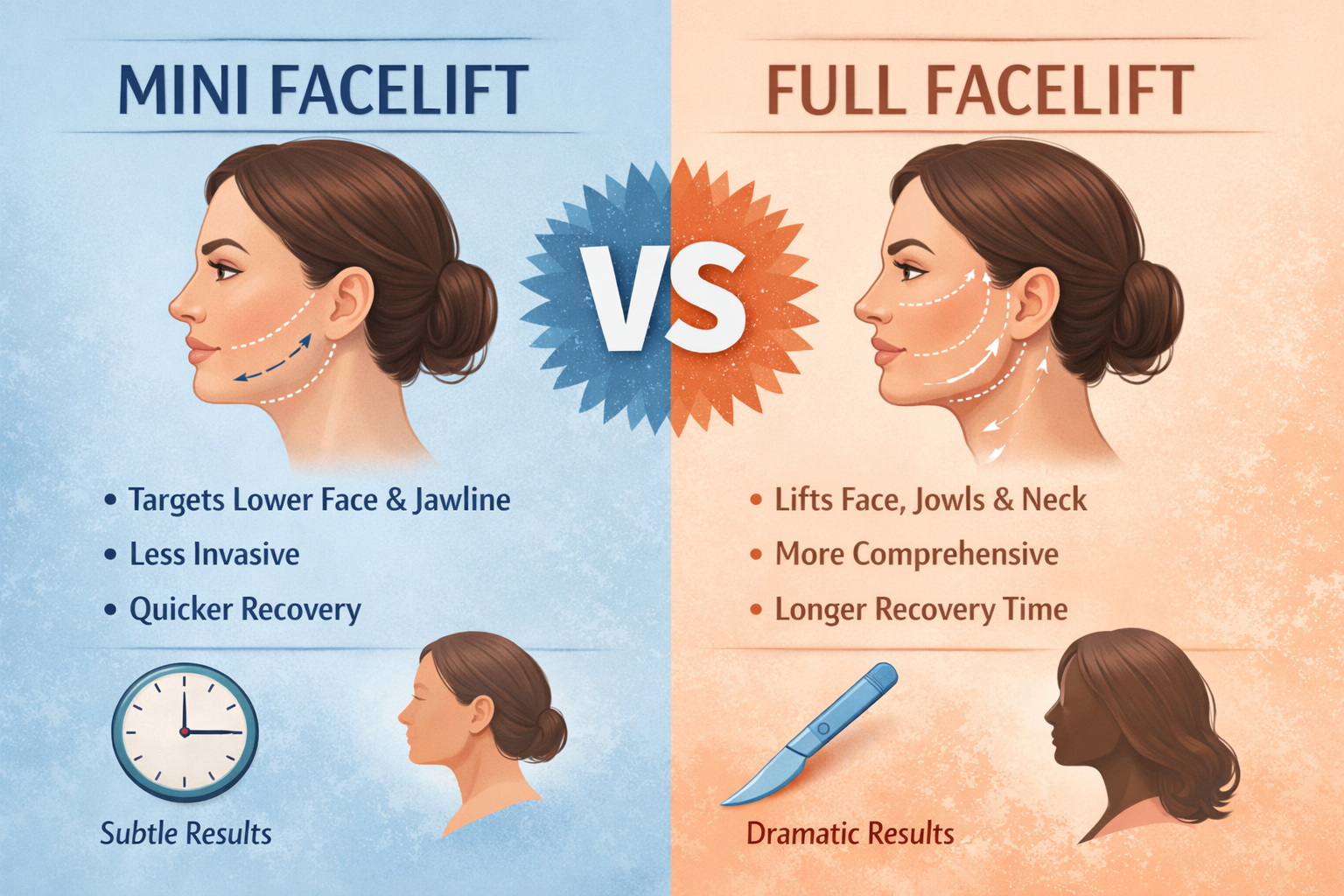
A mini facelift—sometimes called a “weekend facelift” or “short-scar facelift”—is a less extensive procedure targeting early to moderate signs of ageing, primarily in the lower face and jawline.
How a Mini Facelift Works
The procedure involves shorter incisions, typically beginning at the temple hairline, continuing around the ear, and ending behind the earlobe. Through these incisions, Dr. Pradeep Kumar Singh lifts and tightens the underlying SMAS layer before removing excess skin and closing with fine sutures.
Women and men from Defence Colony, Haus Khas, and Nirvana Country in their 40s and early 50s with mild jowling and early jawline softening often find the mini facelift perfectly addresses their concerns.
Advantages of Mini Facelift
- Shorter Surgery: Typically completed in one to two hours under local anaesthesia with sedation.
- Faster Recovery: Most patients return to social activities within seven to ten days.
- Less Scarring: Shorter incisions mean less visible scarring, particularly behind the ear.
- Lower Risk: Reduced surgical time and tissue manipulation translate to fewer potential complications.
Limitations of Mini Facelift
- Limited Scope: Cannot adequately address significant midface sagging, deep nasolabial folds, or substantial neck laxity.
- Shorter Longevity: Results typically last five to seven years compared to ten or more years for a full facelift.
- Not for Advanced Ageing: Patients with significant ageing may be disappointed with mini facelift results.
Wondering if a mini facelift suits your needs? Book now or call +91 82879 23924 for a consultation with Dr. Pradeep Kumar Singh.
What Is a Full Facelift?
A full facelift—technically called a rhytidectomy—is a comprehensive procedure addressing moderate to advanced ageing of the face and neck. It provides more dramatic, longer-lasting results than a mini facelift.
How a Full Facelift Works
The procedure uses longer incisions that extend from the temple, around the ear, and into the posterior hairline. Some techniques include an incision under the chin for neck work. Dr. Pradeep Kumar Singh performs deep-plane or SMAS techniques that lift not just skin, but the entire muscular layer, producing more natural, longer-lasting results.
Patients from Chanakyapuri, Jor Bagh, and Anand Lok seeking comprehensive facial rejuvenation that addresses the entire face and neck benefit most from this approach.
Advantages of Full Facelift
- Comprehensive Results: Addresses the midface, lower face, jawline, and neck in a single procedure.
- Longer Lasting: Results typically endure ten to fifteen years, making it more cost-effective long-term for appropriate candidates.
- Natural Appearance: Deep-plane techniques lift tissues in natural vectors, avoiding the “pulled” look associated with older facelift methods.
- Neck Rejuvenation: Can include platysmaplasty to tighten neck muscles and eliminate banding.
Considerations for Full Facelift
- Longer Surgery: Typically requires three to five hours under general anaesthesia.
- Extended Recovery: Most patients need two to three weeks before returning to social activities.
- More Extensive Incisions: Though well-hidden, incisions are longer than those in a mini facelift.
Comparing Mini and Full Facelift: Key Differences
Women and men from Gulmohar Park, DLF Camelia, and Magnolias often request a direct comparison. Dr. Pradeep Kumar Singh explains the key differences:
- Ideal Age Range: Mini facelift suits patients in their 40s to early 50s with early ageing. Full facelift is typically appropriate for those in their mid-50s to 70s with moderate to advanced changes.
- Areas Addressed: Mini facelift targets the lower face and mild jowling. Full facelift addresses the midface, lower face, jawline, and neck comprehensively.
- Surgery Duration: Mini facelift takes one to two hours; full facelift requires three to five hours.
- Recovery Time: Mini facelift recovery is seven to ten days; full facelift requires two to three weeks.
- Result Longevity: Mini facelift results last five to seven years; full facelift results endure ten to fifteen years.
Ready to discuss your facelift options? Book now or call +91 82879 23924 for personalised guidance.
How Dr. Pradeep Kumar Singh Recommends the Right Procedure
During consultations at Artemis Hospital, Dr. Pradeep Kumar Singh evaluates several factors before recommending a procedure:
- Degree of Ageing: Mild jowling and early laxity may respond beautifully to a mini facelift. Significant sagging, deep folds, and neck concerns require a full facelift.
- Neck Condition: If the neck requires attention, a full facelift with platysmaplasty is typically necessary. Mini facelifts provide minimal neck improvement.
- Patient Goals: Some patients prefer modest improvement with minimal downtime; others want maximum transformation regardless of recovery duration.
- Lifestyle Considerations: Patients from Shanti Niketan, Gold Links, and M3M Golf Estate with demanding schedules may prefer the shorter recovery of a mini facelift, even if it means earlier repeat procedures.
Frequently Asked Questions
1. Am I too young for a facelift?
There is no arbitrary age minimum. Some patients in their early 40s have genetic or lifestyle factors causing premature ageing that warrant intervention. Others in their 60s may have excellent skin quality requiring minimal work. Dr. Pradeep Kumar Singh evaluates your actual tissue condition rather than simply your chronological age.
2. Can I upgrade from a mini facelift to a full facelift later?
Yes. Many patients choose a mini facelift in their 40s or early 50s, then undergo a full facelift a decade later as ageing progresses. This staged approach provides continuous rejuvenation without ever appearing dramatically “done.” Previous surgery does not prevent future procedures.
3. Will people know I had a facelift?
Modern facelift techniques produce natural results. Dr. Pradeep Kumar Singh’s deep-plane approach lifts tissues in anatomically correct vectors, avoiding the tight, windswept appearance of outdated methods. People may comment that you look refreshed or well-rested, but the telltale signs of surgery are absent.
4. How visible are facelift scars?
Incisions are placed within the hairline and natural creases around the ear. Once healed, scars are virtually invisible—even to hairdressers. Dr. Pradeep Kumar Singh’s meticulous closure techniques ensure the finest possible scar quality. Most patients wear their hair up without concern.
5. Can fillers replace a facelift?
Fillers address volume loss but cannot lift sagging tissue. For patients with mild ageing, fillers may delay the need for surgery. However, once significant laxity develops, only surgical lifting provides meaningful improvement. Patients from Palam Vihar, Sohna Road, and Ardee City often combine facelifts with strategic filler placement for optimal results.
6. What is the recovery like?
Both procedures involve swelling and bruising that peaks around day three and gradually resolves. Mini facelift patients typically feel presentable by day seven to ten. Full facelift recovery requires two to three weeks before social comfort. Dr. Pradeep Kumar Singh provides detailed recovery protocols to optimise healing.
Choose the Right Procedure for Your Needs
The decision between mini and full facelift should be based on an honest assessment of your ageing pattern and goals—not marketing hype or cost considerations alone. Patients across Gurgaon and South Delhi, from Green Park to MG Road, achieve excellent outcomes when the procedure matches their actual needs.
Dr. Pradeep Kumar Singh and his team at Artemis Hospital provide candid recommendations, ensuring you receive the procedure that will genuinely address your concerns. His international training and artistic eye ensure natural, refreshed results whether you choose a mini or full facelift.
Ready to discover which facelift is right for you? Book now or call +91 82879 23924 to schedule your consultation today.
Or visit Artemis Hospital, Sector 51, Gurugram, Haryana 122001.
Your rejuvenated appearance awaits. Let Dr. Pradeep Kumar Singh help you turn back the clock naturally.