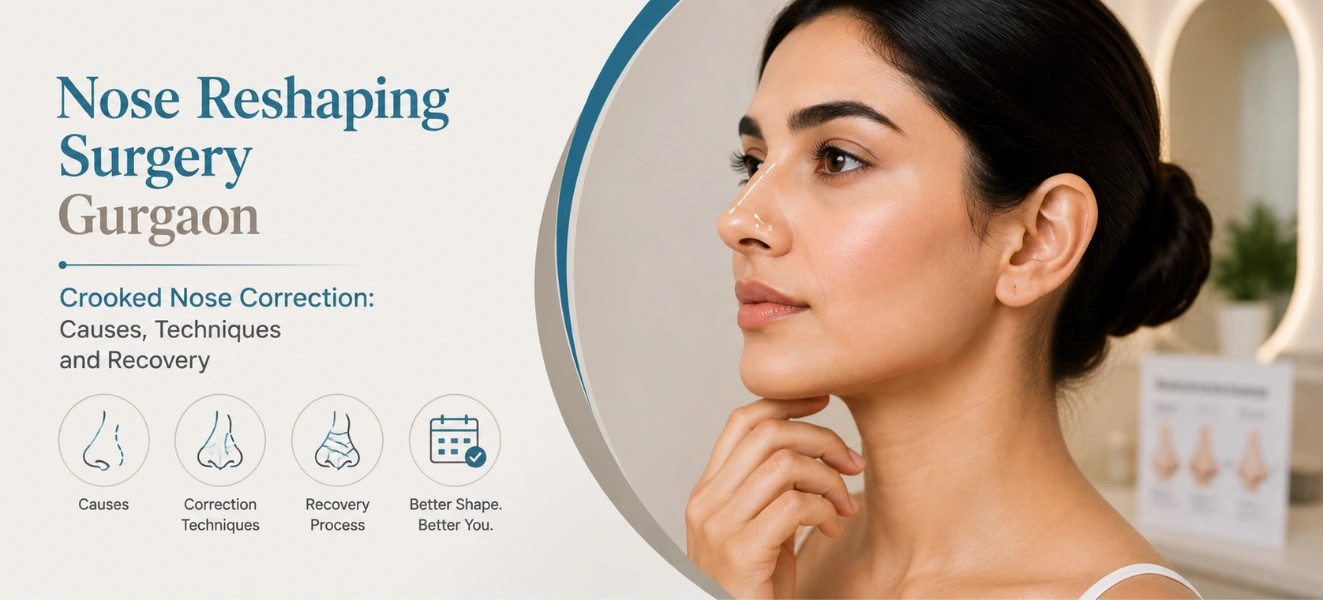
A crooked nose requiring nose reshaping surgery in Gurgaon is one of the most common presentations at rhinoplasty consultations. The demand for nose reshaping surgery in Gurgaon for this specific indication has grown as awareness of the functional and aesthetic components of the correction has increased. At rhinoplasty consultations. It is also one of the most technically challenging, because correcting a deviated nose requires addressing the underlying skeletal deviation, not just improving the surface appearance. A rhinoplasty that straightens a crooked nose on the skin surface without addressing the bony and cartilaginous framework beneath it will not hold its correction: the structural forces that produced the deviation continue to act on the soft tissue correction, and the nose returns toward its previous position over months to years.
This guide covers the three types of nasal deviation, their causes, how nose reshaping surgery in Gurgaon for a crooked nose differs from standard cosmetic rhinoplasty, the relationship between nasal deviation and breathing problems, what recovery looks like, and whether insurance applies to crooked nose correction.
To have your nasal deviation assessed and the appropriate surgical approach recommended, call +91 82879 23924 or arrange a consultation at Artemis Hospital, Gurugram.
What Causes a Crooked Nose Requiring Nose Reshaping Surgery in Gurgaon?
Nasal deviation has three primary causes, each with different structural implications for the correction approach:
- Trauma: A nasal fracture from a fall, sporting injury, or direct blow is the most common cause of a crooked nose in India. Nasal fractures that are not repositioned acutely within ten days of the injury heal in the deviated position and require osteotomies (controlled bone cuts) to correct at least six months after the injury, when the fracture has fully healed. Trauma-related deviation frequently produces both bony and cartilaginous components simultaneously because the force that fractures the nasal bones typically also distorts the upper and lower lateral cartilages and displaces the septum.
- Developmental deviation: The nasal skeleton develops along bilateral symmetrical lines, and asymmetric developmental forces during facial growth in adolescence can produce a nose that has deviated away from the midline without any traumatic event. Developmental deviation is often associated with a deviated nasal septum that grew asymmetrically, pulling the external nose off-centre. This type of deviation is typically present since adolescence and is frequently associated with a degree of nasal airflow obstruction from the deviated septum.
- Post-surgical deviation: A previous rhinoplasty that did not address an underlying septal deviation, or that removed cartilage asymmetrically from one side of the nose, can produce or worsen nasal deviation. Post-surgical deviation is addressed in the revision rhinoplasty framework described in the previous blog in this series.
Important Read: Nose Reshaping Surgery Gurgaon: Surgical vs Non-Surgical Rhinoplasty, A 2026 Comparison Guide
What Are the Three Types of Crooked Nose in Nose Reshaping Surgery?
Nasal deviation is classified by the anatomical zone in which the deviation is predominantly located:
Bony Deviation
The nasal bones, which form the upper third of the nose from the nasal bridge to the point where the bone meets the cartilage (the osseocartilaginous junction), are deviated off-centre. The nasal bridge appears crooked or asymmetric from the front. Correction requires osteotomies: controlled cuts made through the nasal bones to allow them to be repositioned to the midline. Osteotomies are performed with a fine osteotome or using a piezoelectric instrument (piezo rhinoplasty) that vibrates at ultrasonic frequency to cut through bone without cutting the soft tissue, producing cleaner cuts and less post-operative bruising than conventional osteotomes.
Cartilaginous Deviation
The middle third of the nose, formed by the upper lateral cartilages and the septal dorsum, is deviated off-centre while the nasal bones above are relatively straight. Cartilaginous deviation is corrected by scoring and releasing the deviated cartilage, repositioning it to the midline, and maintaining the midline position with spreader grafts placed between the upper lateral cartilage and the septal dorsum. Spreader grafts are one of the most important structural tools in crooked nose surgery and perform two functions simultaneously: they push the deviated upper lateral cartilage toward the midline, and they widen the internal nasal valve, which is frequently collapsed in cartilaginous deviation and is a significant component of the breathing obstruction associated with this deviation pattern.
Combined Bony and Cartilaginous Deviation
The most common presentation, where the deviation involves both the nasal bones and the cartilaginous middle third. Combined deviation requires both osteotomies for the bony component and cartilage management (spreader grafts, scoring, and release) for the cartilaginous component. This is the most surgically comprehensive presentation of a crooked nose and is planned through the open nose reshaping surgery approach in Gurgaon at Artemis Hospital, which provides the direct binocular visualisation needed to address both components precisely in the same session.
Can Nose Reshaping Surgery in Gurgaon Fix a Crooked Nose Without Addressing Breathing?
Yes, where the deviation is entirely cosmetic and there is no associated nasal airflow obstruction, the external correction can be performed without septal surgery. However, at Artemis Hospital, every nose reshaping surgery consultation in Gurgaon for a crooked nose includes nasal airway assessment because the two concerns are frequently coexistent. A deviated septum that deflects the nasal airway is present in most patients with structural nasal deviation, and correcting the external deviation without addressing the septal deflection leaves the patient with a straighter nose that still does not breathe well.
Where septal deviation is confirmed and is contributing to airflow obstruction, combined septorhinoplasty, which addresses both the cosmetic deviation and the functional septum, is the appropriate approach. The combined procedure is more surgically comprehensive and slightly longer in operative time than cosmetic-only correction, but it resolves both dimensions in a single session and avoids a second anaesthetic for a later functional septoplasty. The functional component of the procedure may also support insurance consideration where airflow obstruction is formally documented.
How Is Crooked Nose Surgery Different From Standard Cosmetic Rhinoplasty?
Standard cosmetic rhinoplasty in the majority of patients involves addressing the nasal profile (hump reduction), the tip (definition, projection, and rotation), and possibly the alar base (width). The structural framework of the nose is roughly symmetric, and the corrections are made symmetrically on a roughly symmetrical starting point.
Crooked nose correction in rhinoplasty surgery in Gurgaon is asymmetric surgery on an asymmetric framework. Every element of the procedure, the osteotomy angles, the cartilage scoring, the graft placement, the degree of correction on each side, must be deliberately planned and executed differently on the left and right sides to produce a result that is straight. This bilateral asymmetry in the surgical execution is the key technical demand of crooked nose surgery and is what makes it more complex than standard rhinoplasty. At Artemis Hospital, the open approach is standard for crooked nose correction because it provides the direct visualisation needed to assess and manage the bilateral asymmetry of the framework during the procedure.
Patients from Noida Sector 15 and Sector 25 who travel to Artemis Hospital, Sector 51, Gurugram, for nose reshaping surgery in Gurgaon receive a full frontal and lateral photographic analysis at the consultation that maps the specific zones of deviation, the relative bony and cartilaginous components, and the presence or absence of septal deviation, before any surgical plan is proposed.
Important Read: Septoplasty and Rhinoplasty Combined in Gurgaon: One Surgery for Breathing and a Better-Looking Nose
Will Insurance Cover Crooked Nose Surgery If It Affects Breathing?
Yes, where the functional component of the procedure, the septoplasty for documented airflow obstruction, is formally indicated and documented. The cosmetic correction of the external nasal deviation is not covered by health insurance in India, but the septoplasty for the functional airflow obstruction component may be covered under the medically necessary surgical category in IRDAI-regulated comprehensive health insurance policies. Where the patient has documented breathing difficulty attributable to the septal deviation and formal assessment (nasal endoscopy or nasal airflow measurement) confirms the obstruction, the insurance documentation at Artemis Hospital supports the functional component claim. The aesthetic component remains an out-of-pocket cost.
Frequently Asked Questions
What causes a crooked nose?
The three primary causes of a crooked nose are: trauma (nasal fracture that healed in the deviated position), developmental deviation (asymmetric facial growth during adolescence, typically associated with a deviated septum), and post-surgical deviation from a previous rhinoplasty. Trauma is the most common cause in India, and developmental deviation is the most common cause of crooked nose with associated breathing problems.
Can a crooked nose be fixed without also treating breathing problems in Gurgaon?
Yes, where no septal deviation is contributing to breathing obstruction. However, at Artemis Hospital, every nose reshaping surgery consultation for a crooked nose includes nasal airway assessment because the two are frequently coexistent. Where both are present, combined septorhinoplasty addresses both in a single session, which is more efficient than staging the cosmetic and functional corrections separately.
How is crooked nose surgery different from regular rhinoplasty in Gurgaon?
Crooked nose correction involves bilateral asymmetric surgery on an asymmetric framework, with different interventions on the left and right sides planned to produce a straight result. Standard rhinoplasty addresses a roughly symmetric framework symmetrically. The asymmetric technical demands of crooked nose surgery, including planned osteotomies, spreader grafts, and asymmetric cartilage management, make it more complex and require the direct visualisation of the open rhinoplasty approach.
How long is recovery after crooked nose correction surgery in Gurgaon?
A nasal splint is worn for seven to ten days. Bruising, which is typically more extensive than in standard rhinoplasty because osteotomies are required for bony deviation, resolves within ten to fourteen days. Social presentability is restored within two weeks in most patients. The final alignment and symmetry of the correction is assessable at twelve months as swelling resolves and the structural forces from the osteotomies and grafts stabilise the nose in its new position.
Will insurance cover crooked nose surgery in Gurgaon if it affects breathing?
The functional septoplasty component of crooked nose surgery may be covered under medically necessary surgical provisions in IRDAI-regulated health insurance policies where airflow obstruction is formally documented. The cosmetic nasal deviation correction component is an out-of-pocket cost. At Artemis Hospital, the clinical documentation for insurance consideration of the functional septoplasty component is prepared as part of the pre-operative workup for combined septorhinoplasty cases.
What is the recovery after crooked nose surgery in Gurgaon?
The nasal splint is worn for seven to ten days. Bruising, typically more extensive than in standard rhinoplasty because osteotomies are required, resolves within ten to fourteen days. Social presentability is restored within two weeks for most patients. Exercise resumes at four to six weeks. The final alignment of nose reshaping surgery in Gurgaon for a crooked nose is assessable at twelve months, as structural settling and scar maturation complete the stabilisation of the corrected framework.
Crooked nose correction requires structural thinking, not just surface correction. Call +91 82879 23924 or visit Artemis Hospital, Sector 51, Gurugram, Haryana 122001.
Reviews: Dr. Pradeep Kumar Singh on Google.
Dr. Pradeep Kumar Singh: MCh Plastic Surgery, Fellowship Paris, APSI Member: Head of Plastic Surgery, Artemis Hospital, Sector 51, Gurugram.