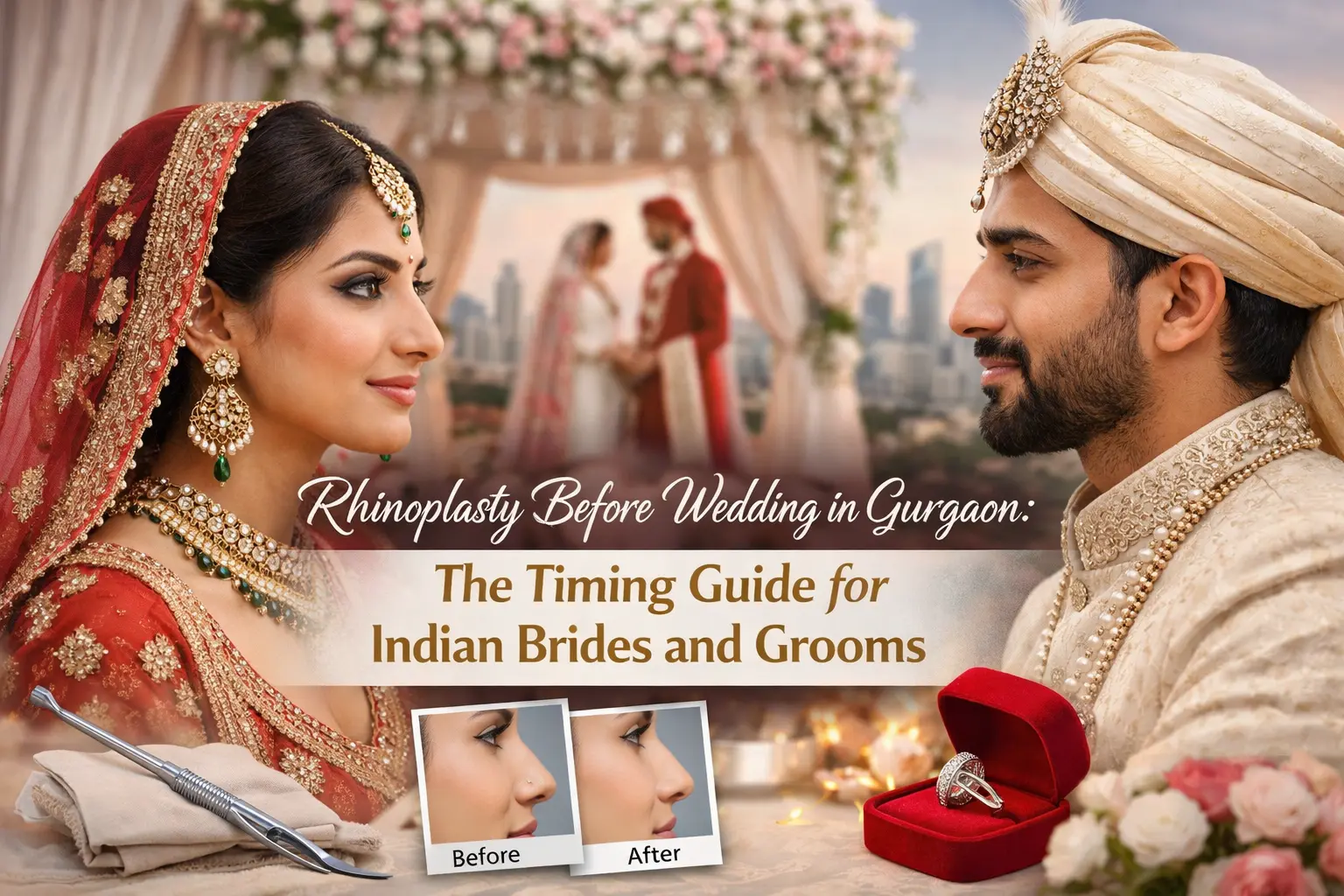
Rhinoplasty before a wedding in Gurgaon requires a different timeline calculation from rhinoplasty in any other context — and the reason lies in the biology of Indian nasal skin. Published research consistently identifies two characteristics that distinguish Indian noses from most Western presentations: thicker nasal skin and weaker lower lateral cartilage. These combine to produce a recovery pattern where the nasal tip — the area most visible in close-range photography — settles considerably later than the standard nine-to-twelve-month guideline assumes for thinner-skinned patients.
For brides and grooms planning rhinoplasty surgery before their wedding in Gurgaon or South Delhi, this matters practically: a timeline built for a thin-skinned patient may leave the nose looking subtly swollen in the tip at nine months, particularly in patients of South Indian heritage, whose skin tends to be thicker than that of North Indian patients. This guide explains the biology behind the timeline, what the nose looks like at each point in recovery, and what this means specifically for wedding photography, pre-wedding shoots, sangeet events, and glasses use.
Book a rhinoplasty consultation with Dr. Pradeep Kumar Singh at Artemis Hospital, Gurugram, or call +91 82879 23924 to have your nasal skin assessed and a personalised wedding timeline built around your specific presentation.
Why Indian Nasal Skin Changes the Recovery Calculation
The thickness of the skin overlying the nasal tip and bridge has a direct and significant effect on how quickly rhinoplasty results become visible. In a thin-skinned patient, even subtle changes to the underlying cartilage framework are immediately visible through the skin, and swelling resolves rapidly because there is less subcutaneous tissue to retain fluid. In a patient with thick nasal skin, the skin itself acts as a veil over the cartilaginous changes beneath it. The new framework is present, but the overlying soft tissue takes considerably longer to redrape and reveal the shape beneath.
Published research in aesthetic surgery literature confirms that Indian nasal skin has thicker subcutaneous tissue than Caucasian noses, alongside weaker upper and lower lateral cartilages. The weaker cartilages require structural reinforcement through grafting rather than reduction, and the thicker skin takes longer to reattach to the new framework. In the thickest-skin presentations — more common in South Indian than North Indian patients — visible tip swelling can persist well beyond twelve months.
A rhinoplasty timeline built on twelve months assumes average skin thickness. Patients with thicker skin should plan for fourteen to eighteen months; patients with average North Indian skin can typically plan for ten to twelve months. A clinical assessment determines which category applies — not a skin type chart.
Month-by-Month: What the Nose Looks Like at Every Wedding Planning Stage
| Month Post-Op | Nose Appearance | Wedding Activity | Verdict |
| Month 1 | Significant swelling, bruising resolved by week 2–3. Tip very swollen. Not the real result. | Not suitable for any ceremony or event | Too early — not recommended |
| Month 2–3 | Gross swelling gone. Shape visible but tip still full, especially in Indian thick-skin cases. | Pre-wedding shoots possible with caution — angles matter | Marginal — risk of dissatisfaction in photos |
| Month 4–5 | Bridge and mid-nose refined. Tip swelling persists in 30–40 per cent of Indian patients. | Sangeet, mehendi possible. No close-up photo shoots yet. | Acceptable for informal events |
| Month 6 | 80–90 per cent of swelling resolved. Shape clearly visible. Close to final result. | Pre-wedding professional shoot appropriate | Good — most patients presentable for photography |
| Month 9 | 95 per cent of result visible. Tip near-final in most North Indian patients. | All wedding ceremonies, receptions, close-up photography | Ideal for most patients |
| Month 12+ | 100 per cent final result. Especially important for South Indian thick-skin presentations. | All photography, all events | Fully settled — photographs match 12-month result |
The most practically significant column in the above table is the second — what the nose actually looks like at each stage. Every patient’s timeline varies based on skin thickness, the extent of the surgical changes made, and individual healing patterns. What the table captures is the average expectation for a patient with typical North Indian skin who has undergone rhinoplasty surgery at Artemis Hospital. Patients with thicker South Indian skin should shift each timeline column approximately two to three months to the right.
The Pre-Wedding Photoshoot: The Timeline Within the Timeline
Indian weddings almost universally involve a pre-wedding shoot scheduled two to four months before the ceremony. For rhinoplasty patients, this shoot creates a second timing pressure that many do not account for when planning their surgery date.
At two to four months post-operatively, the bridge and mid-nose are well-refined. The tip, however, still carries residual swelling in Indian skin patients — making it appear slightly fuller in profile photographs than it will at six to nine months. Three-quarter angle photographs are more forgiving at this stage.
Practical planning guidance for pre-wedding shoot timing:
- Pre-wedding shoot at 3–4 months post-op: Tip definition may not be fully visible. Frontal and three-quarter views are more forgiving than strict profiles. Inform the photographer to approach profile angles cautiously.
- Pre-wedding shoot at 5–6 months post-op: A workable window for most North Indian patients. The bridge and profile are refined; tip swelling is significantly reduced and typically not visible except in extreme close-up.
- Pre-wedding shoot at 9 months post-op: The ideal window — result close to fully settled, and photographs accurately represent the wedding-day appearance.
Patients from Golf Course Road, Sushant Lok, Greater Kailash, Vasant Vihar, Defence Colony, and Anand Niketan who planned rhinoplasty at Artemis Hospital around both the wedding day and the pre-wedding shoot report significantly higher satisfaction with their photographic results at both events.
Wedding Ceremonies and Recovery: What You Can and Cannot Do at Each Stage
Indian weddings typically span three to five days of ceremonies — the mehendi, haldi, sangeet, nikah or pheras, and reception. Each involves different physical demands, social proximity, and photographic intensity. The rhinoplasty recovery timeline creates specific considerations for each:
- Months 1–2 (Avoid all ceremonies): Active healing phase. No ceremonies, events, or close-range photographs.
- Months 3–5 (Sangeet and mehendi possible with precautions): Dance at sangeet can temporarily increase nasal swelling — inform the choreographer and avoid contact risk. Photographs are acceptable but should be reviewed before sharing.
- Month 6+ (All ceremonies appropriate): The nose is stable for all events. Physical activity unrestricted. Close-range photography appropriate.
The Glasses Problem: A Detail Most Patients Miss Until It Is Too Late
One recovery restriction that catches many patients off guard — particularly relevant for Indian weddings — is the six-week ban on wearing glasses after rhinoplasty. Glasses rest on the nasal bridge where the bone is reknitting; constant frame pressure can cause indentation and permanent asymmetry during this period.
For brides and grooms who wear glasses daily, this creates a practical challenge that must be discussed during the pre-operative consultation:
- Contact lenses: The standard solution. Patients not currently wearing contacts should get fitted before surgery.
- Tape-on glasses: For contact-lens-intolerant patients, glasses can be taped to the forehead without resting on the bridge — technique and timing guided by the surgeon.
- Wedding ceremony timing: If the wedding falls within the first six weeks, the use for ceremony photography must be discussed specifically. The surgery date should be moved if full healing cannot be assured before the ceremony.
Rhinoplasty for Weddings at Artemis Hospital: Planning That Matches Your Skin
Dr. Pradeep Kumar Singh performs rhinoplasty surgery at Artemis Hospital — a JCI and NABH-accredited facility in Sector 51, Gurugram — with a pre-operative assessment that includes specific evaluation of nasal skin thickness and cartilage quality. For patients planning rhinoplasty before a wedding, this assessment directly informs the timeline recommendation: a patient with thin North Indian skin receives a nine-to-twelve-month timeline; a patient with thicker South Indian skin is counselled for twelve to fourteen months.
His MCh in Plastic Surgery from SMS Medical College, Jaipur, and Fellowship from St Louis Hospital, Paris, equip him to perform the structural cartilage grafting and precise tip refinement that Indian nasal anatomy requires — alongside post-operative protocols including nasal taping and steroid injection when indicated, which help thick-skinned cases reveal their results sooner. Patients from Ardee City, Palam Vihar, Nirvana Country, Sector 42, MG Road, DLF Camelia, Golf Course Extension, Jor Bagh, Haus Khas, Shanti Niketan, Gold Links, Gulmohar Park, Vasant Kunj, and Chanakyapuri travel to Artemis Hospital for rhinoplasty consultations that account for their specific skin type, not a generic timeline.
Frequently Asked Questions
How many months before my wedding should I have rhinoplasty in India?
Nine to twelve months for patients with average North Indian skin; twelve to fourteen months for thicker South Indian skin. The Indian nasal tip is the last part of the nose to show its final result — thicker skin delays this further. A clinical assessment at Artemis Hospital determines which timeline applies.
Will my nose look natural in wedding photographs six months after rhinoplasty?
For most North Indian patients, yes — 80 to 90 per cent of swelling has resolved, and the bridge and profile are well-defined. Some residual tip softness may be visible in extreme close-up. Patients with thicker South Indian skin should plan for eight to nine months for comparable photographic results.
Can I have rhinoplasty if my wedding is only six months away?
For average North Indian skin with moderate surgical changes, six months is workable but not ideal for wedding photographs. For thick skin or complex tip cases, six months is unlikely to be sufficient. An honest assessment at consultation determines whether six months is realistic for your specific case.
My wedding is in a different city — how do I manage follow-up after rhinoplasty in Gurgaon?
Post-operative follow-up at Artemis Hospital is structured to accommodate out-of-city patients. Critical appointments — cast removal at week one and the three-week check — are planned around return visits to Gurgaon. Subsequent follow-ups at months two, three, six, and twelve can be conducted in person or through high-quality photographs reviewed remotely by Dr. Pradeep Kumar Singh.
What is the difference between rhinoplasty for a wedding and rhinoplasty at any other time?
The surgery is identical. What differs is the planning: the wedding date creates a fixed endpoint that makes skin thickness assessment, timeline calculation, and pre-wedding shoot scheduling specifically relevant. Pre-wedding rhinoplasty requires reverse-engineering from the event date to ensure the result is visible when it matters most.
Plan Early. The Nose Has Its Own Timeline.
Rhinoplasty before a wedding requires one thing: time. Not general planning time — the specific biological time that Indian nasal skin needs to redrape over a new cartilage framework and reveal the result worked toward. Patients most satisfied with their rhinoplasty on their wedding day are consistently those who planned twelve months or more in advance — because their skin had the time it needed.
Book now or call +91 82879 23924 to schedule your pre-wedding rhinoplasty consultation with Dr. Pradeep Kumar Singh at Artemis Hospital.
Or visit Artemis Hospital, Sector 51, Gurugram, Haryana 122001.
Read patient reviews at Dr. Pradeep Kumar Singh on Google.
Dr. Pradeep Kumar Singh — MCh Plastic Surgery, Fellowship Paris, APSI Member — Head of Plastic Surgery, Artemis Hospital, Sector 51, Gurugram.