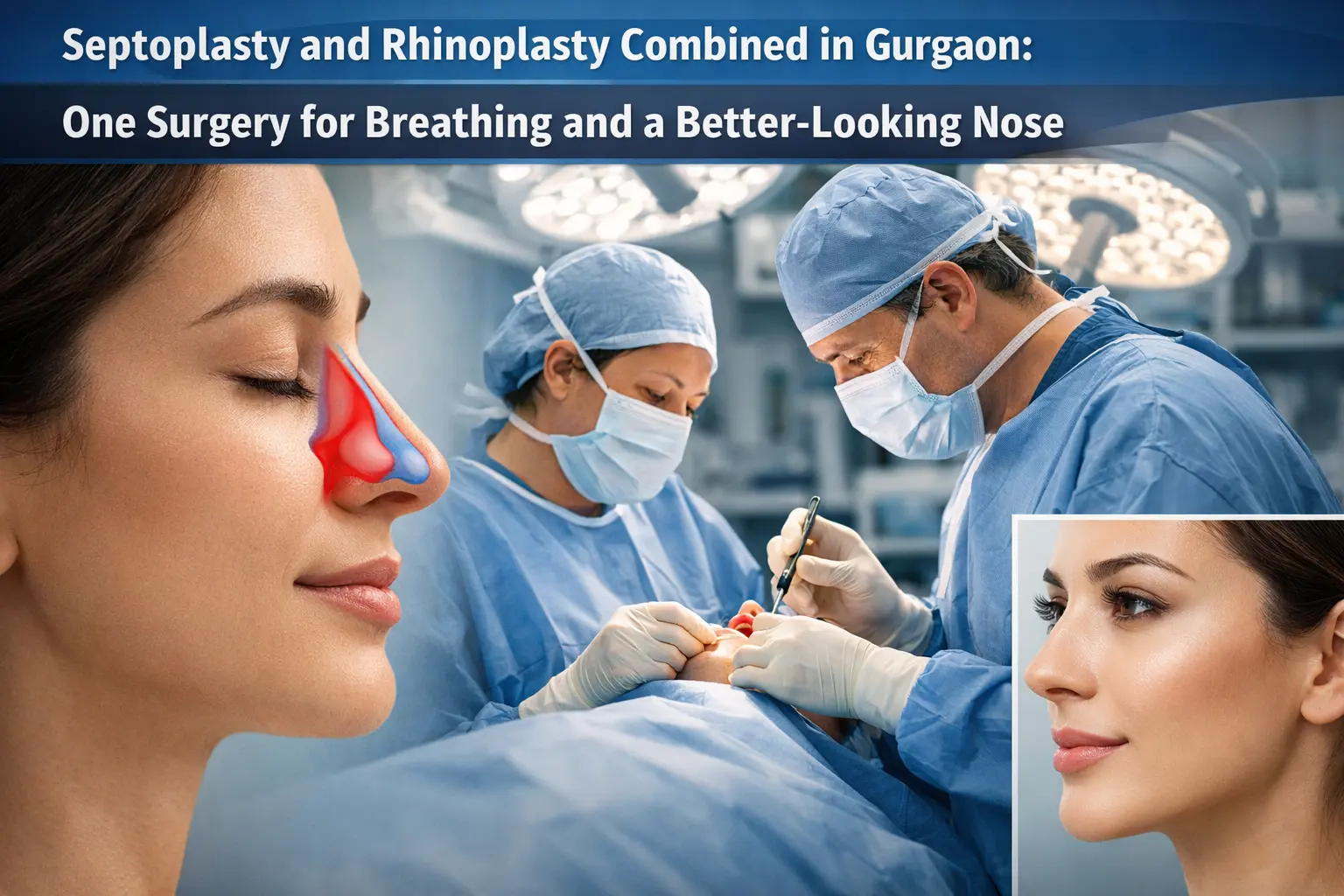
Septoplasty and rhinoplasty combined in Gurgaon is among the most clinically and practically advantageous surgical decisions available to patients who have a deviated septum alongside cosmetic concerns about their nose shape. In a single operating session, the best rhinoplasty surgeon in Gurgaon can correct internal nasal obstruction and reshape the external nose simultaneously, and the patient recovers once rather than twice. What makes the combined approach even more beneficial is a detail that most patients are not told until their consultation: the cartilage removed from a deviated septum is among the best grafting material available for rhinoplasty tip refinement in Indian noses.
For patients in Gurgaon and South Delhi who were told separately that they need septoplasty for breathing and rhinoplasty for appearance, the question worth asking is whether septorhinoplasty eliminates the need to choose at all. This guide explains the difference between the two surgeries, why combining them is clinically superior in the right candidate, and how the procedure works at Artemis Hospital, Gurugram.
Book a septorhinoplasty consultation with Dr. Pradeep Kumar Singh at Artemis Hospital, or call +91 82879 23924 to assess whether combined nose reshaping surgery in Gurgaon is the right approach for your presentation.
Deviated Septum Surgery in Delhi NCR: What Septoplasty Actually Does
Deviated septum surgery, known clinically as septoplasty, is a procedure that corrects the nasal septum, which is the wall of cartilage and bone dividing the two nasal passages. A deviated septum occurs when this central wall shifts significantly to one side, reducing airflow through one or both nostrils. In India, a deviated septum is one of the most common reasons patients in Gurgaon and Delhi NCR present to a plastic surgeon or ENT specialist, and it often goes undiagnosed for years because patients assume nasal congestion and breathing difficulty are normal.
Symptoms that indicate septoplasty in Delhi NCR is necessary include persistent difficulty breathing through one nostril, recurrent sinus infections, chronic nasal congestion on one side, frequent nosebleeds, and sleep disruption or snoring caused by restricted airflow. When a nasal endoscopy or CT scan confirms septal deviation as the cause, septoplasty is indicated.
Septoplasty alone does not change the external appearance of the nose. A patient who has deviated septum surgery in Gurgaon will have improved breathing but the same nose shape. The combined septorhinoplasty approach addresses both concerns in a single procedure.
What Is Septorhinoplasty and Why Does the Combination Produce Better Outcomes?
Septorhinoplasty is the combined procedure in which septoplasty and rhinoplasty are performed together in a single operating session under one anaesthetic. The best rhinoplasty surgeons in Gurgaon and Delhi NCR who offer this combined approach achieve outcomes that neither procedure achieves independently, for a reason that goes beyond simple efficiency.
When a deviated septum is corrected in septorhinoplasty, the removed septal cartilage does not need to be discarded. This cartilage is strong, pliable, and the ideal size and shape for nasal grafting. It is harvested and used directly as graft material for rhinoplasty tip work in nose reshaping surgery in Gurgaon, where Indian nasal anatomy typically requires structural tip reinforcement. This eliminates the need to harvest cartilage from the ear or rib, reducing overall complexity.
The second major advantage is harmonised planning. When nose reshaping surgery in Delhi NCR is planned alongside septoplasty, the surgeon designs the rhinoplasty with full knowledge of the septal anatomy and the cartilage available for grafting. Both components are planned as a single coordinated outcome, producing more predictable results than rhinoplasty performed after a prior septoplasty has already altered the internal anatomy.
Septoplasty Alone vs Combined Septorhinoplasty: A Direct Comparison
| Factor | Septoplasty Alone | Septorhinoplasty (Combined) |
| Breathing improvement | Yes: deviated septum corrected | Yes: septum corrected in the same procedure |
| Nose appearance | Unchanged: no external correction | Reshaped to patient’s goals simultaneously |
| Septal cartilage | Removed or repositioned, discarded | Harvested and used as graft material for rhinoplasty tip work |
| Anaesthesia | Once | Once: both procedures share a single anaesthetic session |
| Recovery periods | One | One: no second surgery, no second recovery |
| Cost efficiency | Lower upfront, but second surgery may be needed later | Higher initial investment, significantly lower combined cost |
| Result harmony | Breathing improves; appearance unchanged | Breathing and appearance corrected in a coordinated plan |
Who Is the Right Candidate for Combined Septoplasty and Rhinoplasty in Gurgaon?
Not every patient with a deviated septum needs or wants rhinoplasty, and not every patient seeking rhinoplasty surgery in Gurgaon has a symptomatic deviated septum. The combined procedure is the right choice for patients who genuinely present with both concerns. The following indicators suggest that combined septorhinoplasty is worth discussing:
- Confirmed symptomatic deviated septum: Nasal endoscopy or imaging confirms significant septal deviation causing breathing obstruction. The deviation is not mild and manageable without surgery.
- Cosmetic nose concerns alongside the breathing issue: The patient has an independent desire for nose reshaping surgery in Gurgaon or Delhi NCR to address the external shape, dorsal hump, wide bridge, tip definition, or nostril width.
- Has not had a previous septoplasty: Prior septoplasty may have reduced the available septal cartilage for grafting. A thorough assessment of remaining cartilage is necessary before planning rhinoplasty in this context.
- Generally good health for a 2 to 3 hour procedure: Septorhinoplasty takes two to three hours under general anaesthesia. Patients must be appropriate surgical candidates for this duration.
- Realistic expectations for both outcomes: The patient understands that septoplasty improves breathing but does not guarantee complete resolution of all nasal congestion, and that rhinoplasty results take nine to twelve months to fully settle in most Indian patients.
Patients from DLF Phase 2, Golf Course Road, Sushant Lok, Greater Kailash, Vasant Vihar, Defence Colony, Jor Bagh, and Haus Khas who have undergone septorhinoplasty at Artemis Hospital report that the consultation clearly established which concerns were functional and which were cosmetic, and how the combined procedure addressed both in a single plan.
How Combined Septoplasty and Rhinoplasty Is Performed at Artemis Hospital, Gurgaon
The procedure at Artemis Hospital, Sector 51, Gurugram, follows a specific sequencing that enables both objectives to be achieved in a single session:
- Anaesthesia: General anaesthesia is administered. The two to three hour procedure duration is well within the safe range for healthy adult patients.
- Septoplasty phase: Incisions inside the nostrils provide access to the nasal septum. Deviated cartilage and bone are repositioned or removed to centralise the septum and restore equal airflow. Where cartilage is removed, it is preserved for immediate use as rhinoplasty graft material.
- Cartilage harvesting: The preserved septal cartilage is shaped into graft material: a columellar strut to support the nasal tip, a shield graft to define tip contour, or a dorsal graft to augment the bridge, depending on the rhinoplasty goals.
- Rhinoplasty phase: Using the open approach for most Indian nose reshaping surgery cases in Gurgaon, the surgeon addresses dorsal hump reduction, tip refinement using the harvested septal cartilage grafts, bridge narrowing, nostril reshaping, or any combination discussed during consultation.
- Closure and splinting: The rhinoplasty incisions are closed, and a nasal splint is applied to support the new framework during initial healing. Internal nasal splints from the septoplasty phase support the repositioned septum.
Recovery After Septorhinoplasty: What Patients in Gurgaon and South Delhi Can Expect
Recovery follows the rhinoplasty timeline, as it governs the external healing schedule. Breathing improvement from the septoplasty component becomes apparent much earlier, within two to three weeks, as internal swelling resolves.
- Week 1: Both the external splint and internal nasal splints are in place. Nasal congestion is significant. Breathing through the nose is limited by internal swelling. The external rhinoplasty result is not visible at this stage. Most patients rest at home.
- Week 2: Splints are removed at the one-week follow-up. Bruising around the eyes begins to fade. The nose looks swollen, but significantly better than day one. Breathing through the nose begins to improve as the septoplasty component heals internally.
- Month 1 to 3: Breathing improvement from deviated septum surgery becomes fully apparent. The bridge and profile from nose reshaping surgery in Gurgaon become visible, though tip swelling persists.
- Month 6: 80 to 90 per cent of the nose reshaping surgery results are visible. Breathing is normal and patients report consistent improvement in sleep quality and exercise tolerance.
- Month 9 to 12: The full rhinoplasty result settles. For Indian patients with thicker South Indian skin, the nasal tip may take up to twelve months for final definition. Septoplasty results are permanent.
Septorhinoplasty by the Best Rhinoplasty Surgeon in Gurgaon: Dr. Pradeep Kumar Singh
Dr. Pradeep Kumar Singh performs functional rhinoplasty in India, including combined septorhinoplasty, at Artemis Hospital, Sector 51, Gurugram. His MCh in Plastic Surgery from SMS Medical College, Jaipur, and Fellowship from St Louis Hospital, Paris, provide the training in both functional nasal surgery and aesthetic rhinoplasty that the combined procedure requires. For patients seeking nose reshaping surgery in Delhi NCR alongside deviated septum correction, both objectives are planned and executed by the same surgeon in a single coordinated procedure.
As Head of the Department of Plastic Surgery at Artemis Hospital, a JCI and NABH-accredited facility, and an active APSI member, Dr. Pradeep Kumar Singh brings the full institutional infrastructure that combined septorhinoplasty requires.
Patients considering septoplasty and rhinoplasty combined in Gurgaon travel to Artemis Hospital from Ardee City, Palam Vihar, Nirvana Country, Sector 42, DLF Camelia, Golf Course Extension, Gold Links, Shanti Niketan, Green Park, Chanakyapuri, Vasant Kunj, South Extension, and MG Road for consultations where both functional and cosmetic concerns are assessed in one appointment.
Frequently Asked Questions
Can septoplasty and rhinoplasty be done at the same time in India?
Yes. Septorhinoplasty is routinely performed at Artemis Hospital, Gurgaon, by Dr. Pradeep Kumar Singh. The combined procedure corrects a deviated septum for improved breathing and reshapes the external nose for cosmetic improvement in a single operating session. Patients in Gurgaon and South Delhi with both a functional breathing concern and a cosmetic nose concern are good candidates.
What is the benefit of combining septoplasty with rhinoplasty rather than having them separately?
The primary benefits are: one recovery period rather than two, one anaesthetic session, septal cartilage available as graft material for nose reshaping surgery in Delhi NCR rather than requiring a second donor site, harmonised surgical planning, and lower combined cost compared with two staged procedures.
Will septoplasty change the appearance of my nose?
Septoplasty alone does not change the external appearance of the nose. It corrects the internal septum without altering the bridge, tip, or nostrils. Patients who want nose reshaping surgery in Gurgaon for cosmetic reasons alongside septoplasty need the combined septorhinoplasty procedure.
How long is the recovery after combined septoplasty and rhinoplasty in Gurgaon?
Recovery is governed by the rhinoplasty component. Most patients return to desk work within seven to ten days; strenuous activity is restricted for four to six weeks. The rhinoplasty result refines over nine to twelve months. Breathing improvement from septoplasty is typically apparent within two to three weeks as internal swelling resolves.
Is a deviated septum always noticeable from the outside?
Not always. A deviated septum is an internal deviation affecting the airway without necessarily producing visible external asymmetry. Some patients with severe deviation have a perfectly straight external nose. The presence of a deviated septum is confirmed through nasal endoscopy or CT imaging, not from external observation.
Does the combined procedure cost more than rhinoplasty alone in Gurgaon?
The combined procedure has a higher upfront cost than rhinoplasty alone due to greater surgical time. However, compared with two-stage procedures, it is considerably more cost-effective: anaesthesia once, facility used once, one recovery period rather than two. For patients who need both procedures, the combined approach represents better overall value.
One Surgery. Two Goals. One Recovery.
Patients who need deviated septum surgery in Gurgaon and nose reshaping surgery in Delhi NCR do not have to choose between breathing better and a better-looking nose. Septorhinoplasty by the best rhinoplasty surgeon in Gurgaon delivers both outcomes from one procedure with one recovery.
Book now or call +91 82879 23924 to schedule your combined septoplasty and rhinoplasty consultation with Dr. Pradeep Kumar Singh at Artemis Hospital.
Or visit Artemis Hospital, Sector 51, Gurugram, Haryana 122001.
Read patient reviews and explore Dr. Pradeep Kumar Singh’s rhinoplasty practice at Google Business Profile.
Dr. Pradeep Kumar Singh, MCh Plastic Surgery, Fellowship Paris, APSI Member, Head of Plastic Surgery, Artemis Hospital, Sector 51, Gurugram.