
Rhinoplasty in 2026 is being chosen for different reasons and planned with different goals than rhinoplasty a decade ago. The shift is captured in a single phrase that appears across the most current aesthetic surgery trend analyses: subtle refinement over dramatic change. Patients presenting for rhinoplasty surgery in Gurgaon in 2026 are, on average, older than their predecessors. They know their face well. They have lived with their nose for three or four decades and have a specific, limited concern rather than a desire to look like someone else. What they want is a version of their own face that is better balanced, not a new face altogether.
This philosophy shift has specific surgical consequences. Rhinoplasty surgery in Gurgaon planned for subtle refinement requires different technique selection, different intraoperative decision-making, and a completely different pre-operative planning conversation than one planned for significant transformation. The 3D imaging tools now available at Artemis Hospital allow this conversation to be grounded in the patient’s actual anatomy rather than in vague verbal descriptions of what ‘smaller’ or ‘more defined’ means to each individual patient. This guide covers the midlife rhinoplasty philosophy in clinical and practical terms, including what 3D imaging contributes to planning, what the specific corrections most relevant to midlife patients involve, and what realistic results look like for rhinoplasty surgery in Gurgaon patients in their forties and fifties.
Call +91 82879 23924 or arrange a consultation at Artemis Hospital, Gurugram, to discuss your specific nasal concerns with Dr. Pradeep Kumar Singh.
What Is Midlife Rhinoplasty, and Why Is It Trending in 2026?
Midlife rhinoplasty refers to rhinoplasty surgery performed in patients typically aged 40 to 60, who are presenting either for the first time with a long-standing concern or for a revision of a procedure performed earlier in their life. It is trending in 2026 for three interconnected reasons:
- Completed facial development and stable anatomy: The face in the forties and fifties has completed all structural development and stabilised. The surgeon is working with a known, predictable anatomical starting point rather than a face that may continue to change post-operatively. Rhinoplasty planned at this stage does not carry the uncertainty of long-term developmental change that affects younger patients.
- Greater clarity about goals: Midlife patients have lived with their nose long enough to know precisely what concerns them and what does not. They are more likely to have a single, clear concern (a dorsal hump in profile, an undefined tip, a slightly wide alar base) than a younger patient who may present with a more generalised dissatisfaction. Specific, defined goals produce more predictable and more satisfying surgical results than generalised ones.
- Rejection of the operated look: Midlife patients are strongly averse to results that appear surgical. They are seeking improvement that their social circle will not immediately attribute to a procedure. This goal is achievable and is, in fact, the standard that contemporary rhinoplasty surgery in Gurgaon at Artemis Hospital is designed to meet. The test of a well-performed midlife rhinoplasty is that observers notice the patient looks well rather than noticing they have had their nose done.
Important Read: Nose Reshaping Surgery Gurgaon: Surgical vs Non-Surgical Rhinoplasty, A 2026 Comparison Guide
What Does Subtle Rhinoplasty Refinement Actually Mean Surgically?
Subtle refinement is not a vague aspiration. It has specific surgical correlates that determine the technique selection and the magnitude of the planned correction:
Conservative Hump Reduction
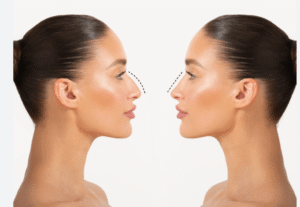
For the midlife patient who presents with a dorsal hump as their primary concern, subtle refinement means reducing the hump to create a straight or very slightly concave dorsal line, not a ski-jump profile. The correction should produce a natural-looking profile from the side that reads as the patient’s own nose improved, not as a nose that has been visibly shortened or modified. The specific millimetre reduction planned is guided by the 3D simulation at the consultation, which allows the patient to preview and approve the degree of change before surgery is confirmed.
Tip Refinement Without Over-Rotation
Midlife patients with a thick skin, under-defined nasal tip benefit from cartilage suture techniques and carefully placed tip grafts that add definition without upward rotation. The nasolabial angle appropriate for a midlife patient is more conservative than for a younger female patient: a natural male or female midlife nose does not have the turned-up tip that reads as youthful in a twenty-year-old but appears incongruous on a fifty-year-old face. The tip correction is planned to improve definition in the frontal and oblique views without changing the profile angle beyond what the individual facial geometry supports.
Preservation of Character
The most important concept in midlife rhinoplasty surgery in Gurgaon is the preservation of nasal character. A face that has aged together over five decades has a coherence: the nose, the jawline, the brows, and the skin all carry the marks of the same life. A rhinoplasty that produces a nose dramatically younger-looking than the surrounding face disrupts this coherence in a way that reads as operated regardless of the technical quality of the result. Preserving character means correcting the specific concern while keeping the nose in proportion and in visual harmony with the unchanged parts of the face.
How Does 3D Imaging Help in Rhinoplasty Surgery Planning in Gurgaon?
Three-dimensional imaging for rhinoplasty planning in Gurgaon at Artemis Hospital allows a simulated version of the proposed surgical correction to be projected onto the patient’s own nasal anatomy before any incision is made. The patient can see a preview of their nose with the planned hump reduction, the proposed tip refinement, and any alar base modification displayed on a rotatable 3D model of their actual face, not on a stock photograph or a generic illustration.
The clinical value of 3D imaging in rhinoplasty planning is not that the simulation guarantees the surgical outcome. It does not, and no ethical practice presents it as a guarantee. The value is twofold: it externalises the conversation about the degree of change, replacing imprecise verbal descriptions with a visual reference that both the surgeon and the patient can respond to; and it frequently reveals that the patient’s actual goals are more modest than they initially described. Patients who arrive saying they want a ‘completely different nose’ often respond to the 3D simulation by pointing at a subtle correction and saying ‘that is actually what I was thinking’. The simulation creates the space for this calibration before surgery, not after it.
Patients from Rohtak Road and Nangloi who travel to Artemis Hospital, Sector 51, Gurugram, for rhinoplasty surgery consultation in Gurgaon receive a full 3D imaging session as part of the planning consultation. The simulation is used to agree the surgical plan in specific, visible terms before the procedure date is confirmed.
Can Rhinoplasty and Septoplasty Be Performed Together in Gurgaon?
Yes, and for midlife rhinoplasty patients specifically, simultaneous septoplasty is more commonly indicated than in younger patients. A deviated septum that has caused some degree of airflow restriction for decades becomes more clinically significant in midlife because of its cumulative impact on sleep quality, exercise-related breathing, and the increasing prevalence of snoring and sleep-disordered breathing patterns in this age group. Addressing the functional component at the same operative session as the cosmetic rhinoplasty avoids a separate procedure and a separate recovery, and any insurance consideration for the functional component can be documented before surgery.
At Artemis Hospital, every rhinoplasty surgery consultation in Gurgaon includes nasal airway assessment as a standard component, regardless of whether the patient presents with a functional complaint. The assessment frequently identifies a moderate septal deviation that the patient has accommodated and did not attribute to their nose. Addressing it simultaneously produces a more complete result, because the external rhinoplasty correction that improves the profile does not help the patient breathe better, and vice versa.
Important Read: Rhinoplasty Surgery Gurgaon: Cost, Best Surgeon Checklist and Types of Nose Surgery
What Makes a Rhinoplasty Look Natural in 2026?
A natural rhinoplasty result in 2026 is defined by three principles that have become the clinical standard at experienced rhinoplasty practices, including Artemis Hospital:
- Proportionality: The corrected nose must remain proportionate to the face that surrounds it. The height of the dorsum, the projection of the tip, and the width of the alar base should each be in correct proportion to the width of the face between the eyes (the intercanthal distance), the height of the mid-third of the face, and the width of the lips. No single correction exists in isolation; each one must be checked against the proportions of the face as a whole.
- Anatomical integrity: Natural results preserve the structural integrity of the nasal framework. Removing too much cartilage from the tip in the pursuit of a refined result weakens the structural support and can produce a pinched tip or a collapsed nasal valve in the years after surgery. The move toward preservation rhinoplasty techniques reflects precisely this lesson: preserving the anatomical framework while improving its position and proportion produces results that age naturally rather than collapsing or distorting over time.
- Skin envelope compatibility: The skin of the nose, particularly in Indian patients with typically thicker skin, must be compatible with the underlying framework change for the result to appear natural. A thin-skinned patient shows every detail of the framework; a thick-skinned patient requires a more robust framework change to show any surface effect. Natural rhinoplasty surgery in Gurgaon matches the magnitude of the framework correction to the skin thickness, rather than applying the same correction to all patients and expecting the same surface result.
How Much Does Rhinoplasty Surgery Cost in Gurgaon in 2026?
Rhinoplasty surgery cost in Gurgaon at Artemis Hospital depends on the extent of the corrections planned, the surgical approach (open or closed), whether septoplasty is performed simultaneously, and the anaesthesia and facility fees. A midlife rhinoplasty involving conservative hump reduction and tip refinement without septoplasty has a different cost profile from a combined functional and cosmetic septorhinoplasty. A personalised cost estimate is provided at the consultation after the 3D imaging and surgical plan are agreed. Contact Artemis Hospital to arrange a consultation.
Important Read: Septoplasty and Rhinoplasty Combined in Gurgaon: One Surgery for Breathing and a Better-Looking Nose
Frequently Asked Questions
What is midlife rhinoplasty, and why is it trending in Gurgaon in 2026?
Midlife rhinoplasty is rhinoplasty performed in patients typically aged 40 to 60, pursuing subtle, specific corrections rather than dramatic transformation. It is trending in 2026 because this demographic has greater clarity about their goals, is averse to the operated look, and benefits from stable facial anatomy that produces predictable surgical results. The philosophy of subtle refinement over dramatic change defines contemporary rhinoplasty surgery in Gurgaon for this patient group.
How does 3D imaging help in rhinoplasty surgery planning in Gurgaon?
3D imaging projects a simulated version of the planned correction onto the patient’s own nasal anatomy before surgery. It externalises the conversation about the degree of change, replaces imprecise verbal descriptions with a visual reference, and frequently calibrates the patient’s goals toward a more modest, more natural correction than they initially described. At Artemis Hospital, 3D imaging is a standard part of every rhinoplasty planning consultation in Gurgaon.
Can rhinoplasty and septoplasty be performed together in Gurgaon?
Yes. Combined septorhinoplasty addresses the cosmetic nasal shape and the functional nasal airway in a single operative session. For midlife patients, simultaneous septoplasty is more commonly indicated than in younger patients because decades of moderate septal deviation have accumulated a cumulative functional impact on breathing, sleep quality, and exercise performance. At Artemis Hospital, nasal airway assessment is a standard part of every rhinoplasty consultation in Gurgaon.
How much does rhinoplasty surgery cost in Gurgaon in 2026?
Rhinoplasty surgery cost in Gurgaon at Artemis Hospital depends on the extent of corrections, the surgical approach, whether septoplasty is included, and facility fees. A personalised estimate is provided at the consultation after the 3D imaging session and surgical plan are confirmed. Call +91 82879 23924.
What makes a rhinoplasty result look natural in 2026?
A natural rhinoplasty result in 2026 maintains proportionality to the surrounding face, preserves the structural integrity of the nasal framework (avoiding over-resection that distorts over time), and matches the magnitude of the framework correction to the skin envelope thickness. The test of a natural result is that observers notice the patient looks well, not that they notice the patient has had a procedure.
How long is recovery after rhinoplasty surgery in Gurgaon?
The nasal splint is removed at seven to ten days. Most bruising resolves within two weeks, and most patients are socially presentable at ten to fourteen days. Return to office work is within ten to fourteen days. The final result of rhinoplasty surgery in Gurgaon in Indian patients with typical thick nasal skin is assessable at twelve months, because thick-skin swelling over the tip resolves progressively over six to twelve months. In patients with thinner skin, eighty per cent of the final result is visible at three to four months.
Rhinoplasty surgery in Gurgaon at Artemis Hospital, subtle, natural, and anatomy-first. Call +91 82879 23924 or visit Artemis Hospital, Sector 51, Gurugram, Haryana 122001.
Reviews: Dr. Pradeep Kumar Singh on Google.
Dr. Pradeep Kumar Singh: MCh Plastic Surgery, Fellowship Paris, APSI Member: Head of Plastic Surgery, Artemis Hospital, Sector 51, Gurugram.