
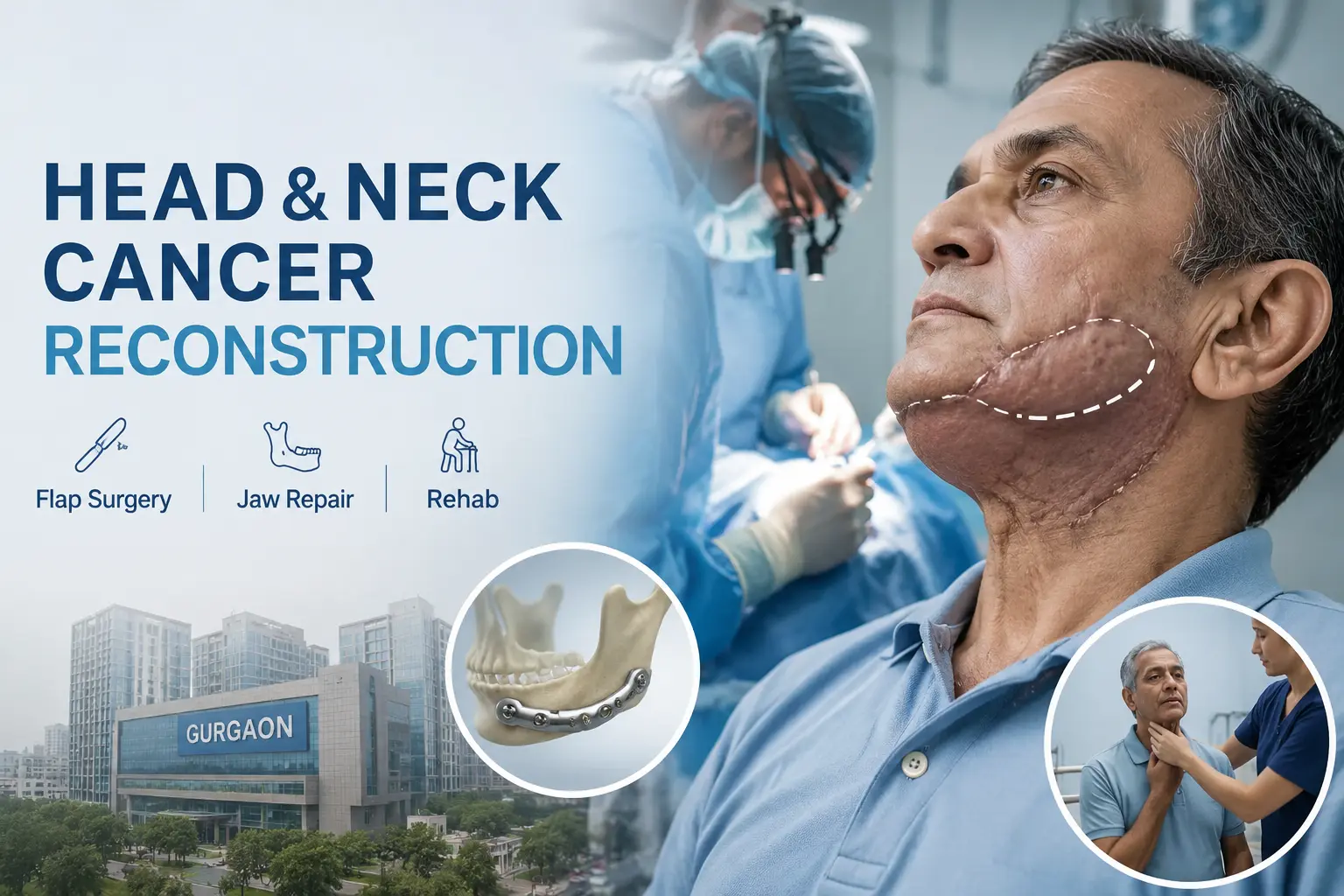
When a patient or a family member is told that head and neck cancer surgery will be required, the immediate focus is on the oncological outcome: whether the cancer can be removed completely, whether lymph nodes are involved, and what treatment will follow surgery. The reconstructive dimension of the operation, what happens after the tumour is removed, what the functional and aesthetic result will be, and what life will look like during recovery, is often not discussed in detail until the surgical planning stage. For many patients, this is the dimension that most affects their day-to-day life in the months and years after treatment.
Head and neck cancer reconstruction in Gurgaon is the plastic surgical discipline that addresses this gap. Its goal is not cosmetic in the conventional sense: it is the restoration of the form and function that oncological surgery removes. Reconstruction after oral cancer may restore the ability to speak clearly and swallow comfortably. Reconstruction after jaw resection may restore the facial contour, the bite, and the structural support for the overlying soft tissue. Reconstruction after laryngeal or pharyngeal surgery addresses the airway and swallowing function that these structures provide. Understanding what head and neck cancer reconstruction in Gurgaon can realistically achieve, and what the process involves from the first surgical planning conversation to the end of rehabilitation, is the purpose of this guide.
Book a reconstruction consultation with Dr. Pradeep Kumar Singh at Artemis Hospital, Gurugram, or call +91 82879 23924 to discuss your specific oncological situation and reconstruction options.
Why Reconstruction Planning Begins Before Oncological Surgery
The plastic surgeon’s involvement in head and neck cancer reconstruction in Gurgaon ideally begins before the oncological resection, not after it. This is because the choices available for reconstruction depend on the extent and geometry of the resection, and the reconstructive plan influences decisions about the margins and tissue preservation that the oncological surgeon makes during the resection itself. A resection planned without regard for the reconstruction is harder to reconstruct well. A resection planned jointly by the oncological surgeon and the plastic surgeon creates defects that are anatomically predictable, with the appropriate tissue preserved to support the reconstruction chosen.
At Artemis Hospital, every head and neck cancer reconstruction in Gurgaon is planned in a multidisciplinary setting, where the head and neck oncological surgeon, the plastic surgeon, and the relevant support specialists review the imaging, the staging, and the patient’s overall medical status before agreeing on the resection and reconstruction plan. The reconstructive approach, which flap will be used, whether the jaw requires reconstruction, and what the soft tissue and skin envelope requirements are, is decided before the patient enters the operating theatre.
Flap Reconstruction in Gurgaon: The Principal Surgical Approaches
The central technique in head and neck cancer reconstruction is flap surgery, where a section of tissue from another part of the body, including skin, fat, muscle, and sometimes bone, is transferred to the site of the cancer resection to reconstruct the defect. Flaps can be classified by how they are transferred:
Local and Regional Flaps
Local flaps use tissue adjacent to the defect, rearranged to close the defect without completely detaching the tissue from its original blood supply. Regional flaps use tissue from a nearby anatomical region, transported to the defect on its original vascular pedicle. The pectoralis major myocutaneous flap, which uses chest muscle and overlying skin rotated up to the head and neck on the pectoral artery, is the most commonly used regional flap for head and neck reconstruction in Gurgaon. It is reliable, relatively straightforward to harvest, and provides substantial tissue bulk for reconstructing large defects of the oral cavity and neck. Its limitation is that the available tissue bulk and the arc of rotation constrain the defects it can reach and the precision of the reconstruction.
Free Flap Microvascular Reconstruction in Gurgaon
Free flap reconstruction transfers tissue from a distant donor site, typically the forearm, thigh, or fibula, by detaching it completely from its original blood supply and reconnecting it to blood vessels in the neck using microsurgical techniques under an operating microscope. Microvascular reconstruction in Gurgaon at Artemis Hospital represents the most precise and versatile approach to head and neck cancer reconstruction: the flap can be designed in three dimensions to match exactly what the resection has removed, and the microsurgical anastomosis creates a new blood supply at the recipient site that sustains the transferred tissue permanently.
The most commonly used free flaps in head and neck cancer reconstruction are:
- Radial forearm free flap: A thin, pliable flap of forearm skin, ideal for reconstructing the oral lining of the tongue, floor of mouth, and pharynx, because its flexibility allows it to be shaped into a tube or folded to replace oral mucosal surfaces without the bulk that stiffer tissues would add.
- Anterolateral thigh (ALT) free flap: A large skin and fat flap from the outer thigh, used for larger oral cavity and pharyngeal defects, or for external skin defects of the neck and face. Its size makes it suitable for substantial tissue replacement, and the donor site can usually be closed directly without the need for a skin graft.
- Fibula free flap: A bone and skin flap harvested from the outer lower leg, used specifically for jaw reconstruction surgery when the mandible has been partially or completely resected as part of the cancer removal. The fibula provides a long segment of bone with its own blood supply that can be shaped and fixed with titanium plates to reconstruct the jaw arch, restoring facial contour, the bite, and the structural support for the overlying soft tissue.
Jaw Reconstruction Surgery in Gurgaon: What Mandibular Reconstruction Involves
Resection of the mandible, whether partial or segmental, is required in cancers of the floor of mouth, the gum, or the mandible itself, where the tumour has involved the bone or where a clear resection margin requires bone removal. Mandibular resection produces a significant functional and aesthetic deficit: without the jaw arch, the facial profile collapses, the remaining soft tissue falls inward, the bite is lost or severely altered, and speech and swallowing are significantly impaired.
Jaw reconstruction surgery using the fibula free flap restores the mandibular arch by shaping the fibula segment into the form of the resected jaw section, fixing it with titanium plates to the remaining mandible at each end, and reconnecting the fibula’s blood supply to neck vessels through microsurgical anastomosis. The overlying skin of the fibula flap simultaneously reconstructs the mucosal lining or external skin of the jaw region. The result is a functional jaw with bone structure, biting capacity where dentition is preserved or planned, and restored facial contour.
In patients who will undergo dental implant placement after jaw reconstruction surgery in Gurgaon, the fibula reconstruction creates the bony foundation into which implants can be placed, restoring mastication function and allowing the patient to eat a near-normal diet. This is a planned, staged rehabilitation process that begins at the cancer surgery stage and continues over the following twelve to twenty-four months as the reconstruction heals and the implants are placed and loaded.
Oral Cancer Reconstruction in Gurgaon: Restoring Speech and Swallowing
Oral cancer surgery may involve partial or total resection of the tongue, the floor of the mouth, the palate, or the inner cheek lining, depending on the site and extent of the tumour. The functional consequences of these resections, without reconstruction, are significant: impaired speech intelligibility, difficulty swallowing both liquids and solids, drooling from an inability to seal the oral cavity, and aspiration of food or liquid into the airway. Head and neck cancer reconstruction in Gurgaon addresses each of these by replacing the resected tissue with a flap whose volume and mobility approximate the function of what was removed.
Tongue reconstruction, in particular, is among the most technically demanding applications of head and neck reconstructive surgery. The tongue is not simply a volume of muscle: it is a mobile, multidirectional structure whose complex movement patterns are responsible for both speech articulation and the oral phase of swallowing. A radial forearm free flap, folded to create a neopharyngeal mound of appropriate volume, can restore swallowing function significantly. Speech rehabilitation following tongue reconstruction requires sustained speech and language therapy, and most patients achieve useful communication, though their articulation will differ from pre-operative speech depending on the extent of resection.
Recovery and Rehabilitation After Head and Neck Reconstruction in Gurgaon
Recovery from head and neck cancer reconstruction is measured in months, not weeks, and involves a coordinated rehabilitation effort alongside the surgical recovery:
- The immediate post-operative period (days 1 to 14): The most critical period for free flap reconstruction is the first three to five days, when the microsurgical anastomosis is most vulnerable to thrombosis. Flap monitoring, where the surgical team assesses the blood supply to the transferred tissue at regular intervals, is a non-negotiable component of post-operative care at Artemis Hospital. Most patients have a temporary tracheostomy to secure the airway during the early post-operative period, and nutrition is maintained through a nasogastric tube while the oral reconstruction heals.
- Weeks 2 to 6: The reconstruction heals, and the tracheostomy is weaned where clinically appropriate. Swallowing assessment begins, and oral feeding commences with modified textures as swallowing function returns. The speech and language therapist’s involvement begins in earnest during this phase.
- Months 2 to 6: Radiation therapy, where indicated as part of the oncological treatment plan, typically begins four to six weeks after surgery, once the surgical wounds have healed sufficiently. Radiation to the head and neck produces significant side effects, including mucositis, xerostomia (dry mouth), and fibrosis of the irradiated tissues, all of which are managed with appropriate supportive care and physiotherapy.
- Months 6 to 24: Dental rehabilitation, including implant placement into the fibula reconstruction where appropriate, begins. Continued speech and language therapy addresses ongoing communication and swallowing goals. Secondary reconstructive procedures, such as refining the soft tissue contour or addressing radiation-related changes, are planned once the primary reconstruction has fully matured and all oncological treatments are complete.
Patients seeking head and neck cancer reconstruction in Gurgaon travel to Artemis Hospital from across Delhi NCR and from other cities in North India, because the multidisciplinary infrastructure required for these cases, including head and neck oncology, plastic and reconstructive surgery, maxillofacial surgery, speech and language therapy, and dental rehabilitation, is coordinated from a single centre.
Head and Neck Reconstruction Surgeon in Gurgaon: Dr. Pradeep Kumar Singh at Artemis Hospital
Dr. Pradeep Kumar Singh performs head and neck cancer reconstruction in Gurgaon at Artemis Hospital, a JCI and NABH-accredited facility in Sector 51, Gurugram. Microvascular head and neck reconstruction requires specific training in microsurgical technique, free flap harvest from multiple donor sites, and the collaborative surgical planning that oncological resection and simultaneous reconstruction demand. His MCh in Plastic Surgery from SMS Medical College, Jaipur, and Fellowship in Advanced Aesthetic Surgery from St Louis Hospital, Paris, provide the reconstructive plastic surgical foundation that these complex, multistage procedures require. As Head of the Department of Plastic Surgery at Artemis Hospital and a member of the Association of Plastic Surgeons of India, Dr. Pradeep Kumar Singh, MCh Plastic Surgery, Fellowship Paris, APSI Member, participates in the multidisciplinary planning of every head and neck cancer reconstruction case at Artemis Hospital, from the initial surgical planning meeting through to the completion of the rehabilitation programme.
Frequently Asked Questions
What is head and neck cancer reconstruction?
Head and neck cancer reconstruction is the plastic surgical discipline that restores the form and function removed by oncological surgery for cancers of the oral cavity, pharynx, larynx, jaw, and surrounding structures. It uses tissue transferred from elsewhere in the body, either on a vascular pedicle or as a free flap with microsurgical reconnection of the blood supply, to reconstruct the defect created by tumour removal. The goal is to restore speaking, swallowing, and facial appearance as completely as the oncological treatment allows.
What types of flap surgery are used for head and neck reconstruction?
The principal flaps used in head and neck cancer reconstruction in Gurgaon are the pectoralis major myocutaneous flap for larger regional defects, the radial forearm free flap for thin, pliable oral lining reconstruction, the anterolateral thigh free flap for larger soft tissue defects, and the fibula free flap for jaw reconstruction surgery when the mandible requires replacement. The choice of flap depends on the site and extent of the resection, the tissue requirements of the defect, and the patient’s anatomy and medical status.
How long is the recovery after head and neck reconstruction?
Recovery from head and neck cancer reconstruction in Gurgaon is measured in months. The immediate post-operative period involves flap monitoring for the first three to five days, airway management, and tube feeding while the oral reconstruction heals, typically two to four weeks. Radiation therapy, when prescribed, begins four to six weeks post-surgery. Full functional rehabilitation, including dental restoration where applicable, extends over twelve to twenty-four months following surgery, depending on the extent of the reconstruction and the oncological treatment required.
Is head and neck reconstruction available in Gurgaon?
Yes. Head and neck cancer reconstruction in Gurgaon is performed at Artemis Hospital by Dr. Pradeep Kumar Singh within a multidisciplinary team that includes head and neck oncology, plastic surgery, maxillofacial surgery, and speech and language therapy. The full infrastructure required for microvascular free flap reconstruction, including operating microscope capability, intensive care monitoring, and specialist nursing for flap observation, is available at Artemis Hospital.
What are the risks of head and neck reconstruction surgery?
The primary surgical risks in head and neck cancer reconstruction in Gurgaon are specific to the flap technique used. For free flap reconstruction, the most significant risk is partial or total flap loss from thrombosis of the microsurgical anastomosis, occurring in approximately 5 per cent of free flap procedures in experienced centres. Donor site complications, including wound healing problems at the fibula, forearm, or thigh harvest site, occur in a minority of patients. All patients receive careful post-operative monitoring to identify and manage complications at the earliest possible stage.
Reconstruction Is Not an Afterthought: It Is Part of the Treatment
The most important shift in understanding that head and neck cancer reconstruction in Gurgaon provides is that reconstruction is not what happens after the cancer treatment is finished. It is an integral component of the surgical treatment itself, planned jointly with the oncological team, executed in the same operative session, and continued through a coordinated rehabilitation programme that runs in parallel with any adjuvant treatment. The patients who achieve the best functional and quality-of-life outcomes after head and neck cancer surgery are those whose reconstruction was planned from the outset with the same care as the resection itself.
Book now or call +91 82879 23924 to schedule your head and neck cancer reconstruction consultation in Gurgaon with Dr. Pradeep Kumar Singh at Artemis Hospital.
Or visit Artemis Hospital, Sector 51, Gurugram, Haryana 122001.
Read patient reviews at Dr. Pradeep Kumar Singh on Google.
Dr. Pradeep Kumar Singh: MCh Plastic Surgery, Fellowship Paris, APSI Member: Head of Plastic Surgery, Artemis Hospital, Sector 51, Gurugram.