There is a specific patient who has become increasingly common at breast augmentation consultations in Gurgaon in 2026. She has lost a significant amount of weight, either through sustained dietary effort, bariatric surgery, or a GLP-1 receptor agonist medication such as semaglutide or tirzepatide. Her body is leaner and more proportionate than it has been in years. She is healthier and fitter. But the breast volume she once had has not returned with her improved fitness. In many cases, it has declined further than it was before the weight loss, because the breast tissue responded more completely to the fat reduction than she anticipated. She is now asking a specific question: what is the right type of breast augmentation surgery for a body that has just been through significant change?
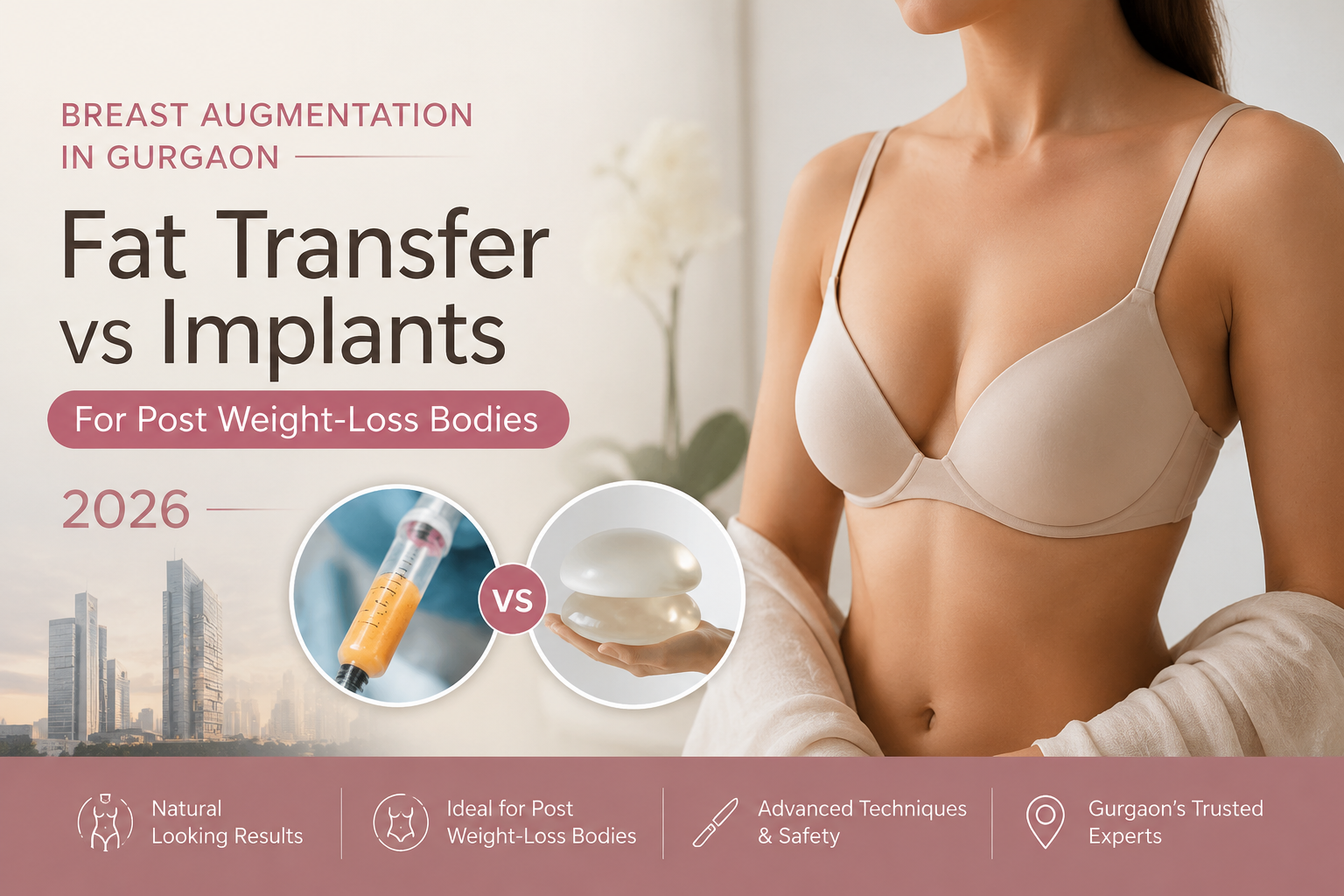
The answer depends on two variables that are specific to this patient population: how much harvestable donor fat she has available, and how much volume restoration she actually needs. For some post-weight-loss patients, breast augmentation surgery in Gurgaon using fat transfer is the right approach. For others, cohesive silicone implants are more appropriate. For some, a combination of both produces the most complete result. This guide explains how the decision is made, what each approach delivers for this specific body type, and what the 2026 evidence shows about outcomes in post-weight-loss breast augmentation.
Call +91 82879 23924 or arrange a consultation at Artemis Hospital, Gurugram, to have your specific presentation assessed by Dr. Pradeep Kumar Singh.
Is Fat Transfer Breast Augmentation Better for Post Weight-Loss Patients?
Fat transfer breast augmentation, which uses liposuctioned fat from the patient’s own body to add volume to the breast, is an appealing option for post-weight-loss patients because it avoids a foreign implant and uses the patient’s own tissue. It is the right choice for post-weight-loss patients who need a modest volume increase (half to one cup size), who have sufficient residual donor fat despite their weight loss, and whose breast skin quality and elasticity are good enough to accommodate the added volume without visible surface irregularity.
The clinical challenge for post-weight-loss and GLP-1 patients specifically is donor fat availability. GLP-1 medications produce fat reduction across the body, including in the areas traditionally used as fat harvest sites: the abdomen, flanks, and inner thighs. In patients who have lost 15 to 20 per cent of their body weight through GLP-1 medications, the donor fat volume may be insufficient to transfer the 300 to 400 millilitres per breast required for meaningful augmentation, even before accounting for the 30 to 50 per cent resorption rate that reduces the final retained volume. At Artemis Hospital, a physical assessment of the donor sites is performed at the consultation before fat transfer is recommended, because the practical limit of the approach must be established before it is proposed as the solution.
For patients who have maintained adequate donor fat despite their weight loss, fat transfer breast augmentation in Gurgaon in 2026 offers a genuine advantage: it simultaneously improves the body contour at the donor site while restoring breast volume, addresses two concerns in a single session, and uses the patient’s own biology without any implant-related monitoring commitment. The survival rate of transferred fat in experienced hands is 60 to 70 per cent, with the retained fat integrating permanently and responding naturally to any future weight changes.
Which Breast Implant Is Best for Athletic and Slim Body Types in Gurgaon?
Athletic and slim-bodied patients present a specific implant selection challenge because they typically have limited native breast tissue coverage over the implant. In a patient with significant native breast tissue, the implant is well-covered and minor variations in implant selection produce minimal visible difference. In a slim patient with 1 to 2 centimetres of pinch thickness over the upper pole, the implant’s surface characteristics, its fill, its profile, and its base width relative to the chest wall are all visible in the final result in ways they would not be in a fuller-breasted patient.
For slim and athletic patients seeking breast augmentation surgery in Gurgaon in 2026, the following implant selection principles apply:
- Submuscular or dual-plane placement: Placing the implant beneath the pectoral muscle rather than directly behind the breast gland (subglandular) adds a layer of tissue coverage over the upper pole, reducing the risk of visible rippling and producing a more gradual, natural transition at the upper breast margin. This is the standard recommendation for patients with limited native tissue coverage.
- Conservative volume within the anatomical base width: The implant base width should not exceed the measured breast base width. For a slim patient with a narrower chest, this constrains the achievable volume. A high-profile implant delivers more forward projection within a smaller base diameter, allowing meaningful augmentation without exceeding the natural breast footprint on the chest wall.
- Smooth cohesive silicone: Smooth, round cohesive silicone implants remain the most appropriate choice for slim patients because they carry the lowest rippling risk (the cohesive gel maintains its shape under thin tissue coverage), require no rotation monitoring, and have no association with BIA-ALCL. CDSCO-approved, FDA-certified smooth cohesive silicone implants are used exclusively at Artemis Hospital for breast augmentation surgery in Gurgaon.
Can Breast Augmentation Fix Volume Loss After Weight Loss?
Yes. Breast augmentation surgery in Gurgaon, whether through fat transfer or implants, directly addresses the volume loss that post-weight-loss and GLP-1 patients experience. The critical clinical distinction is between volume loss alone and volume loss combined with breast ptosis. When significant weight loss has produced both a reduction in breast volume and a descent in breast position (ptosis), augmentation alone, whether fat transfer or implants, does not correct the position. Adding volume to a ptotic breast produces a larger, lower breast, not a fuller, higher one.
For post-weight-loss patients with both volume loss and ptosis, the appropriate combined procedure is a mastopexy-augmentation: the lift corrects the position, and the augmentation restores the volume. This combination is more surgically complex than either procedure alone and requires conservative implant sizing to allow the lift incisions to heal without excessive tension. At Artemis Hospital, every breast augmentation consultation for post-weight-loss patients includes an assessment of ptosis grade, because this single finding determines whether augmentation alone is appropriate or whether a combined approach is needed.
How Long Does Fat Transfer Breast Augmentation Last?
The fat that successfully integrates after transfer is permanent. It behaves like fat anywhere else in the body: it responds to overall body weight changes, growing or shrinking with significant weight fluctuations. For post-weight-loss patients who have reached and maintained their goal weight, the fat transfer result is stable because the body weight is stable. The risk for this specific patient group is that any subsequent weight gain restores fat to the transferred sites as well as to the body generally, potentially producing a larger breast volume than intended. Conversely, any further weight loss through GLP-1 dose adjustment or continued dietary restriction reduces the transferred volume.
This dynamic relationship between transferred fat and body weight is a counselling point that matters specifically for patients whose weight is still in transition. At Artemis Hospital, fat transfer breast augmentation in Gurgaon for post-weight-loss patients is planned only after at least six months of weight stability, ensuring that the result is based on a body that has completed its transformation rather than one that is still changing. Patients from Vasant Kunj and Vasant Vihar who consult for breast augmentation surgery in Gurgaon receive this timing assessment as part of the initial clinical evaluation.
What Is the Cost of Breast Augmentation in Gurgaon in 2026?
Breast augmentation cost in Gurgaon at Artemis Hospital in 2026 depends on the approach: fat transfer augmentation has a different cost structure from implant-based augmentation, reflecting the liposuction component of the fat harvest alongside the breast injection. Implant augmentation cost depends on the implant volume, profile, and brand, the placement approach (submuscular versus dual-plane), the anaesthesia duration, and the facility fees. Combined mastopexy-augmentation has a higher cost than either procedure performed alone. A personalised estimate for breast augmentation surgery in Gurgaon is provided at the consultation after the appropriate approach has been determined. Contact Artemis Hospital to arrange a consultation with Dr. Pradeep Kumar Singh.
Frequently Asked Questions
Is fat transfer breast augmentation better for post-weight-loss patients in Gurgaon?
Fat transfer is the right choice for post-weight-loss patients who need modest volume restoration (half to one cup size), have sufficient residual donor fat at harvest sites, and have good breast skin quality. For patients with insufficient donor fat after significant GLP-1 or other weight loss, or who need more than one cup size of restoration, cohesive silicone implants are the more reliable approach. The decision is made at the consultation after physical assessment of donor site availability and breast base width.
Which breast implant is best for slim or athletic women in Gurgaon?
For slim and athletic patients, submuscular or dual-plane placement of a smooth, round, high-profile cohesive silicone implant sized conservatively within the measured breast base width consistently produces the most natural result. The submuscular position adds pectoral muscle coverage over the upper pole, reducing rippling risk through the thin native tissue. CDSCO-approved, FDA-certified smooth cohesive silicone implants used at Artemis Hospital have the lowest rippling risk and no BIA-ALCL association.
How long does fat transfer breast augmentation last in Gurgaon?
The integrated fat from a successful transfer is permanent. It responds to body weight changes, which is why weight stability for at least six months before surgery is required at Artemis Hospital. For patients who have reached and maintained their goal weight after GLP-1 or other weight loss, the fat transfer result is durable. The 60 to 70 per cent survival rate means the injected volume overcorrects at the time of surgery to account for the expected resorption over the following three to six months.
Can breast augmentation fix volume loss after weight loss or GLP-1 medication?
Yes, directly. Breast augmentation surgery in Gurgaon addresses volume loss through either fat transfer or implants. If the weight loss has also produced breast ptosis alongside volume reduction, a combined mastopexy-augmentation is needed to correct both the position and the volume simultaneously. Augmentation alone in the presence of significant ptosis makes the breast larger and lower, not fuller and higher. The consultation assessment determines whether volume restoration alone or a combined approach is appropriate.
What is the cost of breast augmentation surgery in Gurgaon in 2026?
Breast augmentation cost in Gurgaon depends on the approach (fat transfer versus implants), the implant specifications if applicable, the placement technique, and the facility fees. A personalised estimate is provided at the consultation at Artemis Hospital after the appropriate approach is determined. Call +91 82879 23924.
Is breast augmentation with implants safe in 2026 for Indian patients?
Yes. CDSCO-approved, FDA-certified smooth cohesive silicone implants used at Artemis Hospital for breast augmentation surgery in Gurgaon have an established long-term safety record. The FDA ten-year post-approval data show approximately 92 per cent implant integrity at ten years, with known complication rates for capsular contracture and rupture that are identifiable and manageable with the monitoring programme prescribed at Artemis Hospital. Smooth implants carry no documented association with BIA-ALCL, the rare immune-cell cancer linked to macro-textured implant surfaces, which have been withdrawn from most global markets.
The right approach to breast augmentation surgery in Gurgaon for a post-weight-loss or post-GLP-1 body is determined by the residual donor fat, the degree of volume deficit, and whether ptosis is present alongside the volume change. All three are assessed at a single consultation. Call +91 82879 23924 or visit Artemis Hospital, Sector 51, Gurugram, Haryana 122001.
Reviews: Dr. Pradeep Kumar Singh on Google.
Dr. Pradeep Kumar Singh: MCh Plastic Surgery, Fellowship Paris, APSI Member: Head of Plastic Surgery, Artemis Hospital, Sector 51, Gurugram.