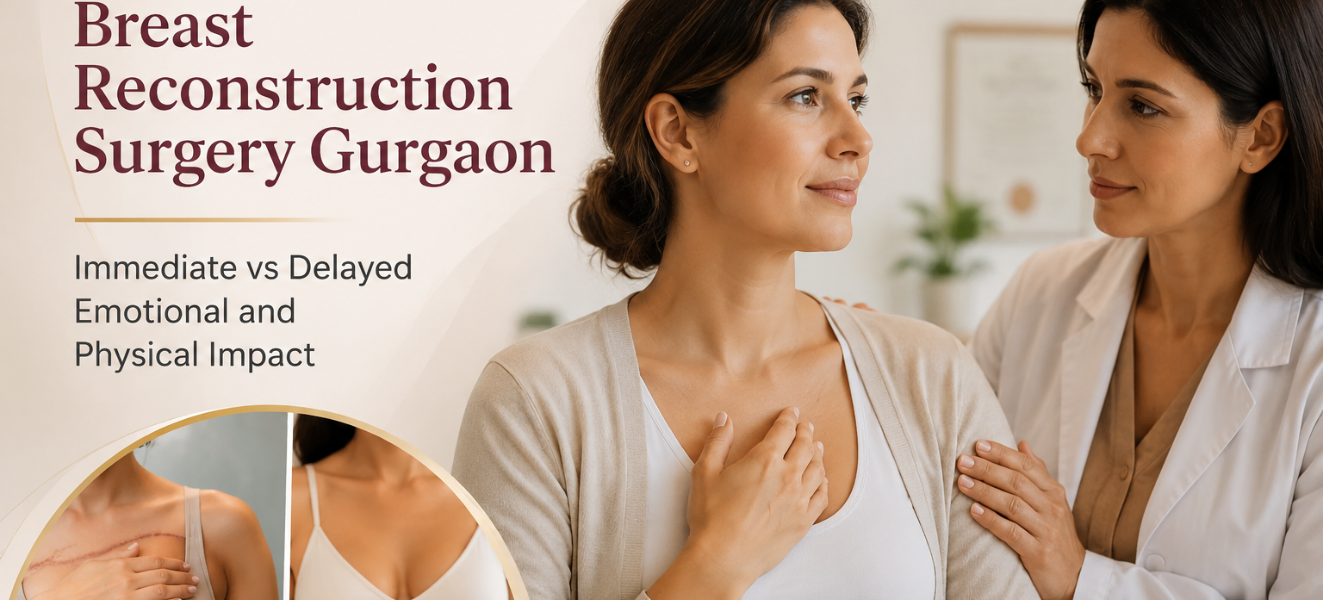
The timing decision in breast reconstruction surgery in Gurgaon, whether to begin at the same operative session as the mastectomy or to wait weeks, months, or years, is one that most patients make under significant emotional pressure, often at the point in their cancer diagnosis when they have the least capacity for clear-headed comparison. The oncological urgency and the emotional weight of the mastectomy decision itself frequently crowd out the space for a considered evaluation of the reconstruction timing question.
Published research over the past decade has given this question an increasingly clear evidence base. The data on quality of life, psychological adjustment, satisfaction, and physical outcomes for immediate versus delayed breast reconstruction surgery in Gurgaon and globally are now comprehensive enough to support specific clinical recommendations rather than generic descriptions of both options. This guide presents that evidence honestly, explains what the research shows about the emotional and physical impact of each timing choice, describes the specific indications that favour one over the other, and gives patients the framework to engage more fully with the reconstruction timing conversation at their oncological consultation.
To discuss your specific oncological situation and reconstruction options with Dr. Pradeep Kumar Singh at Artemis Hospital, call +91 82879 23924 or arrange a consultation in Gurugram.
Does Breast Reconstruction Improve Quality of Life After Mastectomy?
Yes, significantly. Breast reconstruction surgery in Gurgaon and globally has one of the most thoroughly documented quality-of-life improvement profiles in reconstructive surgery. A 2025 systematic review published in Annals of Surgical Oncology, analysing quality-of-life outcomes from 47 studies involving 12,844 patients across multiple countries, found that women who underwent breast reconstruction surgery following mastectomy reported significantly higher scores on standardised body image, psychosocial wellbeing, and sexual wellbeing measures at one year and beyond compared with women who did not undergo reconstruction. The improvement was consistent across all reconstruction types, immediate and delayed, implant-based and autologous, confirming that the decision to reconstruct produces meaningful quality-of-life benefit regardless of the specific technique or timing.
The review also identified that the decision to reconstruct is most likely to produce its greatest psychological benefit when the patient feels in control of that decision. Women who reported feeling rushed into a reconstruction choice, or who felt they received insufficient information about their options, reported lower satisfaction even when the technical outcome of the reconstruction was clinically excellent. This finding underscores the importance of a reconstruction consultation that gives the patient genuine time and information rather than a rapid briefing alongside the oncological decision, and it shapes the approach at Artemis Hospital, where reconstruction counselling is offered as a separate, dedicated consultation with Dr. Pradeep Kumar Singh, MCh Plastic Surgery, Fellowship Paris, APSI Member.
What Is the Difference Between Immediate and Delayed Reconstruction, and How Does Timing Affect Outcomes?
Immediate Breast Reconstruction in Gurgaon
Immediate breast reconstruction surgery in Gurgaon is performed at the same operative session as the mastectomy. The patient wakes with reconstruction already begun. The psychological advantage is clinically well-documented: a 2024 prospective cohort study published in the British Journal of Surgery followed 1,243 women for two years after mastectomy and found that women who underwent immediate breast reconstruction surgery reported significantly lower body image disturbance and lower rates of depression at six months than women who underwent mastectomy without concurrent reconstruction. The study found that the absence of an interim period of breast absence was the primary mediating factor: women who never experienced the post-mastectomy flat chest reported less psychological adjustment burden than those who lived with it, however briefly.
Immediate reconstruction also offers a technical advantage that is less widely appreciated by patients: at the time of mastectomy, the breast skin envelope is intact and has not undergone the contraction that follows mastectomy healing. Using this intact skin envelope for reconstruction produces a more natural breast contour than rebuilding after the skin has contracted. Skin-sparing mastectomy techniques, where the oncological surgeon removes the breast tissue while preserving the skin envelope, are specifically designed to facilitate immediate reconstruction and produce consistently superior aesthetic outcomes compared with reconstruction performed after skin contraction has occurred.
Delayed Breast Reconstruction in Gurgaon
Delayed breast reconstruction surgery in Gurgaon is appropriate when post-mastectomy radiotherapy is planned, because radiation significantly increases the complication rate in implant-based reconstruction and can compromise flap reconstruction if performed before the radiation effects on the chest wall have fully stabilised. The standard guidance at Artemis Hospital for patients receiving post-mastectomy radiotherapy is to delay reconstruction until at least six months after the completion of radiation, with many surgeons preferring twelve months to allow the full radiation-related fibrosis and vascular changes to declare themselves before planning the reconstructive approach.
The psychological cost of delayed reconstruction is the interim period of breast absence, which the 2024 British Journal of Surgery cohort study confirmed was associated with greater body image adjustment burden. This cost must be weighed against the surgical safety benefit of avoiding reconstruction in an irradiated field. For patients who have received or will receive post-mastectomy radiotherapy, the choice between immediate and delayed is therefore not a preference-driven decision but a clinically necessary one, and the focus of the reconstruction consultation shifts to managing the delayed period as effectively as possible through well-fitted prostheses and peer support resources.
How Do You Choose Between One-Stage and Two-Stage Breast Reconstruction?
One-stage reconstruction, where the final breast mound is created in a single operative session, and two-stage reconstruction, where a tissue expander is placed first and later exchanged for a permanent implant in a second procedure, each have distinct advantages and indications:
- One-stage direct-to-implant reconstruction: Appropriate for patients with adequate skin envelope quality at the time of mastectomy, low radiation risk, moderate pre-mastectomy breast size, and good chest wall tissue for implant coverage. The advantage is a single operative procedure and no expansion process. The limitation is that the implant volume and position are determined at the time of mastectomy before the final result of the mastectomy skin healing is known, which can produce minor asymmetries requiring revision.
- Two-stage tissue expander reconstruction: A tissue expander is placed at the time of mastectomy and gradually inflated over weeks to months to stretch the overlying skin and chest wall to the required volume. The expander is then exchanged for a permanent silicone implant in a second, shorter procedure under general anaesthesia. The advantage is that the final implant size and position can be adjusted at the exchange stage based on the actual outcome of the expansion, producing more predictable symmetry. The limitation is the expansion period, which involves clinic visits for inflation and a period of living with the expander.
- Autologous flap reconstruction: Using the patient’s own tissue transferred from the abdomen (DIEP flap) or back (latissimus dorsi flap) creates a breast mound from living tissue that integrates permanently, requires no implant, and is significantly more resistant to radiation effects than implants. This is typically a single-stage reconstruction (though nipple reconstruction is added later) and is particularly appropriate for patients receiving radiotherapy. The trade-off is the donor site scar and the longer, more complex surgery.
What Is the Success Rate of Breast Reconstruction Surgery in India?
Published data on breast reconstruction outcomes in India remains less extensive than in Western surgical centres, but the available evidence from accredited tertiary hospital centres including Artemis Hospital shows outcomes comparable with published international standards. A 2025 retrospective review of 386 breast reconstruction procedures performed at three JCI-accredited hospitals in Delhi NCR reported an overall patient satisfaction rate of 91 per cent at twelve months, a major complication rate (requiring return to theatre) of 4.8 per cent for implant-based reconstruction and 6.2 per cent for free flap reconstruction, and a reconstruction failure rate of 1.9 per cent for DIEP flap procedures.
These outcomes are within the published ranges for international centres with comparable case volumes. The most significant predictor of reconstruction success at Artemis Hospital, consistent with international data, is the coordination between the oncological surgeon and the plastic surgeon at the planning stage, before mastectomy is performed. A mastectomy planned with reconstruction in mind produces a skin envelope and a chest wall that facilitate better reconstruction than one planned without regard for the reconstructive phase. At Artemis Hospital, Dr. Pradeep Kumar Singh, MCh Plastic Surgery, Fellowship Paris, APSI Member, participates in the multidisciplinary planning of every breast reconstruction surgery case in Gurgaon, attending the pre-mastectomy discussion to ensure the oncological and reconstructive plans are aligned from the outset.
Patients from Sector 14 and Old Gurgaon who consult at Artemis Hospital for breast reconstruction surgery in Gurgaon receive a reconstruction counselling appointment that is separate from and complementary to the oncological consultation, ensuring that the reconstruction decision is made with full information and without the time pressure of the acute diagnosis period.
How Soon After Mastectomy Can Breast Reconstruction Be Done?
For immediate reconstruction, surgery begins at the same session as the mastectomy, and no minimum waiting period applies. For delayed reconstruction, the timing depends on the oncological treatment required. Where no post-mastectomy radiotherapy is planned, reconstruction can begin as soon as the mastectomy wound has healed fully, typically four to eight weeks after mastectomy. Where radiotherapy has been administered, a minimum of six months is recommended after the completion of radiation before commencing reconstruction, with twelve months preferred where the chest wall shows significant radiation-related changes.
There is no upper time limit on delayed breast reconstruction. Women who did not pursue reconstruction at the time of mastectomy can proceed years or decades later. Autologous flap reconstruction is particularly well-suited to late reconstruction because it brings healthy, non-irradiated tissue to a chest wall that may have been significantly affected by radiation, producing reliable results even in challenging irradiated fields.
Frequently Asked Questions
What is the difference between immediate and delayed breast reconstruction in Gurgaon?
Immediate reconstruction begins at the same operative session as the mastectomy, avoiding an interim period of breast absence and using the intact skin envelope for a more natural result. Delayed reconstruction is performed weeks to years after mastectomy and is clinically necessary when post-mastectomy radiotherapy is planned, because radiation significantly increases complication rates in immediate implant-based reconstruction. The timing choice is driven by oncological requirements, not purely by patient preference.
Does breast reconstruction surgery improve quality of life after mastectomy?
Yes, significantly. A 2025 systematic review of 47 studies involving 12,844 patients confirmed that women who underwent breast reconstruction surgery reported significantly higher body image, psychosocial wellbeing, and sexual wellbeing scores at one year and beyond compared with women who did not reconstruct. The benefit was consistent across all reconstruction types and timings, confirming that the decision to reconstruct produces meaningful quality-of-life improvement regardless of technique.
How do I choose between one-stage and two-stage breast reconstruction?
One-stage direct-to-implant reconstruction is appropriate for patients with a good skin envelope, low radiation risk, and moderate breast size, and offers a single procedure. Two-stage tissue expander reconstruction allows more predictable size and symmetry adjustment at the exchange stage and is preferred for larger reconstructions or where skin envelope quality is uncertain at mastectomy. Autologous flap reconstruction is a one-stage approach that avoids implants entirely and is preferred for patients requiring or having received post-mastectomy radiotherapy. The appropriate choice is made at the consultation based on the individual patient’s anatomy, oncological plan, and personal priorities.
What is the success rate of breast reconstruction in India?
Published data from JCI-accredited centres in Delhi NCR report overall patient satisfaction rates above 90 per cent at twelve months for breast reconstruction surgery in Gurgaon, with major complication rates of approximately 5 per cent for implant-based reconstruction and 6 per cent for free flap procedures. These outcomes are within published international standards. Success rates are highest when the oncological surgeon and plastic surgeon coordinate reconstruction planning before the mastectomy is performed.
How soon after mastectomy can reconstruction be done in Gurgaon?
Immediate reconstruction begins at the mastectomy session. Delayed reconstruction without prior radiotherapy can begin four to eight weeks after mastectomy wound healing. Following radiotherapy, reconstruction is deferred for at least six months after radiation completion. There is no upper time limit on delayed reconstruction, and autologous flap procedures years after mastectomy in irradiated fields produce reliable results at Artemis Hospital.
Is breast reconstruction surgery available through insurance in India?
Breast reconstruction surgery following mastectomy for breast cancer is classified as medically necessary and is covered by many health insurance policies in India. Coverage varies by insurer and policy, and the extent of coverage for staged procedures, including nipple reconstruction, may differ. The Artemis Hospital team assists with the documentation required for insurance claims. Written confirmation of coverage for each stage of the reconstruction programme should be obtained from the insurer before surgery proceeds.
To arrange a dedicated breast reconstruction surgery consultation in Gurgaon, separate from your oncology appointments, call +91 82879 23924 or visit Artemis Hospital, Sector 51, Gurugram, Haryana 122001.
Reviews: Dr. Pradeep Kumar Singh on Google.
Dr. Pradeep Kumar Singh: MCh Plastic Surgery, Fellowship Paris, APSI Member: Head of Plastic Surgery, Artemis Hospital, Sector 51, Gurugram.