Asha had been managing the pain for eleven years. She saw an orthopaedic surgeon at 28 who attributed it to posture. A physiotherapist at 31 who found chronic trigger points in the trapezius and levator scapulae and gave her exercises that helped for a week. A spine specialist at 34 who found nothing structural and recommended weight management. She ran. She swam. She lost weight. The pain did not follow the weight. It remained exactly where it had always been: a constant ache across the upper back and the base of the neck that was worse at the end of the working day, worse after exercise, and present most consistently in the hours after removing her bra.
At 37, a physiotherapist who had treated her for three years asked a direct question: had anyone ever suggested that the weight of her breasts might be the mechanism driving the chronic muscle tension? No one had. She was referred to Artemis Hospital.
At the consultation with Dr. Pradeep Kumar Singh, MCh Burns and Plastic Surgery, Head of Department of Plastic Surgery at Artemis Hospital, the clinical examination identified classic indicators of symptomatic macromastia. The shoulder grooving from the bra straps was documented. The breast weight was measured. The submammary intertrigo present in the fold beneath the breast was noted. A breast reduction surgery plan was drawn up. Five months later, Asha stopped taking ibuprofen for the first time in over a decade.
This is a composite patient story drawn from common presentations at Artemis Hospital. The delay, in Asha’s case, eleven years, reflects a consistent pattern. The musculoskeletal consequences of macromastia are real, medically significant, and entirely attributable to a correctable mechanical cause. The problem is that they are rarely recognised as such by the practitioners who first encounter them.
The Clinical Evidence: How Breast Weight Causes Musculoskeletal Symptoms
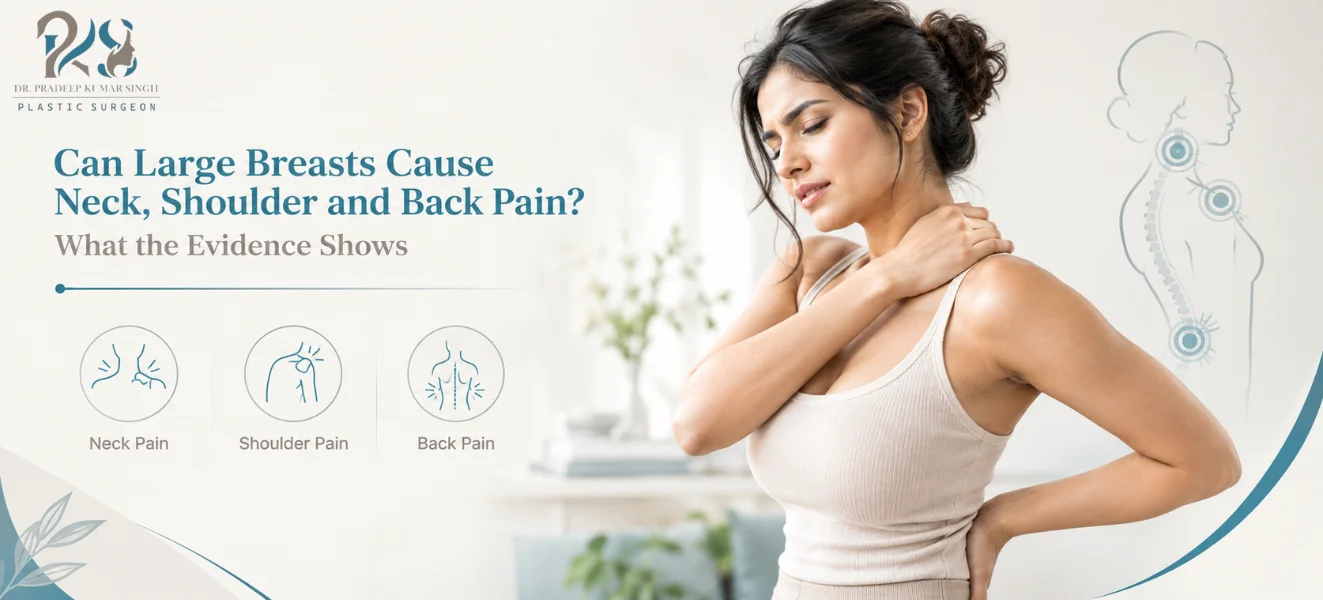
The breast is an unsupported anterior weight borne largely by the bra, which transmits load through its straps to the trapezius and levator scapulae muscles at the shoulder. In patients with macromastia, this transmitted load is sustained throughout the waking day. The muscles bearing it are not designed for continuous low-grade load-bearing; they are designed for dynamic activity. Sustained low-level contraction produces fatigue, trigger point formation, and the progressive referral of pain into the neck and upper back.
A 2020 systematic review in the Annals of Plastic Surgery analysing fourteen studies on breast reduction and musculoskeletal outcomes in 1,847 patients found significant improvement in neck pain in 85 per cent of patients, shoulder pain in 89 per cent, and upper back pain in 91 per cent after breast reduction surgery. The improvements were sustained at long-term follow-up in all studies that included it. These are not marginal improvements in secondary outcomes. They are the primary reported clinical benefit of the procedure for the majority of patients who undergo it.
The published guide on breast reduction surgery for back pain relief provides a detailed breakdown of the physiological mechanism linking breast weight to musculoskeletal symptoms, with reference to the specific anatomical pathways involved.
The Clinical Indicators of Symptomatic Macromastia
Deep, permanent shoulder grooving: Visible indentation of the shoulder skin from bra strap pressure that is present even after the bra is removed and persists into the evening. This is the most objective physical indicator of sustained load-bearing. The depth and permanence of the groove reflects the duration and intensity of the mechanical load.
Chronic neck and upper back pain attributable to breast weight: Present for six or more months, not fully explained by spinal pathology, and confirmed on clinical examination as muscle tension and trigger points in the trapezius and levator scapulae that are relieved when the breast weight is manually lifted. The manual breast lift test, in which the examiner supports the breast weight from below while the patient assesses the change in shoulder and neck tension, is the single most effective clinical tool for establishing the causal relationship between breast weight and musculoskeletal symptoms.
Important Read: Breast Reduction Surgery Gurgaon: How It Relieves Pain and Transforms Posture
Submammary intertrigo: Chronic skin irritation, rash, or recurrent fungal infection in the fold beneath the breast, produced by sustained skin-to-skin contact and recurrent despite topical treatment. A persistent submammary rash in a macromastia patient that has been treated repeatedly with antifungal agents without lasting resolution is a clinical indicator of symptomatic macromastia as a medical condition requiring surgical management.
Exercise limitation: Inability to participate in physical activity due to breast-related pain, discomfort, or the mechanical difficulty of managing large breast movement during exercise. Patients who cannot run, use cardiovascular equipment, or participate in group fitness because of breast-related difficulty are experiencing a functional impairment with health consequences beyond the musculoskeletal domain.
Why This Is a Medical Indication, Not a Cosmetic Preference
The medical indication for breast reduction surgery in Gurgaon is not semantic. In the context of breast reduction surgery in Gurgaon. It has direct implications for insurance coverage, for the documentation required, and for how the procedure is classified in the patient’s medical record.
Under IRDAI regulations, breast reduction surgery that is documented as medically necessary for symptomatic macromastia cannot be excluded as a cosmetic procedure by IRDAI-regulated health insurance policies. The documentation typically required includes the symptom burden assessment, minimum resection weight thresholds (commonly 400 to 500 grams per side, which varies by policy), physiotherapy records, and the clinical examination findings. At Artemis Hospital, the pre-operative documentation for patients seeking insurance coverage is prepared with the insurer’s classification requirements in mind.
The functional impact of macromastia is also relevant to the question of whether the procedure should be deferred. A patient who cannot exercise due to breast-related discomfort is not simply uncomfortable. She is excluded from the cardiovascular and musculoskeletal health benefits of physical activity for a mechanical reason that is entirely surgically reversible. Framing breast reduction as a medical intervention rather than an aesthetic preference changes both how the patient thinks about the decision and how the healthcare system responds to it.
What Breast Reduction Surgery in Gurgaon Involves for Symptomatic Macromastia Patients
Breast reduction surgery for symptomatic macromastia removes the glandular and fatty tissue responsible for the excess weight, repositions the nipple-areola complex to the correct anatomical height, and removes the excess skin that covered the larger breast. The mean resected weight in Indian macromastia studies is approximately 400 to 500 grams per side, representing the load that was previously borne by the shoulder girdle every waking hour.
At Artemis Hospital, the inferior pedicle technique is the standard approach, preserving the blood supply and ductal connections to the nipple and maintaining nipple sensation and lactation potential in the majority of patients. The comparison between liposuction-only and open reduction techniques, and the specific clinical situations where each is appropriate, is addressed in the published guide on liposuction vs open technique breast reduction in Gurgaon. The specific comparison between breast reduction and breast lift, for patients uncertain which procedure addresses their concern, is in the guide on breast reduction vs breast lift in Gurgaon.
Timing recommendations for symptomatic macromastia patients follow the same principles as for all abdominoplasty and breast procedures: stable body weight for six months before surgery, pregnancy plans complete, and any medically supervised weight loss programme at its endpoint. For younger patients considering the procedure, the specific considerations for breast reduction surgery in teenagers and young women in Gurgaon are addressed in the dedicated guide.
Important Read: Breast Reduction Surgery Gurgaon: 7 Things to Consider Before You Proceed
FAQs: Large Breasts, Back Pain, and Breast Reduction Surgery in Gurgaon
Can large breasts really cause neck and back pain?
Yes. Breast reduction surgery in Gurgaon exists precisely because the sustained mechanical load transmitted from large breasts through the bra straps to the trapezius and levator scapulae produces chronic muscle fatigue, trigger point formation, and the referral of pain into the neck and upper back. A 2020 systematic review found that 85 to 91 per cent of women report significant improvement in neck, shoulder, and upper back pain after breast reduction surgery. The causal mechanism is confirmed clinically by the manual breast lift test, in which supporting the breast weight from below produces an immediate reduction in shoulder and neck tension.
How do I know if my back pain is caused by large breasts in Gurgaon?
The clinical indicators are: deep, permanent shoulder grooving from bra straps visible even after the bra is removed; chronic neck and upper back pain present for six or more months without a spinal structural cause; submammary skin irritation recurring despite topical treatment; and exercise limitation from breast-related discomfort. The manual breast lift test at the consultation, in which the examiner supports the breast weight and the patient reports the change in shoulder and neck tension, provides direct clinical confirmation of the mechanical relationship.
Is breast reduction surgery for back pain covered by insurance in Gurgaon?
Under IRDAI regulations, breast reduction surgery documented as medically necessary for symptomatic macromastia cannot be excluded as cosmetic by regulated health insurance policies. The documentation required typically includes symptom records, physiotherapy history, the clinical examination findings, and evidence of minimum resection weight thresholds specified by the individual policy. At Artemis Hospital, the insurance documentation for breast reduction surgery in Gurgaon is prepared to support pre-authorisation for eligible patients.
How much tissue is removed during breast reduction surgery in Gurgaon?
The amount of tissue removed depends on the presenting breast volume, the target size, and the anatomical constraints. In Indian macromastia studies, the mean resected weight is approximately 400 to 500 grams per side. This represents the weight previously borne by the shoulder girdle continuously. Resections below 400 grams per side may not qualify as medically necessary under some insurance policies, and resections above 800 grams per side are classified as large-volume reductions with additional documentation requirements. The planned resection weight is documented at the consultation and included in insurance pre-authorisation submissions where applicable.
What is the recovery from breast reduction surgery in Gurgaon?
Return to desk work occurs in ten to fourteen days. Physical activity returns at six weeks. The compression support garment is worn continuously for four to six weeks. Most patients notice meaningful improvement in shoulder and neck pain within the first month after surgery, as the mechanical load is eliminated and the chronic muscle tension patterns begin to resolve. The full improvement in musculoskeletal symptoms follows a gradual trajectory over three to six months as the body adjusts to the changed load distribution.
Can breast reduction surgery affect breastfeeding in Gurgaon?
The inferior pedicle technique used at Artemis Hospital for breast reduction surgery in Gurgaon preserves the blood supply and ductal connections to the nipple on a vascular pedicle of inferior breast tissue. Published data on this technique show that approximately 60 to 70 per cent of patients retain breastfeeding ability at some level, with full breastfeeding possible in 40 to 50 per cent. Patients planning further pregnancies after breast reduction are advised that pregnancy may cause partial recurrence of breast enlargement, and the timing of surgery relative to family planning should be discussed at the consultation.
Eleven years of managing the pain with analgesics and physiotherapy. Five months after breast reduction surgery, Asha stopped taking ibuprofen. The intervention that produces this outcome is surgical. The consultation that confirms it is at Artemis Hospital.
Call +91 82879 23924
Book a Breast Reduction Surgery Consultation at Artemis Hospital, Gurgaon