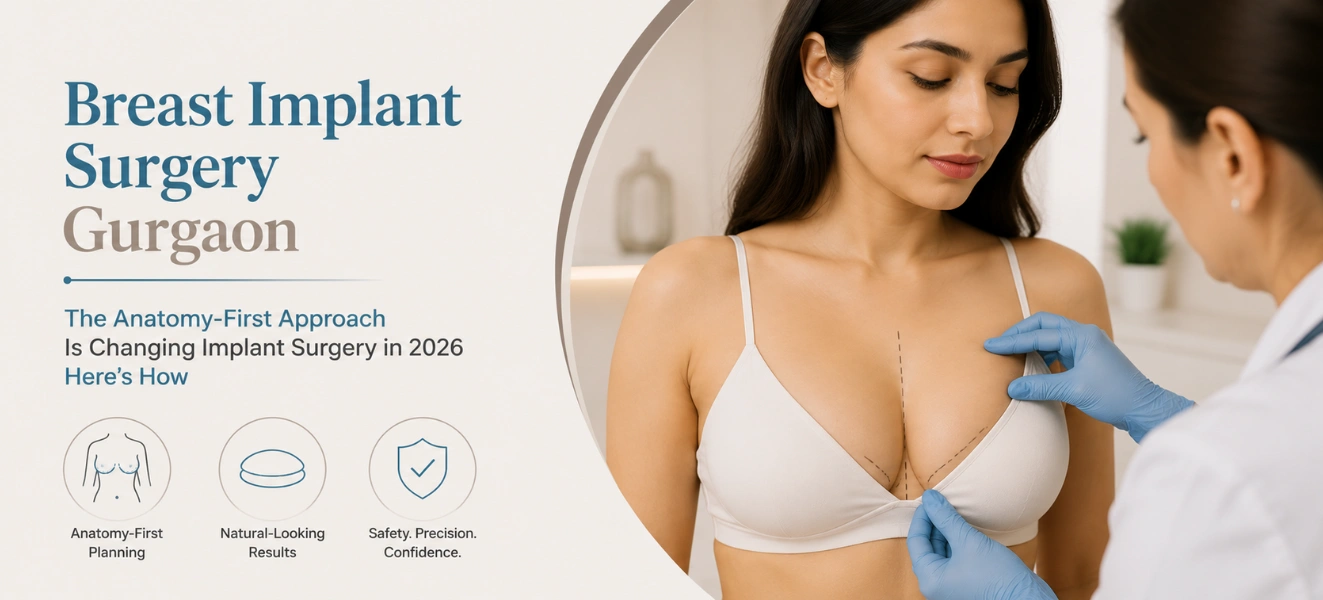
The single most significant shift in breast implant surgery in Gurgaon and globally in 2026 is not a new product or a new technique. It is a change in the decision-making framework: from volume-first to anatomy-first. The volume-first approach, which dominated breast augmentation surgery for two decades, began with the patient’s desired cup size or volume and worked backwards to identify which implant would achieve it. The anatomy-first approach begins with the patient’s tissue characteristics and works forward to identify which implants the anatomy can safely and naturally support.
The difference in outcomes between these two frameworks is clinically significant. Volume-first planning produces a higher rate of implant width exceeding the natural breast footprint, a higher rate of visible rippling in thin-tissue patients, and a higher rate of late complications from tissue thinning caused by oversized implants. Anatomy-first planning, which constrains implant selection within the boundaries defined by the patient’s measured tissue characteristics, produces consistently more natural results with lower complication rates over the medium and long term.
This guide explains what the anatomy-first approach to breast implant surgery in Gurgaon actually involves at Artemis Hospital, why smaller implants are trending in 2026 and what the clinical reason behind that trend is, and what next-generation form-stable cohesive gel implants offer over previous generations.
Call +91 82879 23924 or arrange a consultation at Artemis Hospital, Gurugram, to have your tissue characteristics assessed by Dr. Pradeep Kumar Singh.
What Is the Anatomy-First Approach in Breast Implant Surgery?
The anatomy-first approach to breast implant surgery in Gurgaon begins with four specific tissue measurements taken at the consultation before any implant is discussed:
- Breast base width (BBW): The horizontal distance in centimetres from the medial to the lateral edge of the breast footprint on the chest wall. The implant base width must not significantly exceed this measurement. An implant wider than the natural breast footprint protrudes into the axillary and lateral chest zones, disrupting the natural transition between breast and chest wall and producing a result that reads as augmented from the front.
- Pinch thickness at the upper pole: The amount of tissue pinchable between two fingers at the upper pole of the breast, directly above the implant zone. This measurement determines how much native tissue will cover the implant at its most visible, least-supported zone. A pinch thickness below 2 centimetres identifies a thin-tissue patient who needs submuscular or dual-plane placement for adequate coverage and who is at risk of rippling and implant edge visibility with a thicker implant that stresses the tissue further.
- Skin stretch: The degree to which the breast skin can be stretched downward from the nipple to the inframammary fold. This measurement assesses how much skin is available to accommodate the implant volume without undue tension on the closure.
- Existing ptosis grade: Whether ptosis is present and to what degree determines whether augmentation alone is appropriate or whether a concurrent mastopexy is required. Adding volume to a significantly ptotic breast without addressing the ptosis makes the breast larger and lower, not fuller and better positioned.
These four measurements together define the anatomical envelope within which implant selection is made. The appropriate implant base width, volume, and profile are those that fit within the constraints these measurements define. This is the anatomy-first framework in practice.
Important Read: Breast Implant Surgery Gurgaon: Round vs Teardrop Implants and How to Choose the Right Size in 2026
Why Are Smaller Breast Implants Trending in Gurgaon in 2026?
The trend toward smaller implant volumes in 2026 is one of the most consistently reported findings in aesthetic surgery trend analyses globally. ISAPS data show a measurable shift toward implant volumes under 300 millilitres and away from the 400 to 500 millilitre volumes that were common in the early 2010s. Understanding why requires understanding what the anatomy-first approach reveals about implant sizing:
Many patients who received implants in the 400 to 500 millilitre range ten to fifteen years ago are now returning for revision, not because they want more volume but because they want less. The long-term tissue thinning caused by oversized implants, the weight and gravitational descent accelerated by large implant mass, and the visible rippling that becomes apparent as the overlying tissue thins with age have collectively produced a large revision patient population that is choosing smaller replacement implants. Their experience has become visible data for the next generation of augmentation patients, who are making more conservative size choices at first augmentation as a result.
Smaller implants in the anatomy-first framework are not smaller because of an aesthetic preference for a more modest result. They are smaller because they are correctly sized to the patient’s anatomy. An implant of 275 millilitres in a patient with a 10.5 centimetre breast base width and 1.8 centimetre pinch thickness is not a modest choice; it is the anatomically appropriate choice for that patient. The result looks natural and proportionate precisely because it is consistent with what the anatomy can support without strain.
What Is Dual-Plane Placement, and When Is It Used for Breast Implant Surgery in Gurgaon?
Dual-plane placement is a breast augmentation technique where the implant is placed partially beneath the pectoral muscle (the upper two-thirds) and partially in the retroglandular space beneath the breast gland (the lower third). It combines the coverage advantage of submuscular placement at the upper pole, where tissue coverage is typically thinnest, with the natural lower pole behaviour of a retroglandular implant, where the breast gland can move independently over the lower implant surface.
Dr. John Tebbetts, who described and popularised the dual-plane technique, sub-classified it into three types based on the degree of pectoral muscle release at the inferior muscle border, allowing the technique to be adapted to patients with different degrees of breast tissue descent and different skin elasticity characteristics. At Artemis Hospital, the dual-plane sub-classification is applied to the individual anatomy during breast implant surgery in Gurgaon rather than defaulting to a single placement for all patients, because the same submuscular pocket behaves differently in a patient with good inferior breast tissue support and in one with mild ptosis requiring greater muscle release to allow natural lower pole fill.
What Are Next-Generation Breast Implants, and Are They Safer?
Next-generation form-stable cohesive silicone gel implants, sometimes called gummy bear implants for the way the gel maintains its shape when the shell is cross-sectioned, represent the current pinnacle of implant material technology. They differ from earlier silicone gel generations in two ways: the silicone polymer is more highly cross-linked, making the gel significantly more cohesive and less likely to migrate in the event of shell failure; and the manufacturing process produces a more consistent, predictable gel distribution that maintains the designed implant shape more reliably over time.
Published long-term data from the FDA post-approval studies show that the latest generation of form-stable cohesive smooth round silicone implants demonstrate improved integrity at ten years compared with earlier gel formulations. In the Allergan Core Study, the most recent ten-year data showed an implant rupture rate of approximately 8 per cent at ten years for smooth round cohesive gel implants in the primary augmentation cohort, compared with rupture rates of 15 to 20 per cent for older cohort implants in the same FDA dataset. CDSCO-approved, FDA-certified form-stable cohesive silicone implants are used exclusively at Artemis Hospital for breast implant surgery in Gurgaon, and patients are enrolled in the recommended monitoring programme that includes MRI or ultrasound from five to six years after placement.
Patients from Sector 56 and Sushant Lok 3 who consult at Artemis Hospital, Gurugram, for breast implant surgery in Gurgaon receive the full four-measurement anatomy-first assessment at the consultation, a discussion of the appropriate implant volume and profile within those anatomical constraints, and an explanation of the monitoring programme before any procedure date is agreed.
Important Read: Breast Augmentation Surgery Gurgaon: Silicone vs Saline Implants, Which Is Best for You in 2026?
How Much Does Breast Implant Surgery Cost in Gurgaon in 2026?
Breast implant cost in Gurgaon at Artemis Hospital in 2026 depends on the implant volume and product generation, the placement approach (dual-plane sub-type), the anaesthesia duration, and the facility fees. Form-stable next-generation cohesive silicone implants carry a higher product cost than older generation implants. A personalised cost estimate is provided at the consultation after the anatomy-first assessment determines the appropriate implant selection. Contact Artemis Hospital to arrange a consultation with Dr. Pradeep Kumar Singh.
Frequently Asked Questions
What is the anatomy-first approach to breast implant surgery in Gurgaon?
The anatomy-first approach begins with four tissue measurements (breast base width, upper pole pinch thickness, skin stretch, and ptosis grade) before any implant is discussed. These measurements define the anatomical envelope within which implant selection is made: the base width determines the maximum appropriate implant diameter, the pinch thickness determines placement approach, and the ptosis grade determines whether augmentation alone or combined mastopexy-augmentation is appropriate. This framework consistently produces more natural results and lower long-term complication rates than volume-first implant selection.
Why are smaller breast implants trending in Gurgaon in 2026?
The trend reflects two factors: the anatomy-first framework, which identifies the correctly sized implant for each patient’s tissue characteristics rather than the maximum the patient desires; and the visible long-term outcomes of oversized implants from the previous decade, where tissue thinning, implant descent, and visible rippling have driven a significant revision patient population that is now informing first-time augmentation patients toward more conservative sizes.
Are next-generation breast implants safer than older ones?
Yes. FDA post-approval ten-year data show approximately 8 per cent rupture rates for form-stable cohesive smooth round silicone implants in the primary augmentation cohort, compared with 15 to 20 per cent for older cohort implants. The more highly cross-linked gel reduces migration risk in the event of shell failure. CDSCO-approved, FDA-certified form-stable cohesive silicone implants are used exclusively at Artemis Hospital for breast implant surgery in Gurgaon.
How much does breast implant surgery cost in Gurgaon in 2026?
Breast implant cost in Gurgaon at Artemis Hospital depends on the implant volume and product generation, the placement approach, and facility fees. A personalised estimate is provided after the anatomy-first tissue assessment. Call +91 82879 23924.
What is the difference between round and anatomical breast implants?
Round smooth cohesive silicone implants are symmetric in all directions, carry no rotation risk, and produce excellent natural results when correctly sized to the anatomy-first framework. Anatomical (teardrop) implants have a shaped slope that mimics the natural breast form but require textured surfaces to prevent rotation, which has been associated with BIA-ALCL risk. At Artemis Hospital, smooth round cohesive silicone implants are the standard choice for breast implant surgery in Gurgaon, as they produce natural results without rotation risk or BIA-ALCL association in smooth-surface form.
Can breast implants be combined with a breast lift in Gurgaon?
Yes. Where the anatomy-first assessment identifies both volume deficit and breast ptosis, combined mastopexy-augmentation addresses both in a single operative session. Augmentation alone in the presence of significant ptosis makes the breast larger and lower, not fuller and better positioned. The anatomy-first consultation at Artemis Hospital identifies which patients need augmentation only and which need the combined procedure before any surgical plan is agreed.
Breast implant surgery in Gurgaon at Artemis Hospital starts with your anatomy, not with an implant catalogue. Call +91 82879 23924 or visit Artemis Hospital, Sector 51, Gurugram, Haryana 122001.
Reviews: Dr. Pradeep Kumar Singh on Google.
Dr. Pradeep Kumar Singh: MCh Plastic Surgery, Fellowship Paris, APSI Member: Head of Plastic Surgery, Artemis Hospital, Sector 51, Gurugram.