
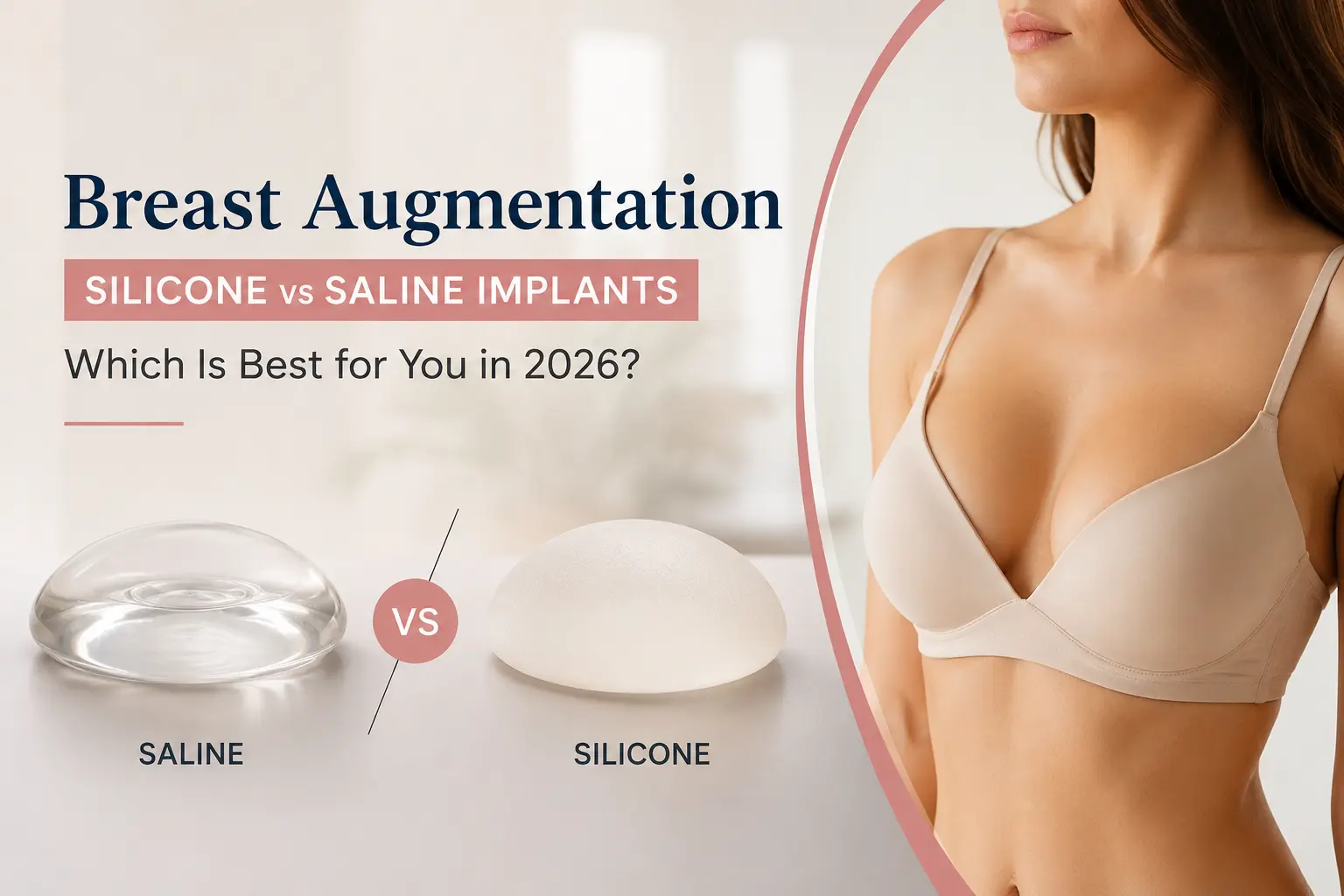
The first question many patients ask at the breast augmentation surgery Gurgaon consultation is not about size or placement. It is about material: silicone or saline? The question is a good one because the material choice genuinely influences how the result feels, what the long-term monitoring commitment is, and how the implant behaves if it ever ruptures. These are not interchangeable options with marginal differences between them. They are distinct clinical choices with distinct trade-offs, and the right answer depends on the individual patient’s anatomy, lifestyle, and preference.
In 2026, cohesive silicone gel implants remain the dominant choice for breast augmentation in Gurgaon and globally, and the published evidence base for their safety and outcomes is the most comprehensive in the history of aesthetic breast surgery. Saline implants remain a clinically valid choice for specific presentations and specific patients. This guide explains what differentiates the two, how the choice interacts with placement and sizing decisions, what the most recent published data shows, and what the consultation at Artemis Hospital involves in making this decision.
Arrange a consultation with Dr. Pradeep Kumar Singh at Artemis Hospital, Gurugram, or call +91 82879 23924.
What Silicone Implants Are and Why They Dominate Breast Augmentation in Gurgaon
Cohesive silicone gel implants consist of a silicone elastomer shell filled with a cross-linked silicone gel of varying cohesivity depending on the product. The gel maintains its shape even when the shell is cut, which is why the current generation is described as cohesive rather than liquid. The clinical advantage of cohesive silicone gel over saline is primarily tactile and aesthetic: the gel most closely replicates the density, weight distribution, and movement of natural breast tissue. In patients with limited native breast tissue, where the implant is covered only by a thin layer of skin and subcutaneous fat, silicone produces a result that feels substantially more natural than saline.
The 2024 update to the FDA’s core study data for cohesive silicone implants reported that at ten years following primary augmentation, approximately 92 per cent of patients had intact implants, capsular contracture requiring surgical correction occurred in approximately 14 per cent, and patient satisfaction remained above 90 per cent across all implant brands studied. These figures represent the most extensively studied aesthetic surgical outcome dataset available. All silicone implants used in breast augmentation surgery in Gurgaon at Artemis Hospital hold CDSCO approval and US FDA certification.
Saline Implants: When They Are the Right Choice
Saline implants consist of a silicone elastomer shell filled with sterile salt water after insertion through a smaller incision than is required for prefilled silicone. The primary advantages are three: the smaller insertion incision, the immediate and unmistakable nature of rupture detection, and the absence of any gel material in the event of shell failure.
The clinical limitation of saline implants for breast augmentation in Gurgaon is tactile. In patients with adequate native breast tissue, a saline implant produces acceptable results that are difficult to distinguish from silicone by touch. In patients with limited native tissue, particularly those with very thin skin and subcutaneous tissue layer, saline implants have a firmer, less natural texture and are more prone to visible surface rippling than silicone. Rippling occurs when the saline shifts within the shell and produces a corrugated texture visible through thin overlying tissue. For patients with limited coverage who want natural-feeling results, cohesive silicone is almost always the better clinical choice.
Saline implants are appropriate for: patients who specifically prefer the absence of silicone gel; patients who prefer the immediate rupture detection that saline provides; patients with adequate native breast tissue where the tactile difference between saline and silicone is less pronounced; and in certain cases where the smaller insertion incision of the saline implant is clinically relevant. The decision is made at the breast augmentation surgery consultation in Gurgaon after assessing the tissue coverage available.
Silicone vs Saline Breast Implants: The Clinical Comparison for 2026
| Factor | Silicone Implants in Gurgaon | Saline Implants in Gurgaon |
| Feel and texture | Most natural feel; closely replicates breast tissue density and movement | Firmer than silicone; less natural in patients with limited native tissue |
| Rippling risk | Lower rippling risk; cohesive gel maintains shape | Higher rippling risk in patients with thin tissue coverage |
| Rupture detection | Silent rupture, the gel maintains shape; MRI or ultrasound monitoring from years 5 to 6 required | Immediate deflation on rupture; visible within days |
| Monitoring commitment | MRI or ultrasound from year 5 to 6, every 2 to 3 years thereafter | No routine imaging required; deflation is self-evident |
| Insertion incision | Larger incision required for prefilled implant | Smaller incision possible as implant is filled after insertion |
| CDSCO/FDA status | CDSCO-approved and FDA-certified; used at Artemis Hospital | CDSCO-approved and FDA-certified; available on request |
| Best suited to | Most patients, particularly those with limited native breast tissue | Patients who prefer no gel; adequate tissue coverage present |
What the 2026 Evidence Says About Long-Term Safety
The long-term safety data for breast implants is more comprehensive in 2026 than at any previous point. The FDA post-approval study data, updated through 2024, confirms that the decade-long patient experience with cohesive silicone gel implants is broadly positive: the majority of complications that occur are identifiable, manageable, and within the complication rates that patients are counselled about at consultation.
The specific safety concern that has received the most attention in recent years is breast implant-associated anaplastic large cell lymphoma (BIA-ALCL), a rare immune-cell cancer linked specifically to macro-textured and salt-loss textured implant surfaces. Smooth cohesive silicone implants, the type used in breast augmentation surgery in Gurgaon at Artemis Hospital, carry a negligible documented BIA-ALCL risk. The macro-textured implants responsible for the majority of reported cases have been voluntarily withdrawn from most markets globally. Patients considering breast augmentation in Gurgaon in 2026 should confirm that the implants to be used are smooth cohesive silicone products and should ask their surgeon directly about the specific product and its surface texture.
The other area of evolving evidence is breast implant illness (BII), a collection of systemic symptoms that some patients attribute to their implants. Published large epidemiological studies have not established a causal link between silicone implants and systemic disease, but approximately two-thirds of patients who undergo explantation report BII do experience symptom improvement after removal. The appropriate clinical response to BII concerns at the consultation is an honest account of the current evidence, a discussion of the patient’s specific symptoms, and a clear explanation that explantation is always available if a patient wishes to have their implants removed.
Breast Augmentation Cost in Gurgaon: What Determines the Price
Breast augmentation cost in Gurgaon depends on the implant material and brand selected, the implant volume and profile, the placement approach, the anaesthesia duration, and the facility fees at Artemis Hospital. Silicone implants are typically more expensive than saline, reflecting the manufacturing cost of the cohesive gel. The total procedure cost is personalised at the consultation after the surgical plan, including implant selection, is agreed. Patients from Noida Extension and Greater Noida West who consult at Artemis Hospital, Gurugram, receive a detailed cost breakdown before any commitment is required.
Frequently Asked Questions
What is the cost of breast augmentation surgery in Gurgaon?
Breast augmentation cost in Gurgaon depends on the implant type, brand, placement approach, and facility fees. A personalised estimate is provided at the consultation at Artemis Hospital after the clinical assessment and implant plan are completed. Call +91 82879 23924 to arrange a consultation.
How long do breast implants last?
Breast implants are not lifetime devices. The published ten-year data show that approximately 92 per cent of cohesive silicone implants are intact at ten years. Implants do not have a fixed replacement schedule: they should be replaced when monitoring identifies a rupture, when capsular contracture requires surgical management, or when the patient chooses to remove or change them. The monitoring schedule for silicone implants, MRI or ultrasound from year five to six and every two to three years thereafter, is a structural part of breast augmentation surgery in Gurgaon aftercare at Artemis Hospital.
What is the difference between silicone and saline implants?
Silicone implants are filled with cohesive gel and produce the most natural feel, particularly in patients with limited native breast tissue. Saline implants are filled with sterile salt water and are firmer to the touch. Saline rupture is immediately apparent as the implant deflates; silicone rupture is often silent and requires imaging to detect. Silicone implants require routine monitoring; saline do not. Both are CDSCO-approved and FDA-certified. The right choice depends on the individual patient’s tissue coverage and preference.
Is breast augmentation surgery safe in India?
Breast augmentation surgery in Gurgaon at Artemis Hospital is performed using CDSCO-approved, FDA-certified implants in a JCI and NABH-accredited operating facility with a full anaesthesia team. The complication rates documented in published long-term studies, including the ten-year FDA post-approval data, reflect what patients can expect when surgery is performed in an appropriately accredited setting by a qualified plastic surgeon. The known complications, capsular contracture and implant rupture in particular, are identifiable and manageable with the monitoring programme that is prescribed after surgery.
Can breast augmentation affect breastfeeding?
Breast implants placed through the standard approaches used at Artemis Hospital, either through the inframammary fold or around the lower areolar border, do not sever the ductal anatomy responsible for milk production and transport. Most patients who have undergone breast augmentation surgery in Gurgaon can breastfeed normally after surgery. Patients with specific concerns about breastfeeding after augmentation should raise them at the consultation, where the surgical approach can be discussed in the context of preserving ductal anatomy.
What is the difference between round and teardrop implants?
Round implants have equal projection across the upper and lower poles and produce fullness throughout the breast. Teardrop, or anatomical, implants have more projection in the lower pole and less in the upper, mimicking the natural breast shape. Round implants at the same volume as teardrop implants produce a fuller upper pole. The choice between the two is made at the consultation based on the patient’s breast dimensions, existing breast tissue, and the desired result. Round, smooth, cohesive silicone implants are the most commonly used in breast augmentation surgery in Gurgaon because of their versatility and the extensive safety data behind them.
Whether silicone or saline is right for your breast augmentation in Gurgaon is a question best answered after the clinical assessment at Artemis Hospital, where tissue coverage, placement, and sizing are all considered together. Call +91 82879 23924 or visit Artemis Hospital, Sector 51, Gurugram, Haryana 122001.
Reviews: Dr. Pradeep Kumar Singh on Google.
Dr. Pradeep Kumar Singh: MCh Plastic Surgery, Fellowship Paris, APSI Member: Head of Plastic Surgery, Artemis Hospital, Sector 51, Gurugram.