Facial volume loss is one of the earliest and least-discussed dimensions of facial ageing. Most people focus on lines and skin laxity, but the deflation of the facial fat compartments, the gradual hollowing of the temples, the flattening of the cheeks, and the deepening of the tear trough and nasolabial fold alter the fundamental shape of the face in a way that lines alone do not. A face that has lost significant volume looks gaunt and tired regardless of the skin quality, and no amount of wrinkle treatment addresses it. Volume restoration is a distinct and essential component of comprehensive facial rejuvenation.
Two options exist for restoring this lost volume: injectable dermal fillers and autologous fat grafting, where fat harvested from the patient’s own body is processed and injected into the areas that have deflated. Both achieve volume restoration, but they are not interchangeable. Fillers are temporary, typically lasting twelve to eighteen months, and are well-suited to early or localised volume concerns. Fat grafting surgery in Gurgaon uses the patient’s own living fat tissue, which integrates with the surrounding tissue and produces volume restoration that can be genuinely long-lasting when the technique produces adequate fat survival. Understanding when each option is the more appropriate choice is the central question this guide addresses.
Book a fat grafting consultation with Dr. Pradeep Kumar Singh at Artemis Hospital, Gurugram, or call +91 82879 23924 to have your facial volume loss assessed and the right restoration approach recommended.
What Fat Grafting Surgery in Gurgaon Actually Involves
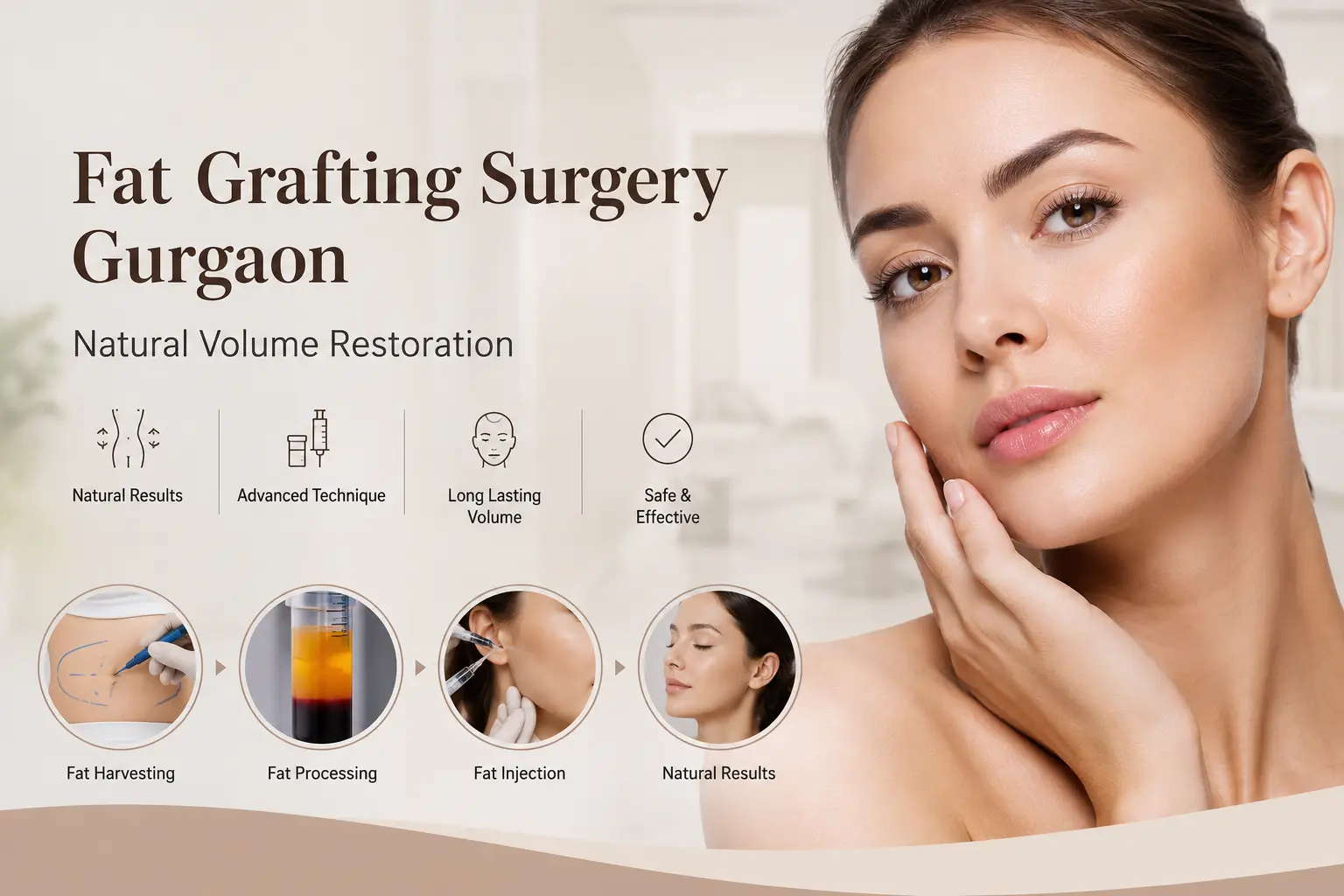
Fat grafting surgery, also called autologous fat transfer, is a two-stage procedure performed under local anaesthesia with sedation or general anaesthesia, depending on the volume of fat required and the number of areas being treated. In the first stage, fat is harvested from a donor site on the patient’s own body, typically the abdomen, flanks, inner thighs, or knees, using a gentle liposuction technique with a fine cannula. The harvested fat is then processed, either by centrifugation or decantation, to separate the living fat cells from the oil, blood, and cellular debris produced during harvesting. In the second stage, the purified fat is injected in small aliquots through fine cannulae into the areas of the face that require volume restoration.
The word ‘aliquots’ refers to the technique of injecting fat in very small parcels rather than in one large bolus. This is clinically important because each fat parcel must establish its own blood supply from the surrounding tissue to survive. Fat injected in large amounts centrally does not receive adequate revascularisation, leading to fat resorption and, in some cases, irregularity. The small-aliquot, multilayer technique maximises the surface area of the injected fat that is in contact with vascularised tissue, improving the proportion of fat that survives and integrates. At Artemis Hospital, fat grafting surgery in Gurgaon is performed using this technique-sensitive approach, and patients are counselled that a single session produces approximately 50 to 70 per cent long-term fat retention on average, with the exact proportion depending on individual healing response and technique.
Areas Treated With Fat Grafting Surgery in Gurgaon: Face and Body
Facial Fat Grafting: Where Volume Matters Most
The face has several distinct fat compartments that deflate at different rates with ageing, and each requires targeted treatment in the correct anatomical plane:
- Temples: Temple hollowing is one of the earliest signs of facial volume loss and one of the most rejuvenating areas to restore. Fat grafted into the temporal region restores the smooth curve from the brow to the cheekbone that characterises the youthful face.
- Midface and cheeks: The malar fat compartment deflates significantly with age, pulling the cheek downward and contributing to the nasolabial fold and tear trough deformity. Fat grafted into the cheek restores the anterior projection and height of the midface, reducing the nasolabial fold without pulling or surgical lifting.
- Tear trough: The depression between the lower eyelid and the upper cheek, which creates the dark, hollow under-eye appearance, is one of the most clinically valuable targets for fat grafting. Precise injection of small quantities of fat in the correct suborbicularis plane restores the smooth transition between the eyelid and cheek.
- Perioral area: Volume loss around the mouth deepens the marionette lines and produces a flattening of the area between the nose and lips. Fat grafted into the perioral fat compartments restores the lip-cheek junction without altering the lips themselves.
- Hands: The dorsum of the hand loses its subcutaneous fat with age, making the tendons and veins visible beneath the skin. Fat grafting into the dorsal hand is a natural body fat transfer approach that restores a smoother, less aged hand appearance.
Fat Grafting as Part of a Combined Procedure
Fat grafting surgery in Gurgaon is most commonly performed as a component of a combined rejuvenation procedure rather than in isolation. Facelift surgery repositions descended facial tissue but does not restore the volume lost from deflated fat compartments; adding fat grafting at the same operative session produces a significantly more complete rejuvenation result. Similarly, fat grafting combined with blepharoplasty addresses not only the excess eyelid skin but the volume-related tear trough that frequently accompanies it. At Artemis Hospital, the consultation for facial rejuvenation always assesses volume loss alongside laxity, because treating only one dimension of facial ageing while ignoring the other produces an incomplete result.
Fat Grafting vs Fillers in Gurgaon: When Each Option Is Right
| Factor | Fat Grafting Surgery in Gurgaon | Dermal Fillers in Gurgaon |
| Duration of results | Long-lasting when fat survival is adequate, years, not months | Temporary: 12 to 18 months for most hyaluronic acid fillers |
| Material | Patient’s own living fat tissue, no foreign material | Synthetic or semi-synthetic filler material injected under the skin |
| Volume capacity | Can restore large volumes across multiple facial zones in one session | Limited by practical volume per area; large-volume treatment requires significant cost |
| Reversibility | Not reversible; fat that survives integration is permanent | Hyaluronic acid fillers are reversible with hyaluronidase |
| Procedure type | Surgical, requires harvesting, processing, and injecting in theatre | Non-surgical, clinic-based injection without anaesthesia |
| Best suited to | Significant, multi-zone volume loss; patients who want a long-lasting result; patients undergoing concurrent surgery | Early or focal volume concerns; patients who prefer a non-surgical approach; trial of volume before committing to surgery |
The decision between fat grafting and fillers is not simply a matter of how long-lasting the patient wants the result to be. It is a clinical assessment of the degree of volume loss present, the number of zones affected, the patient’s preference for surgical versus non-surgical treatment, and whether concurrent surgery is planned. For a patient undergoing a facelift who also has significant midface and temple hollowing, adding fat grafting at the same session is clinically logical and costs a fraction of what years of filler maintenance would cost. For a patient in their mid-thirties with early, focal under-eye hollowing, a precision filler treatment may be the right starting point. The consultation at Artemis Hospital assesses both dimensions and provides a clear recommendation based on the clinical findings.
What Determines How Much Fat Survives After Fat Grafting in Gurgaon
Fat survival after grafting, the proportion of injected fat that establishes a blood supply and integrates permanently, is the most variable and most technique-dependent aspect of fat grafting surgery in Gurgaon. Several factors influence it:
- Harvesting technique: Fat harvested with minimal negative pressure through fine cannulae has higher cell viability than fat harvested aggressively with large-bore cannulae. The gentleness of harvest is the first determinant of how much fat survives.
- Processing method: Centrifugation at the correct speed removes the non-cellular components without damaging the adipocyte cell membranes. Overly aggressive centrifugation or washing reduces cell viability.
- Injection technique: The small-aliquot, retrograde injection technique, where fat is deposited in tiny parcels as the cannula is withdrawn, maximises the contact between injected fat and vascularised tissue.
- Patient biology: Individual variation in tissue vascularity, healing response, and the metabolic activity of the injected fat compartment influences survival rates. This is the factor that varies most between patients and that accounts for the 50 to 70 per cent average retention range published in the literature.
- Smoking: Smoking significantly reduces fat graft survival by impairing the microvascular supply that the grafted fat depends on for revascularisation. Cessation of smoking for at least four weeks before and after surgery is a firm requirement, not a recommendation, at Artemis Hospital.
Fat Grafting Cost in Gurgaon: What Determines the Price
Fat grafting cost in Gurgaon varies depending on the number of facial zones being treated, the volume of fat required, whether fat grafting is performed as a standalone procedure or as part of a combined facelift or blepharoplasty, and the anaesthesia approach. A session addressing a single zone, such as the tear trough alone, has a different cost profile from a comprehensive facial fat grafting procedure treating the temples, midface, tear trough, and perioral area simultaneously. Patients from Palam Vihar, Sector 42, and M3M Golf Estate who attend the consultation at Artemis Hospital receive a personalised fat grafting cost estimate in Gurgaon after the anatomical assessment establishes which zones require treatment and what volume of fat is needed. Contact Artemis Hospital to schedule a consultation with Dr. Pradeep Kumar Singh.
Fat Grafting Recovery in Gurgaon: What to Expect
Recovery from fat grafting surgery in Gurgaon follows two parallel timelines: recovery at the donor site where the fat was harvested, and recovery at the recipient sites in the face where it was injected.
- Days 1 to 5: Swelling at the recipient sites is at its most pronounced. The face appears significantly fuller than the intended final result because of oedema from the injections. The donor site, typically the abdomen or flanks, feels sore and bruised, similar to liposuction recovery. Compression garment use at the donor site reduces bruising and supports the healing tissue.
- Days 5 to 14: Facial swelling reduces noticeably. Patients begin to see the volume contour emerging beneath the residual swelling. Donor site bruising fades, and discomfort reduces significantly.
- Weeks 2 to 6: The facial swelling continues to resolve. Some degree of additional fat resorption occurs during this period as the proportion of grafted fat that does not achieve revascularisation is gradually absorbed. The face will lose some of the initial fullness seen in the first few weeks.
- Months 3 to 6: The fat that has successfully integrated and established its own blood supply is now permanent. The final result of fat grafting surgery in Gurgaon is fully assessable at three to six months, when the resorption phase is complete, and the surviving fat has reached its stable, long-term volume.
Fat Grafting Surgeon in Gurgaon: Dr. Pradeep Kumar Singh at Artemis Hospital
Dr. Pradeep Kumar Singh performs fat grafting surgery in Gurgaon at Artemis Hospital, a JCI and NABH-accredited facility in Sector 51, Gurugram. Fat grafting is a technique that requires specific training in harvesting, processing, and injection to achieve predictable, high-survival results, and it is part of both the surgical and non-surgical repertoire at Artemis Hospital rather than an occasional adjunct procedure. His MCh in Plastic Surgery from SMS Medical College, Jaipur, and Fellowship in Advanced Aesthetic Surgery from St Louis Hospital, Paris, include training in fat grafting as a core facial rejuvenation technique rather than a supplementary option. As Head of the Department of Plastic Surgery and a member of the Association of Plastic Surgeons of India, Dr. Pradeep Kumar Singh, MCh Plastic Surgery, Fellowship Paris, APSI Member, incorporates fat grafting into every comprehensive facial rejuvenation plan where volume loss is a significant component of the ageing presentation.
Frequently Asked Questions
What is fat grafting surgery?
Fat grafting surgery, also called autologous fat transfer, uses fat harvested from the patient’s own body, processed to remove non-cellular components, and injected into areas that require volume restoration. In facial rejuvenation, it addresses the hollowing of the temples, midface, and tear trough that occurs with age. In body applications, it can restore volume to the hands or augment other areas. The fat that successfully integrates and establishes a blood supply produces long-lasting volume restoration.
How long does fat grafting last?
The proportion of fat that survives integration, approximately 50 to 70 per cent on average, lasts permanently. The fat that does not achieve adequate revascularisation is reabsorbed over the first three to six months after surgery. The surviving volume is stable and long-lasting: it responds to body weight changes the same way fat elsewhere in the body does, which is both an advantage, as the volume is biologically normal, and a consideration, significant weight loss after fat grafting reduces the restored volume.
Is fat grafting better than fillers?
Neither is categorically better. Fat grafting is better for patients with significant, multi-zone volume loss who want a long-lasting result, who are willing to undergo a surgical procedure, or who are already having concurrent surgery. Fillers are better for early or focal concerns, for patients who want a non-surgical approach, and for patients who want to trial volume restoration before committing to a more permanent option. The clinical assessment at Artemis Hospital determines which is the right choice for each individual patient’s specific presentation.
What is the cost of fat grafting in Gurgaon?
Fat grafting cost in Gurgaon depends on the number of zones treated, the volume required, whether it is performed as a standalone procedure or combined with other surgeries, and the anaesthesia approach. A personalised estimate is provided at the consultation at Artemis Hospital after the volume assessment. Contact Artemis Hospital to schedule a consultation.
What are the risks of fat grafting surgery?
The main clinical considerations in fat grafting surgery in Gurgaon are partial fat resorption, where the proportion of fat that does not achieve adequate revascularisation is absorbed over the first few months; temporary swelling at both the donor and recipient sites during recovery; and small-volume irregularity if fat is not injected in even, small-aliquot distribution. Serious complications such as fat embolism are rare and are associated with technique errors rather than the procedure itself when performed by a trained plastic surgeon.
Volume Restored from Within: Why Fat Grafting Produces a Different Quality of Result
The results of fat grafting surgery in Gurgaon have a character that filler results do not replicate precisely: the tissue feels like the patient’s own because it is. The face that has been restored with autologous fat moves naturally, responds to facial expression naturally, and changes with body weight naturally. For patients with significant volume loss for whom a filler-based approach would require large quantities and frequent maintenance, fat grafting offers a clinically rational alternative that addresses the deficit in a single, well-planned procedure.
Book now or call +91 82879 23924 to schedule your fat grafting surgery in Gurgaon consultation with Dr. Pradeep Kumar Singh at Artemis Hospital.
Or visit Artemis Hospital, Sector 51, Gurugram, Haryana 122001.
Read patient reviews at Dr. Pradeep Kumar Singh on Google.
Dr. Pradeep Kumar Singh: MCh Plastic Surgery, Fellowship Paris, APSI Member: Head of Plastic Surgery, Artemis Hospital, Sector 51, Gurugram.