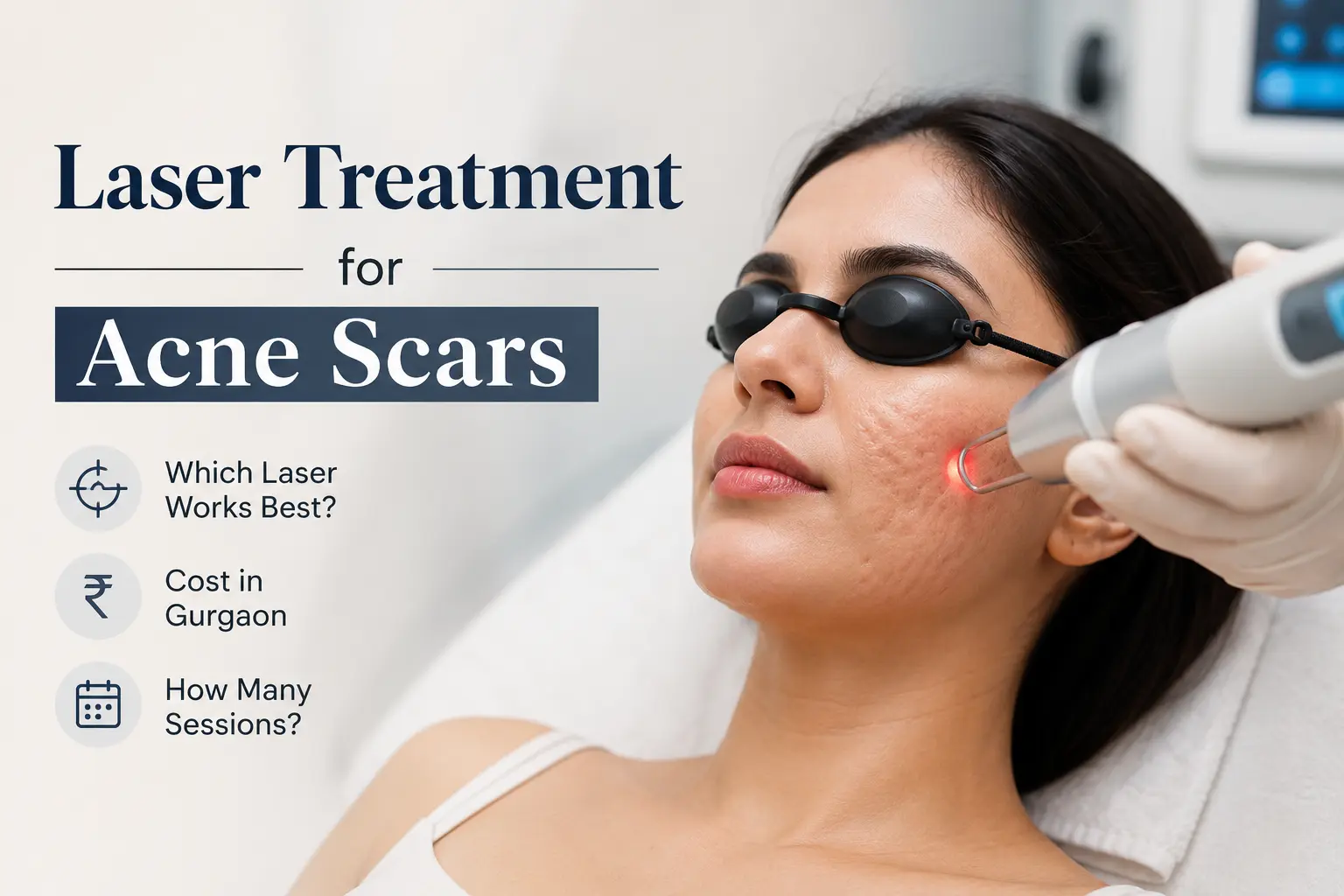
Search for laser treatment for acne scars, and you will encounter a list of names: fractional CO2 laser, Er: YAG, MNRF, Q-switched Nd: YAG, picosecond laser. Each is described on clinic websites as the best treatment for acne scars. None of those descriptions tells you which one is right for your scars, your skin tone, or your recovery tolerance. The confusion is understandable because these are genuinely different technologies that work through different mechanisms and are indicated for different scar types.
The short answer is that no single laser is the best laser treatment for acne scars in Gurgaon for all presentations. Atrophic scarring, which includes rolling, boxcar, and icepick scars at different depths in the dermis, responds differently to different laser wavelengths and energy profiles. Pigmented post-inflammatory marks respond to entirely different laser parameters than structural scars do. Getting the right result depends on correctly identifying what is being treated before selecting the device, not on selecting the most expensive or most heavily marketed laser first.
This guide matches each major laser type to the scar types it addresses, explains what Indian skin tone requires from a safety perspective, and gives a realistic account of how many sessions are typically needed and what recovery involves.
Why Skin Tone Matters as Much as Scar Type for Laser Treatment in Gurgaon
Indian skin falls predominantly in the Fitzpatrick Type III to V range, and this has direct clinical implications for which laser wavelengths and settings can be used safely. Melanin in darker skin types competes with the intended chromophore target for laser energy. When a laser wavelength is highly absorbed by melanin, darker skin absorbs more energy in the epidermis than intended, creating a risk of post-inflammatory hyperpigmentation (PIH), hypopigmentation, or superficial burns.
Aggressive ablative laser resurfacing protocols designed for Western skin types can cause significant pigmentation complications in Indian skin if the parameters are not adjusted appropriately. This is among the most common adverse outcomes from poorly matched laser treatment for acne scars in Gurgaon. The first question to ask at any laser consultation is how the practitioner adjusts their protocol for your specific Fitzpatrick skin type.
Which Laser for Which Scar: The Matching Framework
| Laser Type | Primary Mechanism | Best Suited Scar Type | Safety in Indian Skin |
| Fractional CO2 | Ablative: creates micro-channels that trigger deep collagen remodelling | Moderate to deep boxcar and rolling scars | Safe with conservative settings; PIH risk if overtreated |
| Fractional Er:YAG | Less ablative than CO2; more superficial collagen stimulation with less thermal damage | Mild to moderate atrophic scars; texture improvement | Better safety profile in Indian skin than CO2; preferred first-line in darker skin types |
| MNRF (Microneedling RF) | Non-ablative: RF energy via insulated needles beneath skin without surface ablation | Rolling scars and mild boxcar scars | High safety in Indian skin; minimal PIH risk as RF bypasses melanin-rich epidermis |
| Q-switched Nd:YAG | Selectively targets melanin; photoacoustic disruption of pigment | Post-inflammatory hyperpigmentation; not effective for structural atrophic scarring | Very safe in Indian skin for PIH; standard for pigmentation in Type III to V |
| Picosecond laser | Ultra-short pulses targeting pigment and stimulating collagen | PIH; superficial pigmentation; some evidence for mild atrophic scar improvement | Safe; useful in mixed presentations |
Fractional CO2 Laser for Acne Scars in Gurgaon
Fractional CO2 laser resurfacing is the most widely used laser treatment for atrophic acne scars and has the most substantial evidence base for structural scar improvement. The fractional approach creates columns of ablation separated by untreated skin bridges, which provide the cellular reservoir for rapid healing and significantly reduce the recovery time and risk compared with fully ablative resurfacing.
For patients with moderate to deep boxcar and rolling scars in Indian skin, fractional CO2 laser treatment for acne scars in Gurgaon at Artemis Hospital is performed at conservative energy and density settings, with a minimum of six weeks between sessions. The result develops progressively over three to six months after each session as the collagen produced during healing matures and remodels. Most patients require three to five sessions for significant improvement.
MNRF: The Safer Option for Deeper Indian Skin Tones
Microneedling radiofrequency (MNRF) has become an increasingly preferred first-line treatment for atrophic acne scars in Indian skin. By delivering radiofrequency energy via insulated microneedles that bypass the melanin-rich epidermis and deposit energy directly in the dermis, MNRF achieves meaningful collagen stimulation without the surface ablation that creates PIH risk in darker skin. Recovery is significantly shorter than with fractional CO2, and the risk of post-treatment pigmentation is substantially lower.
MNRF is particularly well-suited to rolling scars and mild to moderate boxcar scars, and to patients with Fitzpatrick Type IV or V skin who are not good candidates for ablative laser resurfacing at therapeutic energy levels. For Indian skin, the choice between MNRF and fractional laser depends primarily on the Fitzpatrick skin type and the severity of the scarring.
How Many Laser Sessions Are Needed for Acne Scars in Gurgaon?
The number of sessions required for laser treatment for acne scars in Gurgaon depends on the severity of the scarring, the laser modality used, and the individual patient’s healing response. Understanding this before starting laser treatment for acne scars in Gurgaon helps set realistic expectations:
- Mild atrophic scarring: Three to four sessions of fractional Er: YAG or MNRF, spaced four to six weeks apart, typically produce satisfying improvement.
- Moderate scarring: Four to six sessions of fractional CO2 (in lighter skin types) or MNRF (in darker skin types), combined where appropriate with subcision for rolling scars before laser sessions begin. Improvement progresses over six to twelve months from the start of treatment.
- Severe or mixed scarring: A combination approach is most effective: subcision for tethered rolling scars, punch excision for deep icepick scars, and then fractional laser or MNRF for the residual atrophic texture. This may involve six to eight treatment sessions overall across a twelve to eighteen-month programme.
Patients from Rohini and Pitampura who travel to Artemis Hospital, Gurugram, for laser acne scar treatment in Gurgaon typically ask how many sessions at the first consultation. The honest answer depends on what the clinical assessment reveals about the scar types present, the skin tone, and the degree of improvement being targeted.
Laser vs Microneedling for Acne Scars in Gurgaon
Microneedling and laser resurfacing are both used for atrophic acne scar treatment in Gurgaon, and both work through related but different mechanisms. Standard microneedling creates mechanical micro-channels in the skin, stimulating collagen production with minimal downtime and good safety in all skin types, but produces more modest improvement per session. MNRF adds radiofrequency energy for deeper dermal stimulation than mechanical needling alone. Fractional laser ablation creates more intense collagen stimulation but carries more recovery and more pigmentation risk in darker skin. For Indian skin, the choice depends primarily on the Fitzpatrick skin type and the severity of the scarring.
Laser Resurfacing Cost in Gurgaon: What to Expect
Laser resurfacing cost in Gurgaon varies based on the laser modality, the treatment area, the number of passes, and the facility. Because multiple sessions are required, the total cost of a laser treatment programme for acne scars in Gurgaon at Artemis Hospital is discussed at the initial consultation once the scar assessment has determined the appropriate modality and the estimated number of sessions. Dr. Pradeep Kumar Singh, MCh Plastic Surgery, Fellowship Paris, APSI Member, supervises acne scar treatment at Artemis Hospital within a framework that begins with clinical scar classification before any laser modality is selected. To arrange an assessment, call +91 82879 23924 or visit Artemis Hospital, Sector 51, Gurugram.
Frequently Asked Questions
Which laser is best for acne scar treatment in Gurgaon?
There is no single best laser. Fractional CO2 is most effective for moderate to deep atrophic scars in lighter skin types. MNRF is preferred for darker Indian skin tones where surface ablation carries PIH risk. Q-switched or picosecond lasers address post-inflammatory pigmentation. The right laser is the one matched to your specific scar type and skin tone, determined by clinical assessment.
How much does laser acne scar treatment cost in Gurgaon?
Laser resurfacing cost in Gurgaon depends on the modality, the number of sessions, the treatment area, and the facility. A cost estimate for a complete treatment programme is provided at the initial consultation at Artemis Hospital after the scar assessment.
How many sessions are needed for laser acne scars?
Three to four sessions for mild scarring, four to six for moderate, and six to eight across a combination programme for severe or mixed scarring. Each session’s collagen response matures over three to six months, so the full result of a session is not visible immediately after treatment.
Is laser treatment for acne scars safe for Indian skin?
Yes, when the correct laser and settings for the patient’s Fitzpatrick skin type are used. MNRF is inherently safe in all skin types. Fractional CO2 and Er: YAG are safe in Indian skin when used at conservative settings with extended intervals between sessions.
What is the difference between a fractional CO2 laser and microneedling for acne scars?
Fractional CO2 ablates columns of skin to trigger deep collagen remodelling, producing more intense tissue response per session but carrying more recovery and pigmentation risk in darker skin. Standard microneedling creates mechanical channels for collagen stimulation with minimal downtime and good safety in all skin types. MNRF combines the mechanical channel with radiofrequency energy for deeper dermal stimulation, maintaining a good safety profile in Indian skin.
Laser treatment for acne scars in Gurgaon works best when the plan starts with an honest assessment of what scar types are present, what the skin tone requires, and what degree of improvement is realistic. That assessment is available at Artemis Hospital. Call +91 82879 23924 to arrange one.
Patient reviews: Dr. Pradeep Kumar Singh on Google.
Dr. Pradeep Kumar Singh: MCh Plastic Surgery, Fellowship Paris, APSI Member: Head of Plastic Surgery, Artemis Hospital, Sector 51, Gurugram.