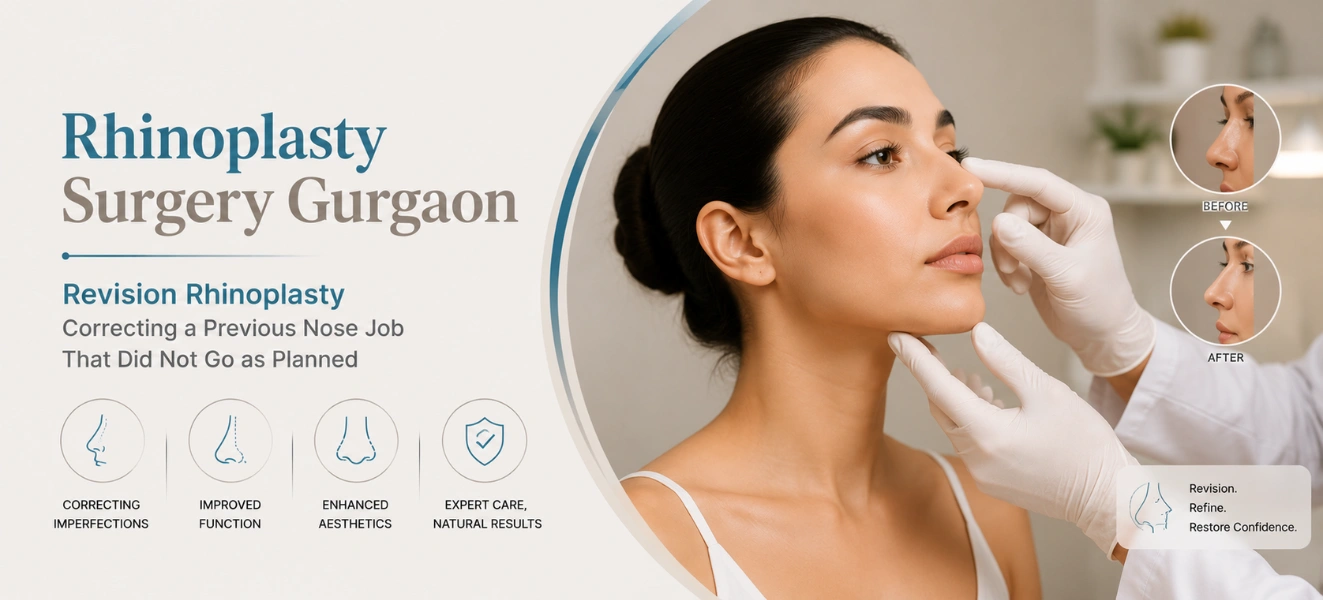
Revision rhinoplasty, the surgical correction of a rhinoplasty result that did not meet the patient’s expectations or that has produced a functional or aesthetic problem not present before the initial surgery, is widely regarded as the most technically demanding procedure in aesthetic facial surgery. The altered anatomy, the scar tissue from the previous surgery, the loss of structural cartilage that was removed or reshaped in the first procedure, and the psychological weight that a previous surgical disappointment adds to the consultation, all make revision rhinoplasty surgery in Gurgaon a fundamentally different undertaking from primary nose reshaping surgery.
If you have had rhinoplasty surgery in Gurgaon or elsewhere and are dissatisfied with the result, or if your nose is developing problems months or years after the initial procedure, this guide explains what you need to know before seeking revision: how long to wait, what makes revision more complex, what cartilage sources are available when the original septal cartilage has been exhausted, what realistic success rates look like, and what questions to ask a revision rhinoplasty surgeon.
Call +91 82879 23924 to arrange a rhinoplasty revision assessment with Dr. Pradeep Kumar Singh at Artemis Hospital, Gurugram.
Why Do Some Rhinoplasty Results Need Correction?
The reasons that rhinoplasty results require revision fall into four categories:
- Aesthetic dissatisfaction: The result does not match what the patient and surgeon discussed pre-operatively. This can reflect a technical shortcoming, a planning failure, or the patient’s post-operative evaluation of a result that was technically well-executed but not what they actually wanted. Aesthetic dissatisfaction accounts for the majority of revision rhinoplasty consultations and is assessed at twelve months after the primary procedure when the swelling has fully resolved.
- Over-resection: Removing too much cartilage from the nasal tip or dorsum produces problems that emerge progressively as the remaining cartilage weakens over months to years. An over-resected tip collapses, producing a pinched, narrow tip that looks operated and may also obstruct the nasal valve. An over-resected dorsum produces a scooped supratip depression. Both require structural reconstruction in revision rhinoplasty surgery in Gurgaon using cartilage grafts to replace what was removed.
- Functional deterioration: A rhinoplasty that displaced internal nasal structures, produced scarring that obstructs the internal nasal valve, or weakened the structural support of the lower lateral cartilages may create or worsen nasal airflow obstruction that was not present before the initial surgery. Functional deterioration after primary rhinoplasty is a compelling indication for revision that is addressed through functional reconstruction alongside any cosmetic corrections.
- Delayed structural changes: The nose continues to change after rhinoplasty as cartilage memory and scar contraction act on the modified framework over months and years. A tip that was straight at three months may drift laterally. A corrected hump may show mild reformation as the scar tissue contracts. These delayed changes are a specific category of outcome dissatisfaction that requires a twelve-month minimum observation period before revision planning begins.
Important Read: Nose Reshaping Surgery Gurgaon: Surgical vs Non-Surgical Rhinoplasty, A 2026 Comparison Guide
How Long Should You Wait Before Revision Rhinoplasty in Gurgaon?
The universally applied standard in rhinoplasty surgery in Gurgaon and globally is twelve months from the primary procedure before revision surgery is planned, and this standard exists for specific clinical reasons. Nasal swelling after rhinoplasty, particularly in the tip and supratip zones of Indian patients with typical thick skin, continues to resolve through the twelfth month. A revision planned at six months addresses swelling as much as the underlying framework, and the result of that revision will continue to change for a further twelve months. Patients who pursue revision before twelve months frequently require a second revision after swelling has fully resolved because the changes they were addressing at six months were partially resolved by natural swelling reduction by nine months.
The one exception to the twelve-month rule is functional compromise: nasal airflow obstruction that developed after the primary procedure and is affecting the patient’s breathing and sleep quality should be assessed earlier, and where the obstruction is clearly produced by the surgical changes rather than by swelling, earlier revision may be clinically appropriate with appropriate documentation of the indication.
Is Revision Rhinoplasty More Complex Than the First Surgery in Gurgaon?
Yes, reliably so, for three specific reasons:
- Altered anatomy: The normal anatomical relationships between the nasal bones, cartilages, and soft tissue are disturbed by the previous surgery and the healing response. The surgeon performing revision rhinoplasty in Gurgaon encounters structures that are in different positions and proportions from their natural state, requiring recalibration of the entire surgical assessment and plan.
- Scar tissue: The scar tissue from the previous procedure creates adhesions between tissue planes that were normally distinct, makes dissection more difficult and less predictable, and reduces the blood supply to the tissues being worked on. Scar tissue also affects the final result of the revision by producing contraction that may continue to change the shape for months after the revision procedure.
- Cartilage depletion: The septal cartilage is the primary graft source for primary rhinoplasty. In a patient who has already had rhinoplasty, the septal cartilage has typically been used in the first procedure and is no longer available in sufficient quantity for revision grafting. Alternative cartilage sources must be used, most commonly the ear cartilage (concha) for smaller grafts and rib cartilage for larger structural grafts.
Important Read: Cosmetic Nose Surgery Gurgaon: Rhinoplasty Types, Cost and Finding the Right Surgeon
What Cartilage Is Used for Revision Rhinoplasty in Gurgaon?
When the nasal septum has been used in the primary rhinoplasty, the cartilage sources available for revision rhinoplasty surgery in Gurgaon are:
- Conchal (ear) cartilage: Harvested from the posterior aspect of the ear bowl (the concha) through an incision behind the ear that heals invisibly. Conchal cartilage is soft and flexible, making it appropriate for finer tip grafts, shield grafts, and alar rim grafts. It is available in adequate quantity for moderate revision needs and does not change the ear shape or appearance when harvested correctly. It is the first-choice cartilage source for revision rhinoplasty when the volume needed is small to moderate.
- Costal (rib) cartilage: Harvested from the cartilaginous portion of the rib cage, typically the fifth, sixth, or seventh rib, through a small incision below the breast or in the lower chest. Rib cartilage is available in large quantities and provides the structural strength needed for major dorsal reconstruction, columellar struts, and multiple grafts in complex revision cases. The donor site scar is small and heals well, but the harvest adds thirty to forty-five minutes to the operative time and produces mild chest wall discomfort for two to three weeks. Rib cartilage is the standard choice for major structural revision rhinoplasty in Gurgaon.
Dr. Pradeep Kumar Singh, MCh Plastic Surgery, Fellowship Paris, APSI Member, has specific training in costal cartilage harvest and its use in revision rhinoplasty, acquired through both his MCh training and his Fellowship in Advanced Aesthetic Surgery from St Louis Hospital, Paris, where complex nasal revision cases represent a significant proportion of the rhinoplasty practice.
What Is the Success Rate of Revision Rhinoplasty in Gurgaon?
Published data on revision rhinoplasty outcomes reflect the increased complexity of the procedure. Patient satisfaction after revision rhinoplasty is reported as approximately 80 to 85 per cent at twelve months in published series from high-volume rhinoplasty centres, compared with approximately 90 to 95 per cent satisfaction after primary rhinoplasty. The revision surgery itself has a higher rate of further revision (secondary revision) of approximately 10 to 15 per cent at five years, compared with five to eight per cent for primary rhinoplasty. These figures are the realistic benchmarks that should be disclosed at the consultation for revision rhinoplasty surgery in Gurgaon, and they are discussed openly at Artemis Hospital as part of the informed consent process.
Patients from DLF Phase 3 and Golf Course Road who consult at Artemis Hospital, Sector 51, Gurugram, for revision rhinoplasty surgery in Gurgaon receive a full review of the primary procedure documentation, imaging review, and a clinical examination of the current nasal state before any revision plan is proposed. The consultation explicitly addresses what the revision can achieve and what realistic expectations should be based on the findings.
Frequently Asked Questions
Why do some rhinoplasty results need correction in Gurgaon?
The four main reasons for revision rhinoplasty are: aesthetic dissatisfaction with the result relative to the pre-operative discussion; over-resection of cartilage producing tip collapse, pinching, or dorsal scooping; functional deterioration from post-surgical nasal valve obstruction or structural weakness; and delayed structural changes as scar contraction and cartilage memory gradually alter the framework over months to years. Each category has different timing implications and different revision approaches.
How long should I wait before revision rhinoplasty in Gurgaon?
Twelve months is the standard minimum waiting period before revision rhinoplasty surgery in Gurgaon is planned for aesthetic concerns. Nasal tip swelling in Indian patients with typical thick skin continues to resolve through the twelfth month, and revision planned before this point risks addressing swelling as much as the underlying framework. Functional deterioration producing breathing obstruction may warrant earlier assessment where the obstruction is clearly caused by the surgical changes rather than residual swelling.
Important Read: Rhinoplasty Before Wedding in Gurgaon: The Timing Guide for Indian Brides and Grooms
Is revision rhinoplasty more complex than the first surgery?
Yes, reliably so, because altered anatomy, scar tissue between tissue planes, and depleted septal cartilage make every stage of the revision procedure more technically demanding than the equivalent stage in primary surgery. Published patient satisfaction after revision rhinoplasty (80 to 85 per cent) is lower than after primary rhinoplasty (90 to 95 per cent), and the rate of further revision after a revision procedure is approximately 10 to 15 per cent at five years versus 5 to 8 per cent for primary procedures.
What cartilage is used for revision rhinoplasty in Gurgaon?
When the nasal septum has been depleted in the primary rhinoplasty, conchal (ear) cartilage is harvested through a small posterior ear incision for moderate revision needs, and costal (rib) cartilage is harvested through a small chest incision for major structural reconstruction requiring large graft volumes. Rib cartilage provides the quantity and structural strength needed for complex revision rhinoplasty surgery in Gurgaon and is the standard choice for significant dorsal or tip reconstruction in secondary cases.
What is the cost of revision rhinoplasty surgery in Gurgaon?
Revision rhinoplasty cost in Gurgaon at Artemis Hospital depends on the extent of the revision, whether conchal or costal cartilage harvest is required, the operative duration, and facility fees. Revision procedures have a higher cost than primary rhinoplasty because of the extended operative time and cartilage harvest requirements. A personalised estimate is provided at the revision assessment consultation. Call +91 82879 23924.
What is the success rate of revision rhinoplasty in Gurgaon?
Published data report patient satisfaction of approximately 80 to 85 per cent at twelve months after revision rhinoplasty surgery in Gurgaon, compared with 90 to 95 per cent after primary rhinoplasty. The rate of further revision after a first revision procedure is approximately 10 to 15 per cent at five years. These figures reflect the increased complexity of revision surgery rather than a failure of technique, and they are disclosed openly at the Artemis Hospital revision consultation as part of the informed consent process.
Rhinoplasty surgery in Gurgaon revision at Artemis Hospital begins with understanding what the original result produced and what the anatomy now allows. Call +91 82879 23924 or visit Artemis Hospital, Sector 51, Gurugram, Haryana 122001.
Reviews: Dr. Pradeep Kumar Singh on Google.
Dr. Pradeep Kumar Singh: MCh Plastic Surgery, Fellowship Paris, APSI Member: Head of Plastic Surgery, Artemis Hospital, Sector 51, Gurugram.