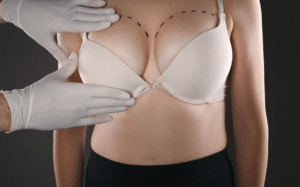
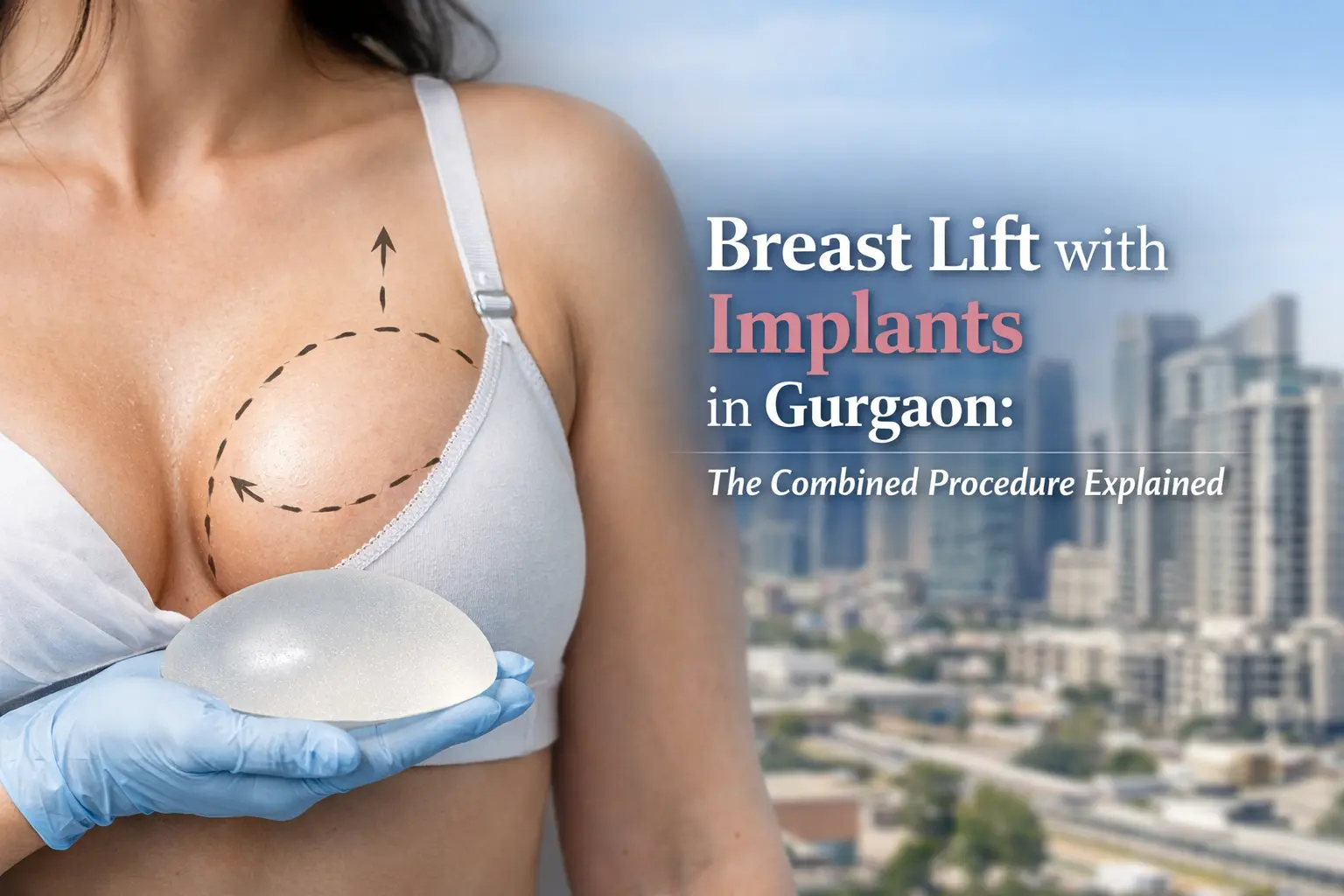
The combination of a breast lift with implants — known clinically as augmentation mastopexy — is one of the most technically demanding procedures in aesthetic surgery. It asks two things of the surgery simultaneously that are in direct tension with each other: a lift removes skin and tightens the breast envelope, while an implant adds volume and places outward pressure on that same envelope. Managing both goals in a single procedure requires significantly more surgical judgment than either operation performed alone, and the outcomes, when the indication is correct, are consistently superior to what either procedure achieves independently.
Patients considering breast lift surgery in Gurgaon frequently discover during consultation that a lift alone will not restore the fullness they remember — the breast shape improves, but the volume remains deflated. Patients considering breast augmentation surgery often realise that adding volume to a ptotic (sagging) breast simply produces a larger sagging breast rather than a lifted, full one. The augmentation mastopexy addresses both simultaneously — and this guide explains who it is right for, what the procedure involves, and what genuinely honest recovery and outcome expectations look like.
Book a consultation with Dr. Pradeep Kumar Singh at Artemis Hospital, Gurugram, or call +91 82879 23924 to discuss whether combined augmentation mastopexy is the appropriate procedure for your goals.
Why Lift Alone or Implants Alone Often Fall Short
Understanding why the combined procedure exists requires understanding what each component addresses independently — and where each falls short when used alone.
A mastopexy repositions the nipple, removes excess skin, and reshapes the breast envelope. What it cannot do is restore volume — women who have lost breast tissue post-pregnancy often find their post-lift breast well-positioned but hollow in the upper pole. A breast augmentation adds volume and projection. What it cannot do is correct nipple position or skin laxity — implants placed in a ptotic breast may simply produce a larger sagging breast, with the implant weight potentially accelerating further skin descent.
Augmentation mastopexy solves both simultaneously: the implant restores upper pole volume whilst the lift reshapes the envelope and repositions the nipple. For women who genuinely need both — which clinical assessment at Artemis Hospital determines — the combined result is closer to the pre-change breast than either procedure achieves independently.
Who Is the Right Candidate for Combined Augmentation Mastopexy
Not every woman who wants both a lift and more volume is a good candidate for the combined procedure. The surgical tension between skin tightening and implant expansion makes the combined approach inappropriate for certain presentations — and in those cases, staging the procedures three to six months apart is the safer recommendation.
The ideal candidate for a combined augmentation mastopexy in Gurgaon typically presents with the following:
- Grade I or Grade II breast ptosis: Grade I (nipple at the breast fold) or Grade II (nipple below the fold but above the lowest breast contour) are appropriate. Grade III ptosis — nipple pointing sharply downward with substantial skin excess — is better addressed through a staged approach.
- Moderate volume loss: The primary complaint is deflation alongside ptosis, not a desire for dramatic enlargement. A one-to-one-and-a-half cup size increase is a safer combined target than two or more cup sizes, which creates excessive outward pressure on the tightened envelope.
- Good skin quality: Adequate skin thickness and elasticity are essential. Thin, heavily stretched skin is at higher risk of wound tension complications in a combined procedure.
- Family planning complete: Future pregnancies affect breast volume and skin elasticity. The combined procedure produces the most lasting result in women who have completed their families.
Combined vs Staged: How the Decision Is Made
Whether to perform augmentation mastopexy as a combined or staged procedure is a clinical judgement — not primarily a patient preference decision. It is based on the degree of ptosis, skin quality, implant volume, and overall surgical risk.
| Factor | Favours Combined Procedure | Favours Staged Procedure |
| Degree of ptosis | Grade I or II (mild to moderate sagging) | Grade III (severe sagging with significant skin excess) |
| Implant size goal | Modest increase (up to 1–1.5 cup sizes) | Large implant volume desired |
| Skin quality | Good skin elasticity and thickness | Thin, stretched skin with poor elasticity |
| Recovery tolerance | Single recovery period preferred | Willing to undergo two separate recovery periods |
| Overall health | Good surgical candidate for longer procedure | Medical conditions limiting anaesthesia duration |
| Nipple position | Mild to moderate lowering | Nipple significantly below the breast fold |
Most patients presenting at Artemis Hospital are appropriate for the combined approach. Staging is recommended where ptosis is severe, implant volume is large, or skin quality makes combined tension management unsafe. This assessment is made explicitly at consultation, with specific reasons, not a general caution.
What the Combined Procedure Involves: Technique and Timing
Performed under general anaesthesia in two and a half to three and a half hours, the procedure involves two coordinated phases:
- Implant placement: A silicone cohesive gel implant is placed submuscularly or in a dual-plane position, which combines subglandular and submuscular placement. Dual-plane is frequently used in augmentation mastopexy as it allows the lower breast to drape naturally over the implant, reducing the risk of the implant appearing separate from the lifted tissue.
- Mastopexy component: The nipple and areola are elevated, excess skin is removed using periareolar, vertical, or anchor pattern depending on ptosis grade, and the skin is closed in layers around the implant.
- Sequencing and tension management: The critical challenge is closing the skin with sufficient tension to lift without placing excessive stress on incision lines over an outward-pressing implant. Too much skin removal creates high tension; too little leaves the lift inadequate. This balance is managed through precise pre-operative implant size selection and intraoperative skin removal planning.
Recovery From Breast Lift With Implants: What Is Different From Each Procedure Alone
Recovery from augmentation mastopexy is longer than either procedure alone — a point worth stating clearly, as patients who research each procedure separately often underestimate the combined requirement.
- Week 1–2: Surgical dressing, supportive bra, strict activity restriction. Dual healing requirements — incision closure and implant positioning — make this phase more restricted than augmentation alone.
- Week 3–6: Progressive return to daily activities. Mastopexy incisions heal whilst the implant pocket forms. The breast appears higher and tighter than the final result during this phase.
- Month 2–3: Implants descend toward final position. Mastopexy scars enter the active healing phase — pink or slightly raised before fading. Most patients return to full activity by month two.
- Month 4–6: The combined result begins to look settled. Implants are in the final position, and scars are fading — the outcome now closely reflects the twelve-month result.
- Month 6–12: Full result and maximum scar fading. Upper pole volume, natural nipple position, and fully remodelled skin envelope.
Patients from Golf Course Road, Magnolias, Sushant Lok, Vasant Vihar, Greater Kailash, Defence Colony, Jor Bagh, Anand Niketan, and South Extension who completed augmentation mastopexy at Artemis Hospital consistently note that the six-month result exceeded their expectations from the pre-surgery discussion.
Surgical Expertise in Combined Augmentation Mastopexy at Artemis Hospital
Augmentation mastopexy demands simultaneous mastery of implant-based augmentation and mastopexy skin pattern design — and the ability to manage the tension between them intraoperatively. A surgeon who operates regularly at this intersection brings a different level of precision to it than one who performs predominantly one or the other.
Dr. Pradeep Kumar Singh — MCh in Plastic Surgery, SMS Medical College, Jaipur; Fellowship in Advanced Aesthetic Surgery, St Louis Hospital, Paris; APSI member; Head of Plastic Surgery, Artemis Hospital — performs augmentation mastopexy across the range of ptosis grades and implant volumes appropriate for the combined approach. His assessment at consultation includes an explicit decision framework — combined or staged, and the specific reasons, rather than a default recommendation in either direction.
Patients considering combined breast lift surgery alongside breast augmentation surgery travel to Artemis Hospital from DLF Phase 2, Sector 51, Nirvana Country, Palam Vihar, MG Road, DLF Camelia, Golf Course Extension, Sector 42, Sector 57, Haus Khas, Shanti Niketan, Gold Links, Gulmohar Park, Green Park, Vasant Kunj, Chanakyapuri, and Sector 53 for consultations that begin with a clinical assessment, not a default recommendation.
Frequently Asked Questions
Can I have a breast lift and implants at the same time in India?
Yes. Combined augmentation mastopexy is routinely performed at Artemis Hospital, Sector 51, Gurugram. Appropriateness depends on the degree of ptosis, planned implant volume, and skin quality — assessed at consultation. Grade I or II ptosis with a modest volume goal typically favours the combined approach. Grade III ptosis or large implant volumes generally favour staging.
Is it safer to have the lift and implants in two separate operations?
In appropriately selected patients, the combined procedure carries a comparable safety profile to each operation performed separately. Anaesthesia is given once, recovery managed once. Cases where staging is genuinely safer — severe ptosis, very thin skin, large implant volume — are identified through clinical assessment, not assumed as a default precaution.
How long after having children should I wait for augmentation mastopexy?
Six to twelve months after completing breastfeeding is the recommended waiting period, allowing breast tissue and skin to stabilise from the hormonal changes of weaning. Breast volume and shape can continue shifting for months after breastfeeding stops. Patients planning further pregnancies are advised to defer the combined procedure until their family is complete.
What is the difference between a periareolar lift and an anchor lift in combined surgery?
Lift technique is selected by ptosis degree: periareolar (mild ptosis, single circular scar), vertical (moderate — adds a scar to the breast fold), or anchor (most ptotic — adds a horizontal fold scar). In combined surgery, the implant adds an additional variable — larger implants can widen a periareolar closure over time if insufficient skin is removed. This makes technique selection in combined cases particularly important.
How long do the results of a breast lift with implants last?
Results are long-lasting but not permanent. Implants maintain shape for ten to twenty years. The lift component is stable for many years, but is affected by weight changes and ageing skin elasticity. Patients with stable weight who have completed their families report the most sustained outcomes — most are satisfied for a decade or longer before any secondary procedure is considered.
Position, Volume, Shape — Addressed Together
Augmentation mastopexy addresses three concerns in one procedure: nipple position, upper pole volume, and breast envelope shape. For women who need all three corrected, the combined result is one that sequential procedures cannot fully replicate — each component shapes the other’s outcome within the same healing process.
Book now or call +91 82879 23924 to schedule your augmentation mastopexy consultation with Dr. Pradeep Kumar Singh at Artemis Hospital.
Or visit Artemis Hospital, Sector 51, Gurugram, Haryana 122001.
Read patient reviews at Dr. Pradeep Kumar Singh on Google.
Dr. Pradeep Kumar Singh — MCh Plastic Surgery, Fellowship Paris, APSI Member — Artemis Hospital, Sector 51, Gurugram.