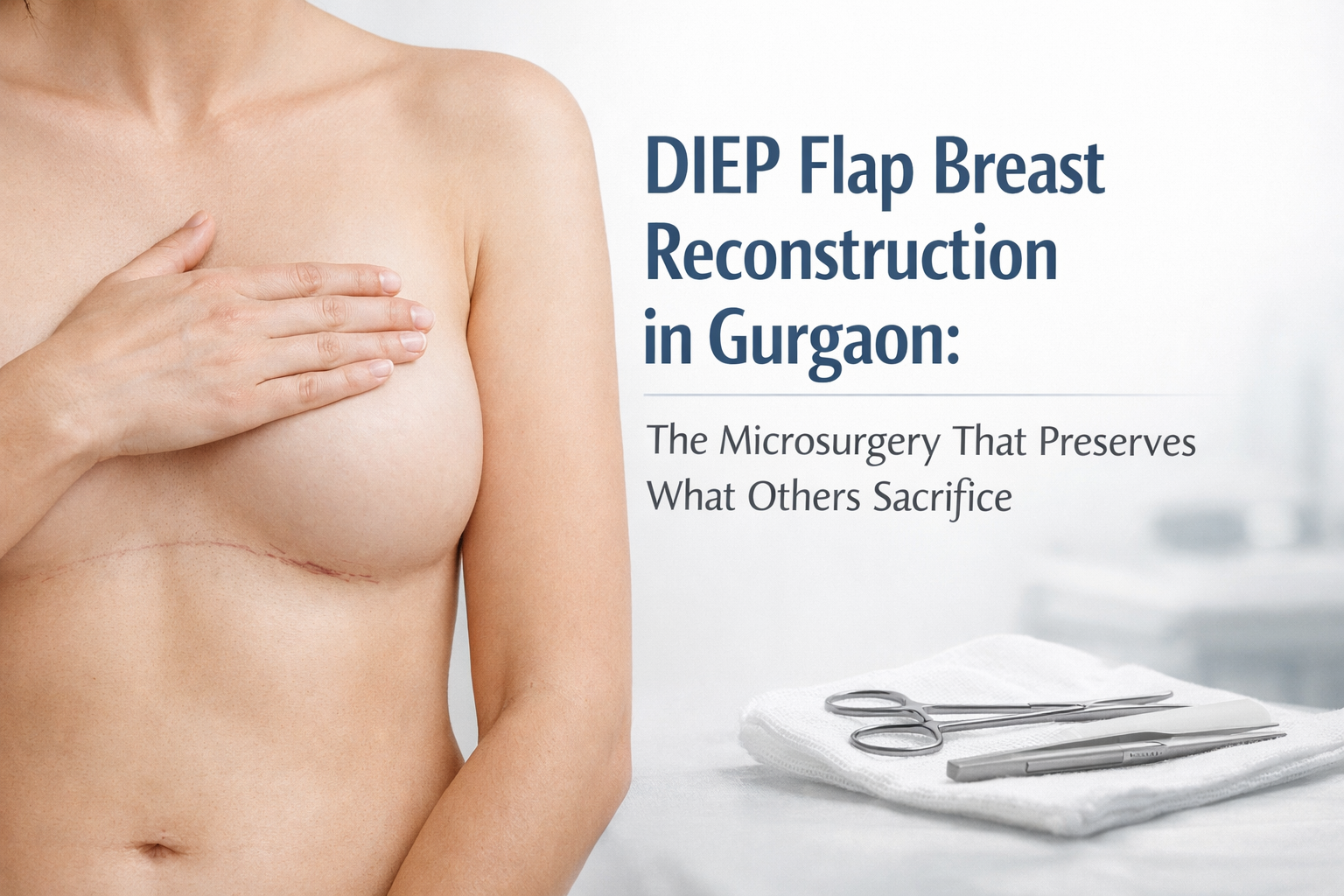
DIEP flap breast reconstruction in Gurgaon is defined by what it does not do. Unlike the TRAM flap that preceded it as the standard of care, the DIEP — Deep Inferior Epigastric Perforator flap — harvests abdominal skin and fat to rebuild the breast without sacrificing the abdominal muscle. The perforator vessels that supply the tissue are dissected free of the muscle under magnification, transferring the tissue with its blood supply intact while the muscle wall remains completely undisturbed.
The practical consequence of this distinction is significant: women who undergo DIEP flap breast reconstruction surgery retain full abdominal muscle function, carry a much lower risk of abdominal hernia, and recover a core strength that older flap techniques measurably compromised. The breast itself — built from the patient’s own living tissue rather than a silicone implant — behaves like natural tissue: it warms to the touch, changes with weight, and ages naturally with the body. For women who have undergone a mastectomy, this combination of outcomes represents the closest reconstruction to the original breast that current surgical techniques can achieve.
Book a reconstruction consultation with Dr. Pradeep Kumar Singh at Artemis Hospital, Gurugram, or call +91 82879 23924 to discuss whether DIEP flap reconstruction is appropriate for your situation.
The DIEP Flap: What the Procedure Actually Involves
DIEP stands for Deep Inferior Epigastric Perforator — the specific blood vessels supplying the abdominal skin and fat used in the reconstruction. Understanding the anatomy clarifies why the technique is both more demanding and more beneficial than its predecessors.
The deep inferior epigastric artery and vein run along the inner surface of the rectus abdominis. Perforator branches pass through the muscle fibres to supply the overlying skin and fat. In a DIEP procedure, these vessels are dissected free of the muscle under microscopic magnification so that the skin and fat above are harvested with an intact blood supply, without removing or cutting the muscle.
The harvested tissue is transferred to the chest, where the flap’s vessels are joined to recipient chest wall vessels using microsurgical anastomosis — sutures placed under an operating microscope, joining arteries and veins two to three millimetres in diameter. Once blood flow through the anastomosis is confirmed, the flap is shaped into the breast mound. The procedure takes six to eight hours for a unilateral reconstruction and ten to twelve hours for bilateral.
DIEP Flap vs TRAM Flap: Why the Muscle Difference Matters
The TRAM flap — Transverse Rectus Abdominis Myocutaneous flap — uses the same abdominal skin and fat as the DIEP, but maintains blood supply differently: a portion or all of the rectus abdominis muscle is harvested with the tissue. This eliminates the need for microsurgical anastomosis, but at the cost of the muscle itself.
| Factor | DIEP Flap | TRAM Flap (Pedicled) |
| Abdominal muscle | Preserved completely — perforator vessels only harvested | Partially or fully sacrificed |
| Abdominal strength | No long-term reduction in core strength | Measurable reduction in core strength post-surgery |
| Hernia risk | Very low — muscle wall intact | Higher — muscle wall weakened by harvest |
| Breast naturalness | Tissue freely repositioned — optimal shaping | Tissue pedicle limits positioning flexibility |
| Microsurgery required | Yes — vessel anastomosis under microscope | No — pedicled blood supply |
| Surgical duration | 6–8 hours (unilateral), 10–12 hours (bilateral) | 4–6 hours |
| Surgeon requirement | Microsurgical expertise essential | Standard plastic surgery training |
The DIEP flap’s muscle preservation advantage is not cosmetic. The rectus abdominis contributes to posture, trunk flexion, and core stability. Its sacrifice in TRAM procedures produces measurable, long-term reductions in core strength and a weakened abdominal wall susceptible to hernia. For women who are physically active or want to return to exercise after reconstruction, the DIEP’s muscle-sparing approach is a meaningful clinical advantage.
Who Is an Appropriate Candidate for DIEP Flap Reconstruction?
DIEP flap reconstruction is not appropriate for every woman undergoing mastectomy. The following criteria are evaluated during consultation at Artemis Hospital:
- Adequate abdominal tissue volume: Women who are very lean may not have sufficient abdominal tissue to create a breast mound of adequate size, particularly for larger original volumes. Implant-based reconstruction or alternative donor sites are considered in these cases.
- No previous major abdominal surgery: Prior abdominal surgeries may have disrupted the perforator vessels that the DIEP flap depends on. A pre-operative CT angiogram maps perforator vessel anatomy and confirms suitability before surgery is planned.
- Non-smoker or willing to cease smoking: Smoking significantly increases flap failure risk through microvascular effects. A minimum of four to six weeks’ cessation before surgery is required — ideally longer. Active smokers are not appropriate candidates.
- Overall health status: The procedure involves six to twelve hours of general anaesthesia. Significant cardiovascular disease, poorly controlled diabetes, or other conditions increasing anaesthetic risk require pre-operative optimisation and specialist clearance.
- Realistic understanding of the recovery: Recovery involves both a chest and an abdominal donor site wound. Hospital stay is three to five days. Full recovery to normal activity takes six to eight weeks, more significant than implant-based reconstruction, requiring practical and psychological preparation.
Immediate vs Delayed DIEP Reconstruction: Timing and Oncology
Whether DIEP reconstruction is performed simultaneously with the mastectomy (immediate) or months later (delayed) is determined in coordination with the oncology team based on several clinical factors:
- Immediate reconstruction: Performed at the same time as the mastectomy, immediate reconstruction preserves the natural breast skin envelope and typically produces the most aesthetic result. The patient wakes with a breast mound already present. It is appropriate when post-operative radiotherapy is not planned — radiation applied to a DIEP flap can cause fat necrosis and fibrosis in the transferred tissue.
- Delayed reconstruction: The safer approach when post-mastectomy radiotherapy is required. Waiting until radiation is complete and the chest wall has recovered allows reconstruction into stable tissue without radiation-related complications.
- Delayed-immediate reconstruction: A tissue expander is placed at mastectomy to preserve the skin envelope, then exchanged for the DIEP flap once oncological treatment is complete — preserving some aesthetic advantages of immediate reconstruction whilst avoiding radiation damage to the final flap.
Dr. Pradeep Kumar Singh works in close coordination with the oncology team at Artemis Hospital to determine the optimal timing for each patient. Women from DLF Phase 2, Golf Course Road, Magnolias, Sushant Lok, Greater Kailash, Vasant Vihar, Jor Bagh, Haus Khas, and Gold Links who have undergone DIEP reconstruction at Artemis Hospital report that the joint oncology and plastic surgery planning process gave them clarity at a time when it was difficult to find.
What Recovery From DIEP Flap Reconstruction Involves
Recovery from DIEP flap breast reconstruction is more involved than recovery from implant-based reconstruction — and being well-prepared for this reality produces better outcomes than being surprised by it.
- Hospital stay (Days 1–5): The flap is monitored using a hand-held Doppler device, checking blood flow hourly for the first 24–48 hours. Any sign of vascular compromise requires immediate return to theatre. This monitoring phase necessitates several days of hospital admission.
- Week 1–3 (At home): Gentle walking is encouraged — it reduces deep vein thrombosis risk. Both sites require dressing care. Patients walk initially with a slightly bent posture to reduce abdominal closure tension, straightening progressively over two to three weeks.
- Week 4–6: Driving typically from week four. Light work resumes. No lifting or strenuous exercise.
- Month 2–3: Full return to normal activity. The reconstructed breast continues to soften and settle. The abdominal donor site scar is in the active fading phase.
- Month 6 onwards: Nipple reconstruction and areola tattooing are performed as secondary procedures at this stage. The final result is fully visible.
Microsurgical Breast Reconstruction at Artemis Hospital, Gurgaon
DIEP reconstruction requires microsurgical expertise, extended operating time, an operating microscope, and dedicated post-operative monitoring. Not all hospitals or surgeons offering breast reconstruction have the perforator dissection experience that the DIEP technique specifically requires.
Dr. Pradeep Kumar Singh — MCh in Plastic Surgery, SMS Medical College, Jaipur; Fellowship from St Louis Hospital, Paris; APSI member — performs DIEP flap reconstruction at Artemis Hospital, a JCI and NABH-accredited facility in Sector 51, Gurugram. The hospital infrastructure supports extended microsurgical procedures with dedicated theatre teams and post-operative flap monitoring. For women across Gurgaon and South Delhi, Artemis Hospital offers the microsurgical expertise, oncology coordination, and institutional accreditation that this procedure requires.
Patients from Palam Vihar, Nirvana Country, Sector 42, DLF Camelia, Golf Course Extension, Ardee City, Shanti Niketan, Green Park, Chanakyapuri, Vasant Kunj, MG Road, and South Extension have accessed DIEP reconstruction at Artemis Hospital — often after being told elsewhere that implant-based reconstruction was their only option.
Frequently Asked Questions
What is the difference between DIEP flap and implant-based breast reconstruction?
Implant-based reconstruction uses a silicone implant to create the breast mound — a shorter procedure with faster recovery. The DIEP flap uses the patient’s own abdominal tissue, producing a breast that feels, moves, and ages like natural tissue. The DIEP demands more from the surgeon and the patient in recovery, but for appropriate candidates, it produces an outcome that implants cannot replicate.
Is DIEP flap reconstruction available in Gurgaon?
Yes. DIEP flap breast reconstruction is performed at Artemis Hospital, Sector 51, Gurugram, by Dr. Pradeep Kumar Singh. The procedure requires microsurgical expertise and dedicated theatre infrastructure — both available at Artemis Hospital. Patients who have been told autologous reconstruction is not available locally are encouraged to seek a consultation here.
What happens to the abdominal donor site after DIEP surgery?
The donor site leaves a horizontal scar across the lower abdomen — similar in position to a tummy tuck scar. The abdominal skin above is advanced downward and closed, often producing a flatter lower abdomen as a secondary benefit. The muscle remains fully intact and functional. Most patients report no functional limitation from the donor site, with the scar fading substantially over twelve months.
Can DIEP flap reconstruction be done if I have had a caesarean section?
In most cases, yes. A caesarean section scar does not typically disrupt the deep inferior epigastric perforator vessels. A pre-operative CT angiogram maps perforator anatomy individually, confirming whether the relevant vessels are intact. The majority of women with caesarean section scars are found to have intact perforator anatomy and are appropriate candidates.
What if there is not enough abdominal tissue for a DIEP flap?
Insufficient abdominal tissue is the most common reason DIEP is not feasible. Alternative autologous donor sites — such as the thigh (PAP flap) or back (latissimus dorsi flap) — may be considered depending on available tissue and desired volume. Implant-based reconstruction remains a reliable option. The consultation at Artemis Hospital includes an honest assessment of DIEP feasibility and clear alternatives when it is not appropriate.
Reconstruction That Lives With You
The DIEP flap does not simply rebuild a breast shape. It rebuilds living tissue — tissue that warms, responds to touch, and changes with the body over time. The procedure demands more of the surgeon and more of the patient in recovery — and it gives back more in return.
Book now or call +91 82879 23924 to schedule your DIEP flap reconstruction consultation with Dr. Pradeep Kumar Singh at Artemis Hospital.
Or visit Artemis Hospital, Sector 51, Gurugram, Haryana 122001.
Read patient reviews at Dr. Pradeep Kumar Singh on Google.
Dr. Pradeep Kumar Singh — MCh Plastic Surgery, Fellowship Paris, APSI Member — Head of Plastic Surgery, Artemis Hospital, Sector 51, Gurugram.