
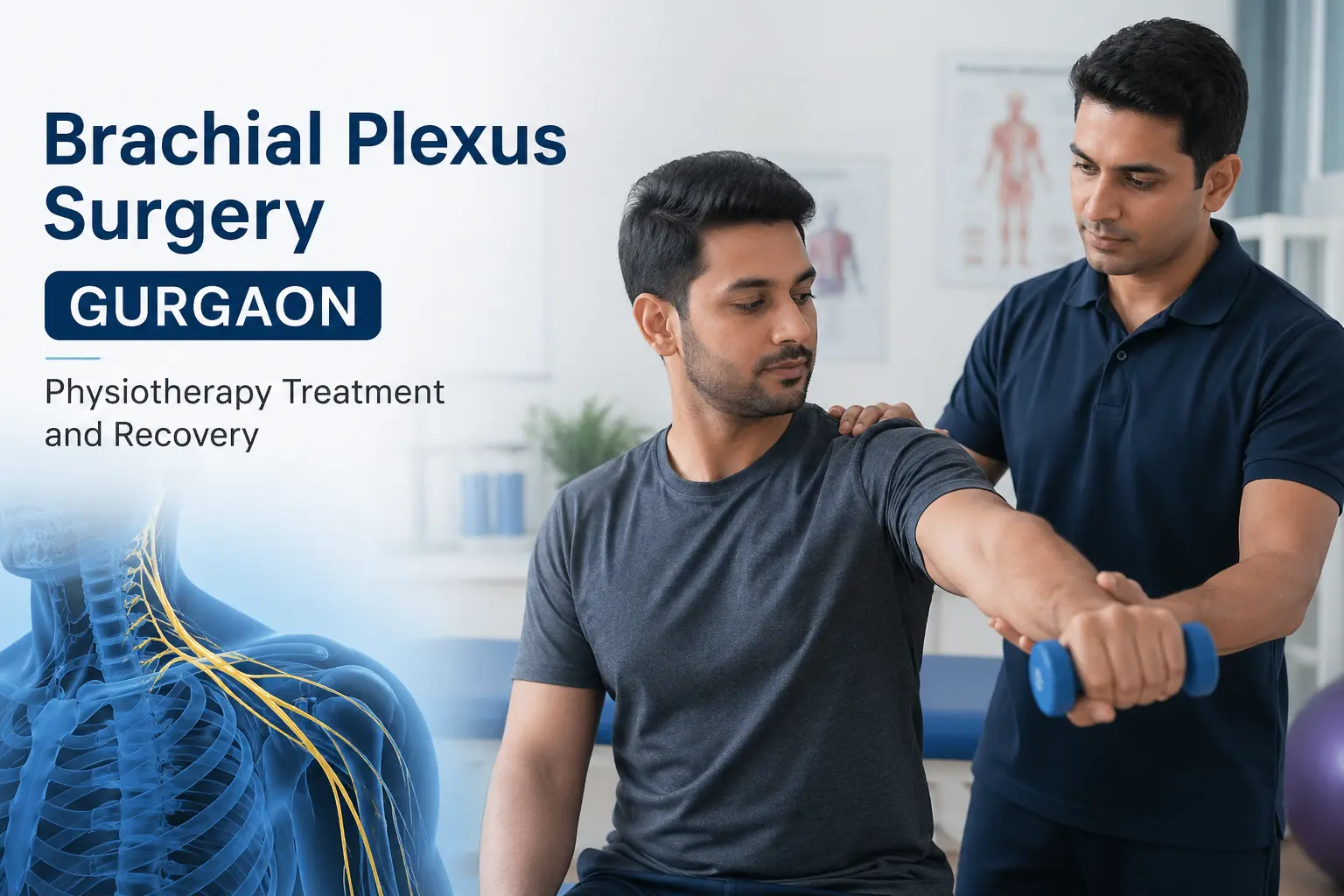
A brachial plexus injury is among the most functionally devastating nerve injuries a person can sustain. The brachial plexus is the network of nerve roots arising from the cervical spinal cord, from C5 through T1, that controls virtually all movement and sensation in the shoulder, arm, and hand. When these nerves are stretched, compressed, ruptured, or avulsed from the spinal cord, the result is a spectrum of disability ranging from transient weakness in specific shoulder muscles to complete and permanent paralysis of the entire upper limb. In India, the most common mechanism of injury is a high-speed motorcycle accident, and the typical patient is a young man in the most productive years of his life.
The management of brachial plexus injury requires a coordinated approach across plastic surgery, neurology, physiotherapy, and occupational therapy. Timing is critical: nerve surgery produces the best outcomes when performed within three to six months of injury, before the target muscles undergo irreversible denervation atrophy. For patients seeking brachial plexus surgery in Gurgaon, the consultation at Artemis Hospital establishes the injury type and severity through clinical examination and advanced imaging, confirms whether spontaneous recovery is proceeding or whether surgical intervention is indicated, and formulates a comprehensive management plan covering surgery, physiotherapy, and long-term rehabilitation.
Book a brachial plexus consultation with Dr. Pradeep Kumar Singh at Artemis Hospital, Gurugram, or call +91 82879 23924 to have your injury assessed and a management plan formulated.
Understanding Brachial Plexus Injury: Types, Severity, and Why Timing Matters
The clinical classification of brachial plexus injuries follows the anatomical level and nature of the nerve damage. Neurapraxia is the mildest form, where the nerve sheath is intact but conduction is temporarily disrupted, and full spontaneous recovery is expected within weeks to months. Axonotmesis involves disruption of the axon within an intact nerve sheath, allowing spontaneous regeneration at a rate of approximately one millimetre per day, but with a recovery timeline of many months and variable completeness. Neurotmesis is a complete nerve disruption requiring surgical repair to achieve any meaningful recovery, while root avulsion, where the nerve root is torn directly from the spinal cord, represents the most severe injury category, as no peripheral reconnection can restore continuity with the central nervous system.
The distinction between these injury types cannot always be made from the clinical presentation alone. MRI myelography and electrodiagnostic studies are used to assess the continuity of the nerve roots, the presence of a pseudomeningocele indicating root avulsion, and the electrical activity pattern of the denervated muscles. This imaging and electrophysiology workup is an essential part of every brachial plexus assessment at Artemis Hospital because the findings directly determine which surgical approach, if any, is indicated and what the realistic recovery trajectory will be.
The most important timing principle in brachial plexus injury management is that surgical nerve repair must be performed before the target muscles undergo irreversible denervation atrophy. Axonal regeneration occurs at approximately one millimetre per day, meaning that a nerve repair at the level of the shoulder may take twelve to eighteen months to reach the distal hand muscles. If the muscles have been completely denervated for too long before reinnervation arrives, they may not recover meaningful function regardless of the success of the nerve repair. Published evidence and clinical consensus agree that surgery is most effective when performed within three to six months of injury for most presentations.
Surgical Options for Brachial Plexus Injury at Artemis Hospital
The surgical approach to brachial plexus injury depends on the injury level, the nerve root involvement, the time elapsed since injury, and the presence of any intact proximal nerve tissue that can be used as a source for repair. The principal techniques available are:
- Neurolysis: Where the nerve is intact but entrapped in scar tissue from the injury, surgical release of the scar compressing the nerve can restore conduction without requiring nerve grafting. This is appropriate for neurapraxia and mild axonotmesis presentations.
- Nerve grafting: Where the nerve has been disrupted, a segment of healthy donor nerve, typically the sural nerve from the lower leg, is used to bridge the gap between the proximal and distal nerve ends. The donor nerve axons regenerate across the graft and eventually reinnervate the target muscles.
- Nerve transfer (neurotisation): Where the proximal nerve root is avulsed and no local donor nerve is available, a functioning but expendable nerve from another source, such as the spinal accessory nerve, intercostal nerves, or contralateral C7, is redirected to power the denervated muscles. Nerve transfer is preferred in root avulsion cases because it provides reinnervation from a proximal source without requiring the axon to traverse the full length of the injured root.
- Free functional muscle transfer: In long-standing injuries where the target muscles have undergone irreversible atrophy and nerve repair alone cannot restore function, a functioning muscle from elsewhere in the body, most commonly the gracilis from the inner thigh, is transplanted to the arm along with its nerve and blood supply. The transplanted muscle is connected to an appropriate donor nerve and trained by the physiotherapy team to perform elbow flexion or finger function.
- Tendon and joint reconstruction: Secondary procedures to address joint contractures, tendon transfers to redirect remaining muscle function, and orthotic support are often performed in the months to years following primary nerve surgery to maximise the functional outcome.
Physiotherapy in Brachial Plexus Injury, Before and After Surgery
Physiotherapy is not a secondary consideration in brachial plexus injury management. It is a parallel and equally essential treatment that begins from the time of diagnosis and continues throughout the recovery, regardless of whether surgery is performed. In the pre-surgical period, the physiotherapy goals are to maintain joint range of motion in the shoulder, elbow, wrist, and fingers against the onset of contracture from muscle imbalance, to prevent further deterioration of denervated muscle through careful use of electrical stimulation, and to educate the patient about the months and years ahead.
After brachial plexus surgery in Gurgaon at Artemis Hospital, physiotherapy transitions from a protective to an active reinnervation-support role. As regenerating axons reach the target muscles over the following months, the physiotherapy programme shifts to sensory re-education, progressive resistance training for returning muscle function, biofeedback to help patients recruit newly reinnervated muscle units, and proprioceptive training to re-establish coordinated upper limb function. The physiotherapy team and the surgical team at Artemis Hospital work in close coordination, with regular joint assessments to align the rehabilitation programme with the clinical signs of reinnervation as they develop.
A case report published in the RGUHS Journal of Physiotherapy documented full functional recovery in a patient with partial brachial plexus traction injury over an eight-month structured rehabilitation protocol. The report emphasised that structured rehabilitation and patient motivation, maintained consistently over the recovery timeline, were the primary determinants of successful rehabilitation, and noted the importance of close communication between surgeons, physiotherapists, and physiatrists in the management of these complex injuries.
Recovery Timeline: What to Expect Month by Month
Patients and families facing brachial plexus injury are better served by an honest recovery timeline than by reassurance that may later prove inaccurate. The recovery from nerve surgery is measured in months and years, not weeks, and the rate-limiting factor is always the biology of axonal regeneration rather than the surgical technique.
| Stage | What Happens |
| Months 1 to 3 post-surgery | No visible functional return yet. Axons are regenerating through the repair site. Physiotherapy focuses on joint protection, passive range of motion, and patient education. |
| Months 3 to 6 | Earliest Tinel’s sign progression, where tapping the nerve along its course produces tingling distally, indicates axon regeneration is progressing. Continued physiotherapy maintains muscle and joint readiness for reinnervation. |
| Months 6 to 12 | Earliest muscle contractions may appear in proximal muscles reinnervated first. Active physiotherapy begins to recruit these emerging motor units. |
| Months 12 to 18 | Progressive reinnervation reaches more distal muscles depending on the level of repair and the length of nerve regeneration required. Functional training intensifies as more muscle groups become active. |
| 18 months to 2 years | Final functional plateau is approached. Assessment determines whether secondary procedures (tendon transfers, muscle transfers) would add further functional gain. |
| Beyond 2 years | Ongoing functional optimisation through physiotherapy and occupational therapy. Myoelectric and other orthotic devices may be appropriate for residual functional deficits. |
Pain Management in Brachial Plexus Injury
Neuropathic pain is one of the most significant and least visible consequences of brachial plexus injury. Root avulsion injuries in particular produce severe deafferentation pain, a centrally mediated pain that can be experienced in a limb that is otherwise completely insensate. Patients describe this pain as burning, electric, or crushing, and it can be severe enough to significantly disrupt sleep, work, and psychological well-being. This pain is resistant to standard analgesics and requires specialist management.
The pain management programme for brachial plexus injury patients managed through brachial plexus surgery in Gurgaon at Artemis Hospital includes pharmacological management with neuropathic pain agents, nerve block procedures where indicated, and psychological support because the combination of disability, pain, and prolonged recovery creates a significant psychosocial burden. Some patients with intractable deafferentation pain benefit from surgical pain management procedures, including dorsal root entry zone lesioning, which addresses the central sensitisation mechanism of root avulsion pain. Involvement of a pain specialist is an integral part of the multidisciplinary care team at Artemis Hospital for these patients.
Brachial Plexus Surgery Gurgaon at Artemis Hospital
Dr. Pradeep Kumar Singh performs brachial plexus injury surgery in Gurgaon at Artemis Hospital, a JCI and NABH-accredited facility in Sector 51, Gurugram. His MCh in Plastic Surgery from SMS Medical College, Jaipur, and Fellowship in Advanced Aesthetic Surgery from St Louis Hospital, Paris, include training in the microsurgical techniques that nerve grafting, nerve transfer, and free functional muscle transfer require. Brachial plexus injuries are managed at Artemis Hospital within a multidisciplinary framework that includes plastic surgery, physiotherapy, occupational therapy, pain management, and psychological support, coordinated from a single centre to avoid the fragmentation of care that is unfortunately common in the management of these complex injuries. As Head of the Department of Plastic Surgery and a member of the Association of Plastic Surgeons of India, Dr. Pradeep Kumar Singh, MCh Plastic Surgery, Fellowship Paris, APSI Member, has specific experience in the surgical management of brachial plexus injuries across the full spectrum from neurapraxia through to complete root avulsion.
Patients seeking brachial plexus surgery Gurgaon and brachial plexus injury treatment travel to Artemis Hospital from DLF Phase 2, DLF Phase 4, Golf Course Road, Magnolias, Sushant Lok, Sector 56, Nirvana Country, DLF Camelia, Ardee City, Sector 42, M3M Golf Estate, Palam Vihar, Greater Kailash, Defence Colony, Vasant Vihar, Jor Bagh, Gold Links, Shanti Niketan, Haus Khas, Anand Niketan, Gulmohar Park, Green Park, Vasant Kunj, and South Extension.
Frequently Asked Questions
What is the success rate of brachial plexus surgery?
Success in brachial plexus surgery is measured in functional terms: the return of meaningful motor and sensory function in the affected limb. Published outcomes from major centres indicate that nerve grafting for complete rupture injuries achieves useful functional return in 60 to 80 per cent of cases when performed within the optimal surgical window. Nerve transfer outcomes depend heavily on the donor nerve selected and the target muscle being reinnervated. Free functional muscle transfer achieves useful elbow flexion in the majority of appropriately selected patients. The two factors most significantly associated with outcome are delay in surgery and the number of avulsed nerve roots.
How long does recovery from brachial plexus surgery take?
Recovery from brachial plexus surgery is measured in months to years rather than weeks. Axonal regeneration proceeds at approximately one millimetre per day, meaning that reinnervation of muscles at the elbow level may take six to twelve months following a shoulder-level repair, and reinnervation of hand muscles may take eighteen months to two years or longer. The physiotherapy programme runs throughout this entire period. Most patients reach their functional plateau at eighteen months to two years after surgery, at which point any remaining deficits are addressed with secondary reconstructive procedures or orthotic devices.
Is physiotherapy necessary after brachial plexus surgery?
Physiotherapy is not optional after brachial plexus surgery in Gurgaon or anywhere else: it is a clinical necessity. Without structured physiotherapy, surgical nerve repair cannot achieve its full potential. The reinnervated muscles must be actively recruited, trained, and strengthened as motor function returns; the joints must be maintained against contracture throughout the waiting period before reinnervation; and the patient must learn to interpret and use newly returning sensation. A structured rehabilitation protocol, maintained consistently over the full recovery timeline, is the single most important determinant of functional outcome after the quality of the surgical repair itself.
Can brachial plexus injury recover without surgery?
Mild brachial plexus injuries, classified as neurapraxia or mild axonotmesis, do recover spontaneously in the majority of cases without surgical intervention. The standard approach is observation with physiotherapy for three to six months after injury. If nerve function does not return within this period, surgical exploration is recommended because the window for effective nerve repair begins to close beyond six months as denervation atrophy progresses. Root avulsion injuries, where the nerve is completely torn from the spinal cord, do not recover spontaneously and require surgical nerve transfer if any functional recovery is to be achieved.
A Complex Injury That Requires a Coordinated Approach
Brachial plexus injury demands the same precision in its management as it inflicts in its damage. The surgical options are technically demanding, the recovery is long, and the physiotherapy programme is as important as the surgery itself in determining how much function ultimately returns. At Artemis Hospital, the approach to brachial plexus injury management integrates surgery, physiotherapy, pain management, and psychological support within a single coordinated care framework, because the outcome of treatment for this injury is determined not by any one of these elements in isolation but by how effectively they work together over the months and years of recovery.
Book now or call +91 82879 23924 to schedule your brachial plexus surgery Gurgaon consultation with Dr. Pradeep Kumar Singh at Artemis Hospital.
Or visit Artemis Hospital, Sector 51, Gurugram, Haryana 122001.
Read patient reviews at Dr. Pradeep Kumar Singh on Google.
Dr. Pradeep Kumar Singh: MCh Plastic Surgery, Fellowship Paris, APSI Member: Head of Plastic Surgery, Artemis Hospital, Sector 51, Gurugram.