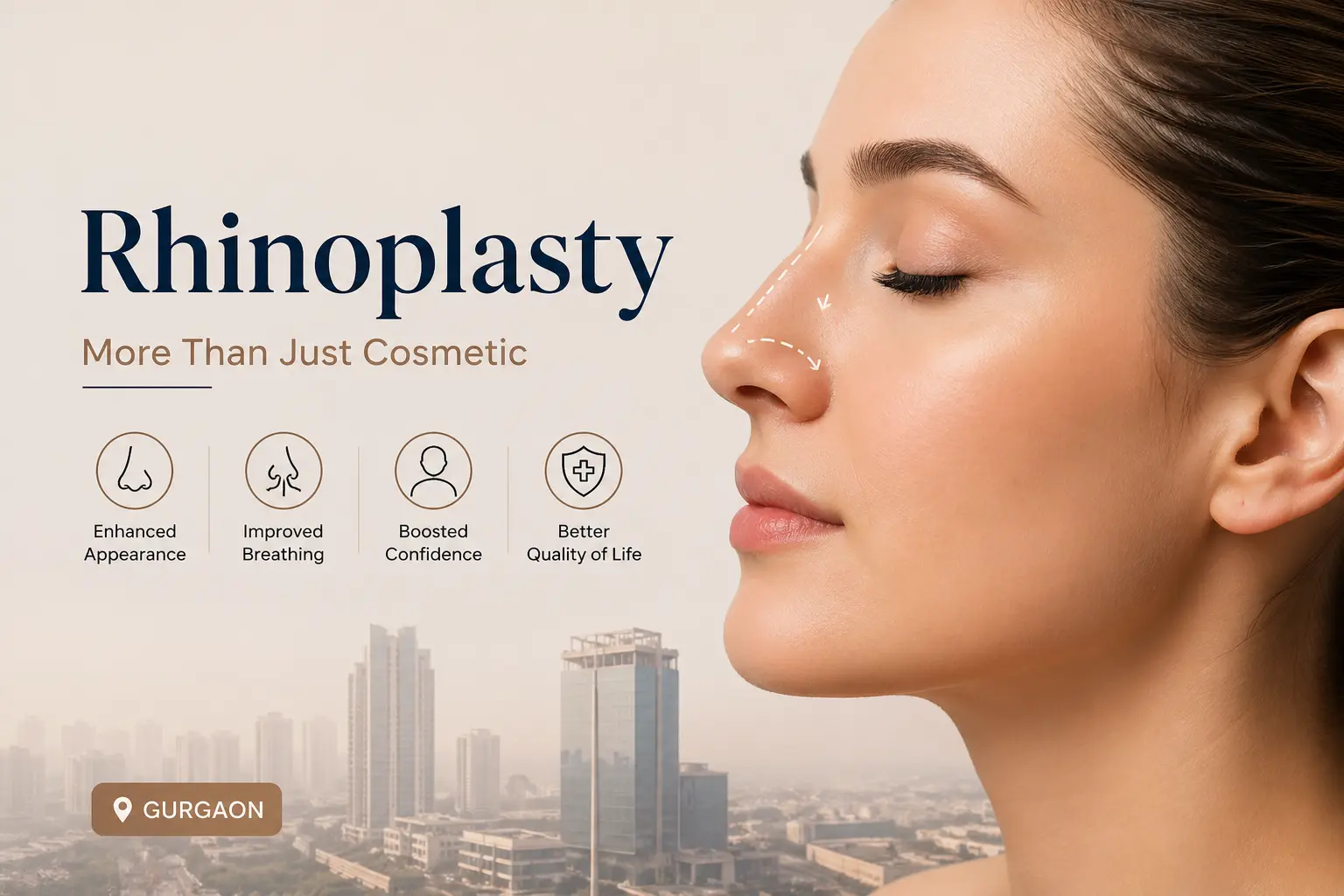
When a patient decides to have their nose reshaped, the reason they give is rarely one-dimensional. Some are bothered by a dorsal hump that has shaped how they feel in photographs and social settings for years. Others have been breathing through one nostril for so long that they have forgotten what full bilateral airflow feels like. Many are managing both at the same time: a nose they are unhappy with aesthetically that also happens to have a deviated septum, causing chronic nasal obstruction. The reality of nose surgery is that it almost always delivers benefits across more dimensions than the patient originally presented for.
This is particularly true when a functional concern, a structural problem affecting nasal airflow, is addressed alongside cosmetic reshaping in the same operative session. The combination, clinically termed septorhinoplasty, corrects the internal architecture of the nose simultaneously with its external appearance. Recovery timelines are consolidated, costs are reduced compared to two separate procedures, and the result addresses both the aesthetic and the functional dimensions comprehensively.
The breadth of outcomes available through rhinoplasty surgery in Gurgaon at Artemis Hospital, across the cosmetic, functional, psychological, and structural dimensions, is what this guide covers. Understanding what nose reshaping surgery can address beyond the visible helps patients arrive at the consultation with a more complete picture of what is possible for their specific presentation.
Book a consultation with Dr. Pradeep Kumar Singh at Artemis Hospital, Gurugram, or call +91 82879 23924 to discuss what rhinoplasty can address for your specific nasal anatomy and concerns.
Improved Breathing: The Most Life-Changing Benefit for Many Patients
Nasal obstruction is more disruptive to daily quality of life than most non-sufferers appreciate. Chronic mouth breathing, reduced sleep quality, daytime fatigue, impaired exercise tolerance, and recurrent sinus infections are all consequences of significant structural nasal obstruction. The structures most commonly responsible are a deviated nasal septum, the central wall that divides the nasal cavity, and enlarged inferior turbinates, which are the scroll-shaped bones inside the nose that regulate airflow and humidity.
Functional rhinoplasty addresses these internal structures directly. When a septum is deviated, it compresses one side of the nasal passage, sometimes partially or almost completely blocking airflow on that side. Septoplasty, the straightening of the deviated septum, is performed through internal incisions with no external scar and is most efficiently combined with any cosmetic nose reshaping rather than performed as a separate procedure. In septorhinoplasty in Gurgaon at Artemis Hospital, the internal functional correction and the external reshaping are performed in the same session under general anaesthesia, allowing a single recovery period to serve both goals. Published clinical studies consistently report that patients who undergo combined septorhinoplasty demonstrate not only improved nasal airflow but also better sleep quality scores and reduced frequency of sinus episodes in the twelve months following surgery.
Facial Harmony: Why the Nose Anchors the Whole Face
The nose is the only facial feature that cannot be adjusted with makeup, framing, or styling. It sits at the centre of the face, and its proportions influence the perceived size, balance, and harmony of every other feature around it. A dorsal hump makes the nose appear disproportionately large and heavy in profile. A bulbous, wide tip diffuses the facial focus. A nose that is too narrow or too long for the facial frame disrupts the visual balance that creates the impression of harmony in the face as a whole.
Cosmetic rhinoplasty surgery in Gurgaon works by adjusting the underlying bone and cartilage framework that shapes the nose. It does not alter the nose in isolation from the face: the goal is always a nose whose proportions fit the specific dimensions of that patient’s face, forehead, chin, and cheekbones. This is why the result of skilled nose reshaping surgery in Gurgaon looks entirely natural rather than operated, because the changed feature now fits the face rather than existing in contrast to it. Patients who felt strongly self-conscious about a specific nasal feature frequently report that the postoperative result is less about the nose itself and more about finally being able to see their face as a whole rather than as a collection of parts.
Psychological Wellbeing: What the Evidence Shows
The evidence for psychological benefit following cosmetic rhinoplasty is substantial and consistent across published studies. A study examining social confidence in ninety rhinoplasty patients found statistically significant reductions in self-consciousness across all measured social contexts following surgery, with patients reporting improved confidence in photographs, professional settings, and personal relationships. A 2025 comprehensive review of functional rhinoplasty outcomes reported that patients who underwent combined septorhinoplasty for both cosmetic and breathing concerns showed the greatest overall quality-of-life improvements compared to those who underwent either procedure independently.
What this evidence does not support is the idea that rhinoplasty resolves psychological distress rooted in causes other than the nose itself. The appropriate candidate for nose reshaping surgery in Gurgaon is someone who has a specific, articulable concern about a nasal feature that surgery can realistically address, and who has realistic expectations about the nature and extent of the improvement. The consultation for rhinoplasty surgery in Gurgaon at Artemis Hospital includes an honest conversation about expectations and motivations, because a patient whose expectations exceed what the anatomy supports will not achieve the psychological benefit that the clinical evidence documents.
Correcting Traumatic Injury and Congenital Deformity
Not every patient who presents for nose surgery in Gurgaon is motivated by aesthetic dissatisfaction. A meaningful proportion carry nasal deformity from a fracture sustained during a road accident, a sporting injury, or a fall, where the bone healed in an abnormal position. Others were born with a congenital nasal asymmetry or structural deformity that has affected both their appearance and their breathing from childhood. Both of these presentations benefit from rhinoplasty, and in both cases, the procedure addresses a genuine structural problem rather than an aesthetic preference.
Post-traumatic rhinoplasty restores the nasal framework to a more anatomically normal position, improving both the profile and the nasal airway. In cases where the fracture occurred within the past few weeks, early treatment is preferable before the bones set in their displaced position. In older injuries where malunion has occurred, osteotomies are required to rebreak and reset the nasal bones under controlled conditions. The full scope of what can be addressed within rhinoplasty surgery in Gurgaon at Artemis Hospital, from cosmetic refinement to post-traumatic reconstruction, is discussed at the consultation based on each patient’s specific anatomy and history.
Structural Correction of the Nasal Tip, Bridge, and Nostrils
Beyond the broad categories of cosmetic and functional rhinoplasty, the specific structural corrections most frequently requested by patients in Gurgaon and across Delhi NCR fall into three main areas. Bridge corrections address dorsal humps or saddle nose deformities, where the bridge is either too prominent in profile or has collapsed inward. Tip corrections address a bulbous, wide, drooping, or pinched nasal tip, where the lower lateral cartilages are refined, repositioned, or supported using cartilage grafts to achieve a more defined and projecting tip. Nostril corrections address excessive flaring or asymmetric nostril shape through small incisions placed in the crease between the nostril and cheek.
Most patients who present for rhinoplasty surgery in Gurgaon at Artemis Hospital require corrections across more than one of these areas, which is why open rhinoplasty, which provides full direct visualisation of all nasal structures simultaneously, is the approach most commonly chosen for complex presentations. The specific structures to be modified are agreed upon at the consultation and documented as part of the surgical plan, so that both the surgeon and the patient have a clear shared understanding of the goals before the procedure begins.
Who Is a Good Candidate for Rhinoplasty Surgery in Gurgaon?
A good candidacy for rhinoplasty surgery in Gurgaon rests on a combination of physical, timing, and psychological criteria. Physically, the candidate should have completed nasal growth, which occurs by the mid-teens in most individuals, though surgeons generally prefer to wait until the patient is in their late teens or early twenties to ensure skeletal maturity. There should be a specific, identifiable structural concern that surgery can realistically address, whether cosmetic, functional, or both. The overlying skin should have adequate quality to redrape cleanly over the new framework.
From a timing perspective, nasal surgery is best planned when the patient is in good general health, is a non-smoker or has committed to cessation for at least four to six weeks before surgery, and is not under significant psychological stress related to other life circumstances. Psychologically, the candidate for rhinoplasty surgery in Gurgaon should have a specific, realistic, and self-motivated goal rather than a desire to resemble a reference photograph or to satisfy another person’s preference.
Dr. Pradeep Kumar Singh, Rhinoplasty Surgeon, Gurgaon at Artemis Hospital
Dr. Pradeep Kumar Singh performs nose reshaping surgery in Gurgaon at Artemis Hospital, a JCI and NABH-accredited facility in Sector 51, Gurugram. His MCh in Plastic Surgery from SMS Medical College, Jaipur, and Fellowship in Advanced Aesthetic Surgery from St Louis Hospital, Paris, provide both the technical breadth to address cosmetic, functional, and reconstructive nasal presentations and the aesthetic sensitivity to plan corrections that enhance rather than alter the patient’s individual facial character. As Head of the Department of Plastic Surgery and a member of the Association of Plastic Surgeons of India, Dr. Pradeep Kumar Singh, MCh Plastic Surgery, Fellowship Paris, APSI Member, brings the discipline of plastic surgery to every rhinoplasty consultation at Artemis Hospital.
Patients seeking rhinoplasty surgery Gurgaon travel to Artemis Hospital from DLF Phase 2, DLF Phase 4, Golf Course Road, Magnolias, Sushant Lok, Sector 56, Nirvana Country, DLF Camelia, Ardee City, Sector 42, M3M Golf Estate, Palam Vihar, Greater Kailash, Defence Colony, Vasant Vihar, Jor Bagh, Gold Links, Shanti Niketan, Haus Khas, Anand Niketan, Gulmohar Park, Green Park, Vasant Kunj, and South Extension.
Frequently Asked Questions
Does rhinoplasty surgery improve breathing?
Yes, when a functional component is included in the procedure. Septorhinoplasty in Gurgaon, which combines correction of the deviated nasal septum and enlarged turbinates with cosmetic nose reshaping, consistently improves nasal airflow, sleep quality, and exercise tolerance in patients with documented nasal obstruction. The functional component does not add significantly to recovery time when combined with cosmetic rhinoplasty in a single session.
How long does rhinoplasty take to show its final result?
The nasal splint is removed at seven to ten days, at which point most swelling and bruising are visible. Swelling in the tip and bridge resolves progressively over three to four months, but the deep tissues, particularly in patients with thicker skin, continue to refine and settle for up to twelve months. The accepted convention is that the final result of rhinoplasty surgery in Gurgaon is assessed at the one-year mark, not immediately after the initial swelling resolves.
Can rhinoplasty correct a broken nose?
Yes. Post-traumatic rhinoplasty addresses nasal fractures that have healed in a displaced position and restores the nasal framework to a more normal profile and airway. The specific approach depends on how long ago the fracture occurred, whether the bones have fully set in the displaced position, and the degree of both cosmetic and functional disruption. All of these factors are assessed at the rhinoplasty surgery consultation at Artemis Hospital.
Is rhinoplasty surgery permanent?
Yes. The changes made to the nasal bone and cartilage during rhinoplasty are permanent. The nasal bones do not revert to their pre-operative position, and cartilage reshaping and grafting produce lasting structural changes. Natural ageing of the overlying skin continues after surgery, but this affects all facial features and does not undo the structural corrections made during rhinoplasty. The final settled result of nose reshaping surgery in Gurgaon at Artemis Hospital is stable and lasting.
More Than Just the Nose
The benefits of nose reshaping surgery in Gurgaon extend well beyond the shape of the nose itself. Improved breathing, better sleep, restored nasal structure after injury, facial harmony, and measurable gains in social confidence and self-image together constitute an outcome that most patients describe as more significant than they expected before they proceeded. At Artemis Hospital, the goal of every rhinoplasty consultation is to understand the full scope of what each patient needs, cosmetic, functional, or both, and to plan the surgery accordingly.
Book now or call +91 82879 23924 to schedule your rhinoplasty surgery Gurgaon consultation with Dr. Pradeep Kumar Singh at Artemis Hospital.
Or visit Artemis Hospital, Sector 51, Gurugram, Haryana 122001.
Read patient reviews at Dr. Pradeep Kumar Singh on Google.
Dr. Pradeep Kumar Singh: MCh Plastic Surgery, Fellowship Paris, APSI Member: Head of Plastic Surgery, Artemis Hospital, Sector 51, Gurugram.