Most people who search for eyelid tightening surgery in Gurgaon are searching from a specific, felt concern rather than a clinical diagnosis. They feel their eyes look tired, heavy, older, or puffy. What they may not know is that these perceptions map to distinct anatomical zones, and the surgery that corrects the upper eyelid concern has no effect on the lower eyelid concern and vice versa. Choosing the wrong procedure, or not recognising that both zones are contributing to the appearance, is the most common source of unmet expectations after blepharoplasty.
This guide maps five specific visual concerns to the procedure that corrects each one, explains what upper and lower eyelid tightening surgery in Gurgaon involves at Artemis Hospital, and gives a week-by-week account of what recovery looks like for each approach. Dr. Pradeep Kumar Singh, MCh Plastic Surgery, Fellowship Paris, APSI Member, performs blepharoplasty as part of a broader facial rejuvenation practice at Artemis Hospital, Sector 51, Gurugram, a JCI and NABH-accredited facility where eyelid surgery is performed with the same precision standards applied to more extensive facial procedures.
To have your eyelid zone concerns mapped to the correct procedure, call +91 82879 23924 or arrange a consultation at Artemis Hospital, Gurugram.
Which Specific Concern Does Each Eyelid Procedure Address?
The clinical starting point for any blepharoplasty consultation is to identify which of the following concerns is present, because each maps to a different procedure:
| Visual Concern | Zone Affected | Correct Procedure |
| Heavy, hooded upper eyelids that look tired | Upper eyelid skin excess | Upper blepharoplasty: skin excision through eyelid crease |
| Puffiness in the inner corner of the upper eyelid | Upper eyelid fat herniation | Upper blepharoplasty with conservative fat removal or repositioning |
| Rounded lower eyelid bags visible when looking forward | Lower eyelid fat herniation | Lower blepharoplasty: transconjunctival or subciliary approach |
| Dark hollow beneath the eye (tear trough) | Volume loss at lid-cheek junction | Lower blepharoplasty with fat repositioning to tear trough, or filler |
| Crepey texture and fine lines on lower eyelid skin | Lower eyelid skin quality | Subciliary lower blepharoplasty with skin excision, or laser resurfacing |
| Drooping eyelid margin covering the pupil | Levator muscle weakness (ptosis) | Levator repair: different procedure from blepharoplasty; requires specialist assessment |
A patient presenting to Artemis Hospital for eyelid tightening surgery in Gurgaon with both upper hooding and lower bags has two anatomically distinct concerns that require two different procedures, either performed simultaneously or staged. The consultation assessment covers all zones before any surgical plan is agreed.
What Upper Eyelid Tightening Surgery in Gurgaon Involves
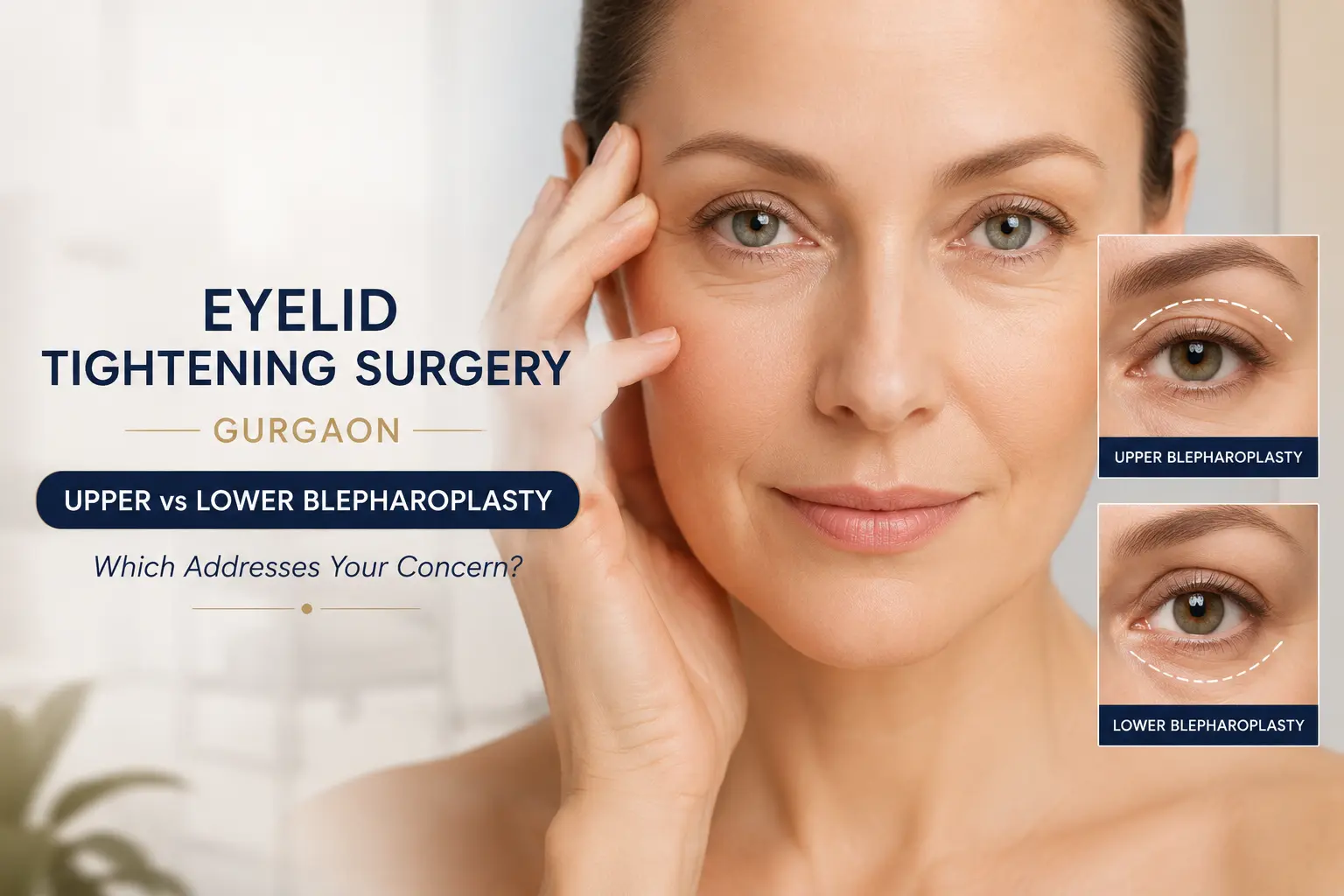
Upper blepharoplasty is performed through a single incision placed precisely in the natural upper eyelid crease. The incision runs the length of the visible eyelid between the inner and outer corners, and it heals to a virtually invisible line within two to three months because it lies exactly in the skin fold that already exists in the resting eyelid. Through this incision, the surgeon removes the calculated amount of excess skin, addresses any upper eyelid fat herniation with conservative fat removal or repositioning, and repairs the incision in fine interrupted sutures.
The calculation of how much skin to remove is the most technically demanding aspect of upper blepharoplasty. Removing too little leaves results in residual hooding. Removing too much creates lagophthalmos, where the eye cannot fully close, producing dry eye symptoms and a wide-eyed appearance that does not look natural. Published guidelines from the American Society of Ophthalmic Plastic and Reconstructive Surgery indicate that a minimum of 20 millimetres of skin must remain between the upper eyelid incision and the brow, regardless of the degree of excess present, to ensure the eyelid closes completely. At Artemis Hospital, this measurement is taken at the consultation before any upper eyelid tightening surgery in Gurgaon is planned.
Operative time for upper blepharoplasty is 45 to 90 minutes under local anaesthesia with sedation. Most patients are discharged on the same day. Sutures are removed at five to seven days, and most patients return to desk work within seven to ten days. Upper eyelid scars in the crease are typically invisible at two to three months.
What Lower Eyelid Tightening Surgery in Gurgaon Involves
Lower blepharoplasty addresses fat herniation and, where present, skin excess in the lower eyelid. The approach depends on what the clinical examination reveals:
Transconjunctival Approach: No External Scar
When lower eyelid fat herniation is the primary concern and the overlying skin quality is good with no significant skin excess, the transconjunctival approach places the entire incision inside the lower eyelid, where it is completely invisible from the outside. The fat compartments are accessed from behind the lower eyelid and are either removed conservatively or repositioned into the tear trough hollow to fill the volume deficit that frequently accompanies lower eyelid fat herniation. This technique, fat repositioning rather than fat removal, is Dr. Pradeep Kumar Singh’s preferred approach for most lower blepharoplasty patients because it avoids the hollow, skeletonised lower eyelid appearance that older fat removal techniques sometimes produced as patients aged further after surgery.
Subciliary Approach: When Skin Excision Is Required
When lower eyelid skin excess and crepey skin texture are present alongside fat herniation, the subciliary approach places a fine incision just below the lower lash line, allowing simultaneous skin removal. This approach heals to a pale scar below the lashes that is well-concealed and largely invisible within three to four months. The subciliary technique is technically demanding because the lower eyelid must be supported during healing to prevent ectropion, where the lower lid pulls away from the eye. At Artemis Hospital, a canthopexy, a small stitch that supports the outer corner of the lower eyelid, is used in selected patients to prevent this complication, particularly in those with pre-existing lower lid laxity.
Patients from Sector 57 and Badshahpur who consult at Artemis Hospital, Sector 51, Gurugram, for eyelid tightening surgery in Gurgaon frequently arrive having identified one concern at home but discover a second zone of change at the examination that they had not attributed to the eyelid specifically. The comprehensive eyelid assessment at the consultation ensures that all contributing zones are identified and that the surgical plan addresses the complete picture.
Can Eyelid Surgery Improve Vision, and Is It Covered by Insurance?
Upper eyelid tightening surgery in Gurgaon is a functionally indicated procedure when significant skin hooding obstructs the superior visual field. When the excess upper eyelid skin descends far enough to cover the upper portion of the pupil, the effective visual field in the superior quadrant is reduced. Patients typically notice this as difficulty reading in overhead light or as the need to tilt the head back slightly to see clearly. A formal Humphrey visual field test, which maps the superior field defect attributable to the eyelid skin, is the clinical documentation required for health insurance coverage consideration in India. At Artemis Hospital, patients with suspected visual field obstruction are referred for this test before the consultation concludes, because confirming the functional component can meaningfully affect the cost of the procedure through insurance coverage.
Eyelid Surgery Recovery in Gurgaon: Week by Week
Upper blepharoplasty recovery is faster and less visible than lower blepharoplasty recovery. Both follow a consistent pattern:
- Days 1 to 3: Cold compresses applied for 15 minutes every hour while awake significantly reduce swelling. Bruising peaks on days two and three. Most patients rest at home with the head elevated. No screen time for prolonged periods in the first 48 hours because eye strain increases swelling.
- Days 4 to 7: Upper blepharoplasty sutures are removed at five to seven days. Bruising begins yellowing. Many patients are comfortable leaving the house with sunglasses from day five onward. Lower blepharoplasty patients have more visible bruising at this stage.
- Week 2: Upper blepharoplasty patients return to desk work in most cases. Lower blepharoplasty or combined four-lid blepharoplasty patients typically need ten to fourteen days. Concealer makeup can be applied from day seven to ten once sutures are removed.
- Weeks 3 to 6: Residual swelling resolves progressively. Some patients experience a tightness in the lower eyelid zone that resolves as healing matures. Light exercise resumes at three to four weeks.
- Months 2 to 3: The full result of eyelid tightening surgery in Gurgaon is assessable. Upper eyelid scars in the crease are typically invisible. Lower eyelid subciliary scars have faded to a pale, fine line below the lash line. The improvement in the eyelid contour and the reduction in the appearance of fatigue are fully established.
How Much Does Eyelid Tightening Surgery Cost in Gurgaon?
Eyelid tightening surgery cost in Gurgaon depends on the zones addressed, whether upper eyelid alone or combined upper and lower blepharoplasty is performed, the surgical approach for the lower eyelid (transconjunctival or subciliary), the anaesthesia method, and the facility fees at Artemis Hospital. Upper blepharoplasty under local anaesthesia with sedation has a lower cost profile than combined four-lid blepharoplasty under general anaesthesia with fat repositioning. Where the upper eyelid procedure qualifies as functionally indicated based on documented visual field obstruction, partial insurance coverage may reduce the patient’s out-of-pocket cost. A personalised cost estimate for eyelid tightening surgery in Gurgaon is provided at the consultation after the zone assessment. Call +91 82879 23924 to arrange an assessment at Artemis Hospital.
Frequently Asked Questions
How much does eyelid tightening surgery cost in Gurgaon?
Eyelid tightening surgery cost in Gurgaon ranges based on whether the upper eyelid alone or combined upper and lower blepharoplasty is performed. Upper blepharoplasty under local anaesthesia costs less than a combined procedure under general anaesthesia. A personalised estimate is given at the consultation at Artemis Hospital, Sector 51, Gurugram, after the clinical zone assessment. Where the procedure qualifies as functionally indicated, insurance may contribute to the cost.
What is the recovery time after blepharoplasty in Gurgaon?
Upper blepharoplasty patients return to desk work within seven to ten days. Combined upper and lower blepharoplasty requires ten to fourteen days before most patients are comfortable in professional settings. Sutures from upper blepharoplasty are removed at five to seven days. The full result of eyelid tightening surgery in Gurgaon is assessable at two to three months, when all swelling has resolved, and scars have matured.
Can blepharoplasty improve vision?
Yes, when significant upper eyelid hooding obstructs the superior visual field. A Humphrey visual field test documents the extent of the field defect before surgery. Where visual field obstruction is confirmed, upper eyelid tightening surgery in Gurgaon performed for this functional indication may qualify for partial insurance coverage. At Artemis Hospital, patients with suspected visual field impairment are referred for formal field testing at the consultation.
How long do eyelid surgery results last in Gurgaon?
Upper blepharoplasty results are long-lasting because the skin removed does not regrow. Most patients maintain significant improvement for seven to ten years. Natural ageing continues after surgery, and the upper eyelid may develop new skin excess over time, but the structural improvement from the initial procedure remains meaningful for many years. Lower eyelid fat repositioning results are similarly durable because the repositioned fat integrates with the surrounding tissue.
Is eyelid tightening surgery painful?
Eyelid tightening surgery in Gurgaon is performed under local anaesthesia with sedation or general anaesthesia, so patients do not experience pain during the procedure. The post-operative period involves mild discomfort, primarily tightness and a sensation of swelling, rather than acute pain. Most patients manage comfortably with paracetamol and cold compresses for the first three to four days. The recovery is significantly less uncomfortable than most patients anticipate before the procedure.
What is the best age for eyelid surgery in Gurgaon?
The appropriate age for eyelid tightening surgery in Gurgaon is determined by anatomy, not by a fixed number. Significant upper eyelid hooding can present from the late thirties onward, and lower eyelid fat herniation is genetically determined and may be present and bothersome from the mid-thirties or earlier. Surgery is appropriate when the degree of change is clinically significant, when the patient’s expectations are realistic, and when any vision-related functional concern has been properly assessed. At Artemis Hospital, the consultation determines candidacy based on these criteria.
Eyelid tightening surgery in Gurgaon at Artemis Hospital addresses the specific concern your eyelid zone presents. Call +91 82879 23924 or visit Artemis Hospital, Sector 51, Gurugram, Haryana 122001 to book a clinical zone assessment.
Patient reviews: Dr. Pradeep Kumar Singh on Google.
Dr. Pradeep Kumar Singh: MCh Plastic Surgery, Fellowship Paris, APSI Member: Head of Plastic Surgery, Artemis Hospital, Sector 51, Gurugram.