
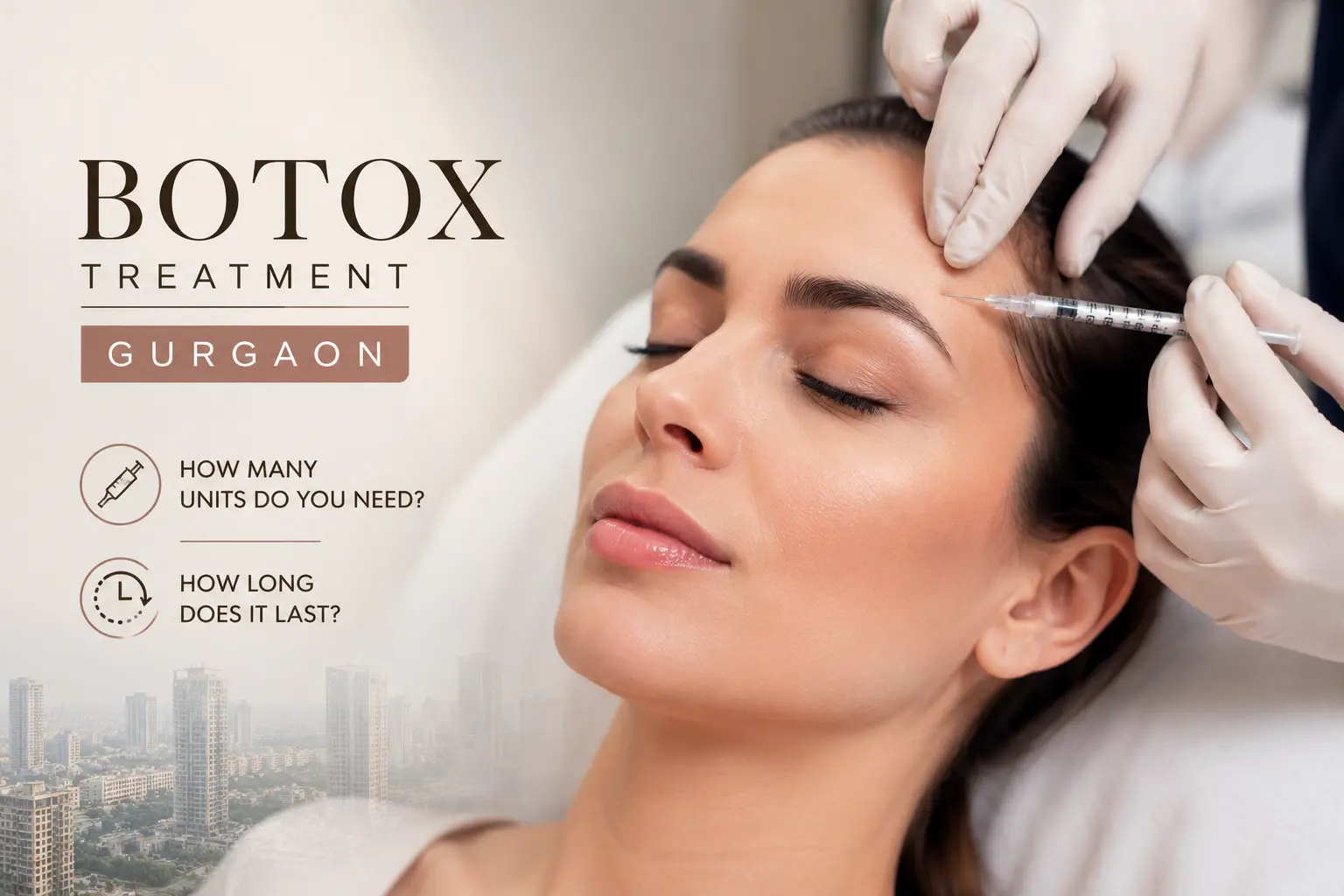
Patients who have researched Botox treatment before the consultation often arrive with a specific question: how many units will I need? It is a reasonable question because Botox in Gurgaon and elsewhere is priced per unit at many clinics, making the unit count directly relevant to cost. But the more important reason to understand units is clinical: the right dose for a given patient in a given treatment area is the dose that produces the intended result without over-treating the muscle to the point of reduced expression, and under-treating the muscle to the point of insufficient effect.
There is no single universally correct unit count for any treatment area. The appropriate dose depends on the patient’s muscle mass, their pattern of dynamic wrinkle formation, their history of previous botulinum toxin treatment, and the specific result they want. Understanding why unit counts vary between patients, what the published clinical standards are for each area, and what determines longevity helps patients evaluate whether Botox treatment in Gurgaon at a particular clinic is being delivered with clinical precision or with a standard template that does not account for individual variation.
To have your facial muscle pattern assessed and a personalised dose plan developed, call +91 82879 23924 or arrange a consultation at Artemis Hospital, Gurugram.
How Botox Units Are Defined and Why They Matter
Botulinum toxin type A is measured in biological activity units, where one unit represents the amount of toxin that produces paralysis in a specific proportion of a standardised laboratory mouse population (the mouse LD50 assay). Different botulinum toxin products, Botox (onabotulinumtoxinA), Dysport (abobotulinumtoxinA), and Xeomin (incobotulinumtoxinA) are calibrated in units that are not directly interchangeable: Dysport units are approximately three times smaller in the muscle-paralysing equivalence than Botox units, meaning that a treatment described as 60 Dysport units is approximately equivalent to 20 Botox units. This is a source of confusion and occasional misdirection in Botox pricing comparisons. At Artemis Hospital, all Botox treatment in Gurgaon uses CDSCO-approved, FDA-certified products with units quoted on a consistent product-specific basis, and patients are always told which product is being used and the unit count for their treatment plan.
Standard Unit Ranges by Treatment Area
Published clinical dosing guidelines and the product prescribing information provide starting ranges for each treatment area. These ranges represent the typical effective dose in an average patient, and they are adjusted up or down based on individual assessment:
| Treatment Area | Standard Dose Range (Botox units) | Clinical Notes |
| Glabella (frown lines) | 20 to 30 units | The most consistently treated area; FDA-approved indication; higher doses for deeper, well-established lines in patients with strong corrugator muscles |
| Forehead (horizontal lines) | 10 to 20 units | Lower doses essential to preserve brow elevation; dose calibrated to muscle mass and existing brow position |
| Crow’s feet (per side) | 10 to 15 units (total 20 to 30 for both sides) | Injected lateral to the orbit; dose balanced against risk of affecting lower eyelid movement |
| Brow lift (depressor relaxation) | 4 to 8 units per side | Targeted injection of lateral orbicularis and corrugator tails; asymmetric dosing for uneven brows |
| Masseter (per side) | 25 to 50 units (total 50 to 100) | Larger muscle; higher dose required; three to four sessions to achieve progressive volume reduction |
| Platysmal bands (per band) | 5 to 10 units per band | Multiple bands treated; effect lasts shorter than facial areas due to muscle activity in neck |
| Chin (mentalis) | 4 to 8 units | Reduces dimpling; lower dose to preserve lip movement |
These ranges are starting points, not fixed prescriptions. A patient with a small, light frontalis muscle and a naturally low brow needs a lower forehead dose than a patient with a heavy frontalis and a high brow. A patient with very strong corrugator muscles creating deep, static glabellar lines needs a higher dose than a patient with mild, purely dynamic frown lines. The clinical assessment at the Botox treatment Gurgaon consultation at Artemis Hospital establishes each patient’s specific muscle pattern and designs the dose plan accordingly.
What Determines How Long Botox Lasts
The duration of botulinum toxin effect is the most variable dimension of the treatment and is a source of frequent patient questions. The clinical average is three to four months for standard cosmetic doses in the standard facial areas. The actual range is two to six months, and understanding the factors that shift a patient’s result within this range helps set realistic expectations and understand why results may differ between sessions:
Dose
Within the therapeutic range, a higher dose generally produces a longer-lasting effect because more of the neuromuscular junction’s acetylcholine release mechanism must recover before muscle activity returns. This is not, however, a licence for over-dosing: doses above the therapeutic range do not extend duration meaningfully and increase the risk of unwanted spread to adjacent muscles. The goal is the minimum dose that produces the desired clinical effect in each patient.
Muscle Mass and Activity Level
Larger muscles with higher resting activity, the masseter being the most obvious example, have proportionately shorter durations of effect because the neuromuscular junction regeneration keeps pace with the degree of toxin present. This is why masseter Botox treatment in Gurgaon, where the muscle bulk is significant, typically shows a shorter duration than the forehead in the same patient at the same session.
Treatment History
There is good published evidence that patients who undergo regular botulinum toxin treatment over several years develop progressively longer intervals between treatments. The mechanism is twofold: the habitually relaxed muscles gradually reduce their bulk through disuse atrophy, requiring less toxin to achieve the same effect at each subsequent session, and the dynamic wrinkles that the muscle produces become less deeply etched over time because the skin has not been repetitively folded along those creases during the treatment period. This is the most clinically convincing reason for regular Botox treatment in Gurgaon rather than treating only when lines are already visible.
Metabolism and Physical Activity
High levels of physical activity, particularly vigorous aerobic exercise that elevates metabolism, is associated with shorter Botox treatment duration in some patients. This is not well-established in controlled studies but is a consistent clinical observation. Patients who report unusually short duration relative to the dose administered should discuss their exercise pattern and metabolic rate at the consultation, as this may warrant a dose adjustment.
Why More Units Is Not Always Better
A clinical principle that protects against the most common Botox complications is that more is not better in dose selection. The forehead is the clearest example. Forehead lines are produced by the frontalis muscle, which is also the primary brow elevator. A forehead dose that is too high does not produce a natural resting brow position: it produces brow ptosis, where the brow falls to or below the orbital rim, creating a heavy, tired appearance that is the opposite of the refreshed result the patient wanted. The correct forehead dose relaxes the lines while preserving enough frontalis activity to maintain the brow at its resting height. This requires assessing the brow position at rest and during animation before injecting, which is the first step of the clinical assessment for every Botox treatment in Gurgaon at Artemis Hospital.
How to Assess Whether Your Botox Dose Is Right
Patients who have received Botox treatment elsewhere and are considering switching clinics, or who feel their previous results were unsatisfying, can use the following indicators to assess whether the dosing at their previous treatment was appropriate:
- Result lasted less than 8 weeks: This typically indicates underdosing for the patient’s muscle mass. A conservative start is appropriate for a new patient, but if a review at two weeks shows adequate effect, the dose can be adjusted upward at the next session.
- Forehead felt very heavy or brow drooped: This indicates the forehead was overdosed. The frontalis was over-relaxed relative to the brow depressors, causing brow ptosis. The correct adjustment is a lower forehead dose or a dose redistribution toward the depressor muscles.
- One side wore off before the other: Bilateral asymmetric dosing may indicate inconsistent injection technique or different muscle mass on each side. An asymmetric dose plan, where the more active side receives slightly more toxin, may be indicated at the next session.
- No effect visible at two weeks: True resistance to botulinum toxin is rare but documented. More commonly, this indicates incorrect product storage, product dilution beyond specification, or injection into the wrong tissue plane. The review appointment at ten to fourteen days exists precisely to identify and address this.
Patients from Chanakyapuri and the Diplomatic Enclave who attend Botox treatment consultations in Gurgaon at Artemis Hospital receive a personalised dose plan at every session, reviewed against the result of the previous session where applicable. The dose is never a standard template applied to all patients.
Frequently Asked Questions
How much does Botox treatment cost in Gurgaon?
Botox cost in Gurgaon is typically calculated by the number of units administered. The total cost depends on the areas treated and the dose appropriate for each area based on clinical assessment. A personalised cost estimate is provided at the consultation at Artemis Hospital. Call +91 82879 23924.
How long does Botox last in Gurgaon?
The clinical average for Botox treatment in Gurgaon is three to four months for standard cosmetic doses in standard facial areas. The actual range for individual patients is two to six months, depending on dose, muscle mass, treatment history, and metabolic rate. Patients who have regular treatment over several years typically find the interval between sessions extends progressively as the treated muscles gradually reduce their bulk.
Is Botox safe for first-time patients?
Yes. Botulinum toxin type A has one of the most extensive safety records in cosmetic medicine. For first-time patients, conservative dosing with a review at ten to fourteen days to assess the result and determine whether any area needs a small additional dose is standard practice at Artemis Hospital. A conservative start followed by personalised adjustment is safer and produces better long-term results than starting with a high dose in a new patient.
What areas can be treated with Botox in Gurgaon?
The established treatment areas for botulinum toxin in cosmetic practice include the forehead, glabella (frown lines), crow’s feet, brow depressors for non-surgical brow lift, masseter for jawline slimming, platysmal bands in the neck, chin dimpling from mentalis hyperactivity, and bunny lines on the nasal bridge. Each area is assessed individually at the consultation. The treatment plan is developed based on which of the patient’s concerns are dynamic and amenable to botulinum toxin rather than requiring a filler or surgical approach.
How many units of Botox do I need for my forehead?
The standard forehead dose range is 10 to 20 units for botulinum toxin type A, adjusted for the individual patient’s muscle mass, existing brow position, and whether glabellar treatment is being performed simultaneously. Patients with a low resting brow require a lower forehead dose than those with a high brow to avoid brow ptosis. The appropriate forehead dose is assessed at the Botox treatment consultation in Gurgaon based on the brow position at rest and during animation before any injections are placed.
Can I exercise after Botox treatment in Gurgaon?
For the first four hours after Botox treatment in Gurgaon, strenuous exercise is avoided to reduce the risk of toxin migration from the injection site to adjacent muscle groups. Most practitioners recommend waiting until the day after treatment before resuming vigorous exercise. Some patients who participate in very high levels of aerobic exercise note shorter Botox duration than expected, which can be discussed at the consultation and may warrant a dose adjustment.
A personalised dose plan is the foundation of consistent, natural-looking Botox treatment in Gurgaon. To arrange a consultation with Dr. Pradeep Kumar Singh at Artemis Hospital, call +91 82879 23924 or visit Artemis Hospital, Sector 51, Gurugram, Haryana 122001.
Reviews: Dr. Pradeep Kumar Singh on Google.
Dr. Pradeep Kumar Singh: MCh Plastic Surgery, Fellowship Paris, APSI Member: Head of Plastic Surgery, Artemis Hospital, Sector 51, Gurugram.