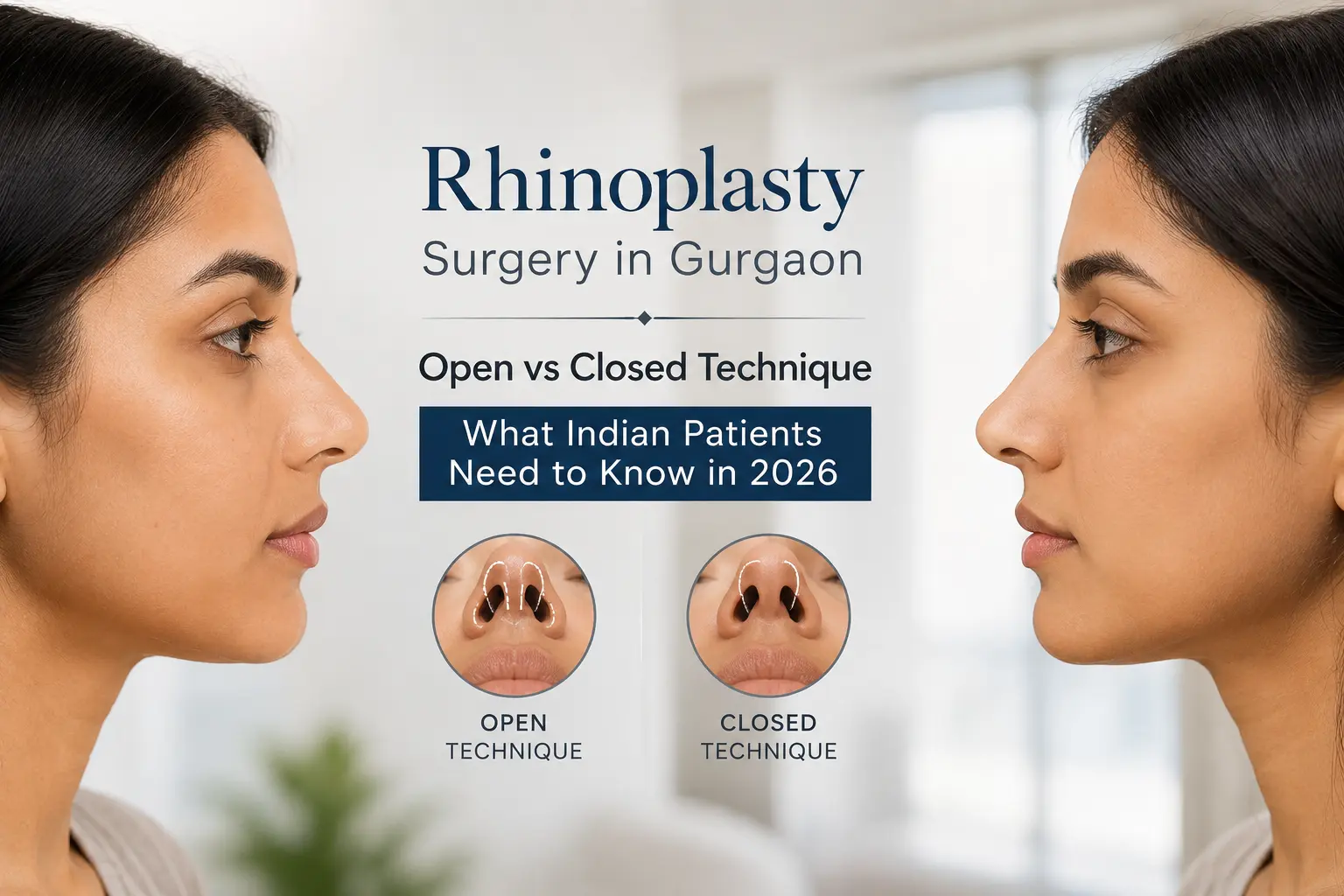
Most of the rhinoplasty information available online is written for, and photographically illustrated with, patients from Western countries with Fitzpatrick Type I to II skin and nasal anatomy that reflects those populations. Indian patients researching rhinoplasty surgery in Gurgaon are reading material that may not apply to their anatomy. Indian nasal anatomy differs in specific and clinically important ways from the noses depicted in most rhinoplasty guides, and these differences determine which techniques are appropriate, what results are achievable, and what recovery looks like.
This guide addresses rhinoplasty surgery in Gurgaon specifically for Indian patients: what makes Indian nasal anatomy different, how the choice between open and closed rhinoplasty techniques is made for Indian presentations, what thick skin means for results and recovery, and what realistic outcomes look like based on published data from 2025 and 2026. Dr. Pradeep Kumar Singh, MCh Plastic Surgery, Fellowship in Advanced Aesthetic Surgery from St Louis Hospital, Paris, performs rhinoplasty surgery in Gurgaon at Artemis Hospital, a JCI and NABH-accredited facility in Sector 51, Gurugram, and brings specific training in ethnic nasal anatomy to every rhinoplasty consultation.
To discuss your nasal anatomy and the appropriate approach for rhinoplasty surgery in Gurgaon, call +91 82879 23924 or arrange a consultation at Artemis Hospital, Gurugram.
What Makes Indian Nasal Anatomy Different and Why It Matters
Four characteristics of Indian nasal anatomy routinely differ from Western nasal anatomy and have direct implications for rhinoplasty planning and outcomes:
Thicker Nasal Skin
Indian patients typically have a thicker nasal skin envelope than Fitzpatrick Type I and II patients, particularly in the tip and supratip zones. Skin thickness determines how much of the underlying cartilage framework refinement becomes visible in the final result. A thin-skinned patient shows the framework changes with high fidelity: even small improvements in cartilage definition are visible on the skin surface. A thick-skinned patient has a substantial soft tissue envelope between the modified cartilage and the external surface. This means that the degree of tip refinement visible after rhinoplasty surgery in Gurgaon is less pronounced in patients with thick skin than in the same structural change in a thin-skinned patient. Managing expectations around this is a fundamental part of the pre-operative consultation. The surgeon can refine the cartilage framework significantly, but the overlying skin reveals that refinement only to the degree its thickness allows.
Less Nasal Tip Projection
Indian noses typically have less forward projection of the nasal tip from the facial plane than Western reference norms. This is a normal anatomical variant, not a deformity. However, it means that tip projection in rhinoplasty for Indian patients often involves cartilage grafting to augment forward projection alongside any refinement work, rather than simply reshaping existing cartilage. The tip grafts used most commonly are the columellar strut, which provides a structural base for tip support, and the tip onlay graft, which adds projection and definition at the dome. These are harvested from the septum in most primary rhinoplasties, with rib cartilage reserved for larger projections or revision cases.
Wider Alar Base
The alar base, the width between the outer edges of the nostrils at the base of the nose, is proportionately wider in Indian patients than in Western reference norms and may require alar base reduction through small incisions placed in the alar-facial crease. Alar base reduction is a simple, well-tolerated procedure with well-concealed scars. Its inclusion in the surgical plan depends on whether the alar base width is disproportionate to the tip projection and dorsal width after the primary corrections are made, which is assessed at the consultation.
Swelling Duration in Thick-Skinned Patients
Thick-skinned patients have a longer postoperative swelling resolution period than thin-skinned patients because the thicker dermis retains oedema fluid more stubbornly. In a thin-skinned patient, 80 per cent of the swelling may resolve within three to four months. In a thick-skinned patient, the same milestone may not be reached until six to nine months, and the final result may take twelve to eighteen months to fully emerge. A 2025 review of rhinoplasty outcomes in South Asian patients reported that thick-skin patients consistently rated their satisfaction higher at twelve months than at six months, confirming that the swelling resolution timeline, not any lack of surgical precision, accounts for the apparent delay in the visible result. This is why the accepted convention for assessing rhinoplasty surgery results in Gurgaon for Indian patients is the twelve-month mark, not the three-month mark.
Open vs Closed Rhinoplasty in Gurgaon: Which Is Right for Indian Noses?
The open rhinoplasty approach, which adds a 4 to 5 millimetre columellar incision to allow the nasal skin to be fully elevated, providing direct binocular visualisation of the entire cartilage framework, is the preferred approach for most Indian rhinoplasty presentations at Artemis Hospital. The reasons are specific to Indian nasal anatomy:
- Tip cartilage grafting requires direct visualisation: Placing a columellar strut, a tip onlay graft, or a shield graft with the precision needed for a natural result requires seeing both lower lateral cartilages simultaneously from above, which is only possible through the open approach. The closed approach’s tunnel view does not provide the spatial orientation needed for reliable graft placement in Indian tip anatomy.
- Thick skin requires deliberate structural planning: In thick-skinned patients, small, conservative framework changes are not visible through the skin. The improvements must be structurally significant to produce a visible result. Planning and executing substantial structural changes reliably requires the full direct visualisation of the open approach.
- Cartilage symmetry assessment: Indian nasal tip cartilages frequently exhibit natural asymmetry. Correcting asymmetry requires seeing both cartilages simultaneously from the same visual angle, which the open approach provides, and the closed approach does not.
The closed rhinoplasty approach in Gurgaon remains appropriate for simpler Indian rhinoplasty presentations: isolated modest hump reduction without tip work, where the tip cartilages do not require modification and the access provided by internal incisions is sufficient for the rasping and cartilage reduction required. For these limited cases, the closed approach avoids the columellar scar while still achieving the correction. The choice between open and closed approaches is made at the consultation based on the specific corrections planned, not as a default choice.
How Many Sessions Does Rhinoplasty Require in Gurgaon?
Rhinoplasty surgery in Gurgaon is performed as a single surgical session under general anaesthesia, typically lasting two to four hours depending on the extent of the corrections and whether septoplasty for breathing is included simultaneously. This is a single operation, not a staged programme. The recovery involves a nasal splint for seven to ten days, swelling resolution over three to eighteen months depending on skin thickness, and a twelve-month assessment appointment to evaluate the final result. Revision procedures, where required, are planned after the twelve-month assessment to allow all swelling to resolve before evaluating what, if anything, requires further refinement.
What Does Rhinoplasty Cost in Gurgaon, and What Does It Include?
Rhinoplasty surgery cost in Gurgaon at Artemis Hospital depends on the extent of corrections required, whether the open or closed approach is used, whether septoplasty is performed simultaneously, the anaesthesia duration, and the facility fees. A comprehensive open rhinoplasty with cartilage grafting, alar base reduction, and simultaneous septoplasty has a different cost profile from a simple closed hump reduction. The cost is personalised at the consultation after the nasal assessment and surgical plan are agreed. Patients from Karol Bagh who travel to Artemis Hospital, Sector 51, Gurugram, for their rhinoplasty surgery consultation in Gurgaon receive a detailed cost breakdown before any decision is required. Contact Artemis Hospital to arrange a consultation.
Rhinoplasty Surgery in Gurgaon: What Realistic Results Look Like for Indian Patients
A realistic result from rhinoplasty surgery in Gurgaon for an Indian patient with typical thick-skin anatomy is a nose that is better proportioned relative to the face, with improved tip definition, a reduced or smoothed dorsal profile, and a balanced alar base width. What it is not is the precise duplication of a thin-skinned reference photograph. The result in a thick-skinned patient will always be more subtle in the degree of tip refinement visible on the skin surface than in an equivalent thin-skinned patient, even when the underlying cartilage framework change is structurally substantial. Communicating this difference honestly at the pre-operative consultation is the aspect of rhinoplasty surgery in Gurgaon that most distinguishes an experienced ethnic rhinoplasty practitioner from one who applies a standard protocol to all patient types.
Frequently Asked Questions
How much does rhinoplasty surgery cost in Gurgaon?
Rhinoplasty surgery cost in Gurgaon at Artemis Hospital depends on the extent of corrections, the approach used (open or closed), whether septoplasty is included, and the facility fees. A personalised estimate is provided at the consultation after the nasal anatomy is assessed. Call +91 82879 23924.
What is the difference between open and closed rhinoplasty in Gurgaon?
Open rhinoplasty adds a small columellar incision to allow the entire nasal framework to be visualised directly. It is preferred for tip work, cartilage grafting, asymmetry correction, and most Indian rhinoplasty presentations. Closed rhinoplasty performs all incisions inside the nostrils and is appropriate for simpler corrections such as isolated hump reduction. The choice is made on technical grounds for each case at the rhinoplasty consultation in Gurgaon.
How long does rhinoplasty swelling last in Gurgaon?
For Indian patients with typical thick nasal skin, rhinoplasty swelling resolves over twelve to eighteen months. The nasal splint is removed at seven to ten days. Most visible bruising clears within two weeks. Eighty per cent of the swelling resolves within three to six months, but the final tip definition in thick-skinned patients continues to emerge until twelve to eighteen months. The accepted convention at Artemis Hospital is to assess the final result at the twelve-month appointment.
Can rhinoplasty fix a deviated septum in Gurgaon?
Yes. Septorhinoplasty, where septoplasty for a deviated septum is performed simultaneously with cosmetic rhinoplasty, addresses both the breathing impairment and the external nasal appearance in a single operative session. At Artemis Hospital, every rhinoplasty surgery consultation in Gurgaon includes a nasal airway assessment to identify whether the septum contributes to both functional and aesthetic concerns that can be addressed together.
How long is the recovery after rhinoplasty surgery in Gurgaon?
The nasal splint is worn for seven to ten days. Most patients are socially presentable within two weeks with residual mild swelling. Return to office work is typically within ten to fourteen days. Physical exercise resumes at four to six weeks. For Indian patients with thick nasal skin, the full result of rhinoplasty surgery in Gurgaon is assessable at twelve months, not at three to six months as some shorter recovery timelines suggest.
Is rhinoplasty surgery painful in Gurgaon?
Rhinoplasty surgery in Gurgaon at Artemis Hospital is performed under general anaesthesia, so there is no pain during the procedure. The post-operative period involves mild discomfort from nasal congestion, the pressure of the splint, and mild bruising, all of which are well-managed with oral medication for the first week. Most patients describe the experience as less uncomfortable than they anticipated. The discomfort reduces significantly once the splint is removed at seven to ten days.
To discuss your specific nasal anatomy and the right rhinoplasty approach for your presentation, call +91 82879 23924 or visit Artemis Hospital at Artemis Hospital, Sector 51, Gurugram, Haryana 122001.
Reviews: Dr. Pradeep Kumar Singh on Google.
Dr. Pradeep Kumar Singh: MCh Plastic Surgery, Fellowship Paris, APSI Member: Head of Plastic Surgery, Artemis Hospital, Sector 51, Gurugram.