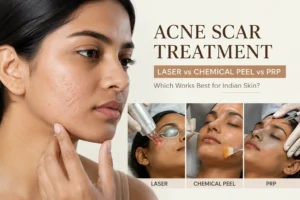

Most patients who walk into a consultation for acne scar treatment in Gurgaon believe their scars have not improved because the treatment was not strong enough. In the majority of cases, the real reason is simpler and more fixable: the treatment that was used was not the right one for the scar type they actually have. Ice pick scars, boxcar scars, and rolling scars each have a different structure beneath the skin, and each requires a different clinical approach. Applying the same modality to all three types, which is what many clinics do, produces partial results for one type and virtually no improvement for the others.
The answer to whether acne scars can be treated is an unambiguous yes. Published clinical data reports 50 to 80 per cent improvement in scar appearance when treatment is matched to scar morphology. The problem is not the absence of effective treatments. It is the mismatch between the treatment selected and the type of scar being treated. Getting this right is the central purpose of a consultation for acne scar treatment in Gurgaon at Artemis Hospital, where scar classification precedes every treatment recommendation.
Book your acne scar consultation with Dr. Pradeep Kumar Singh at Artemis Hospital, Gurugram, or call +91 82879 23924 to have your scar types correctly identified and the right treatment plan prescribed for you.
Why Acne Scar Treatments Fail: The Scar-Type Mismatch Problem
Atrophic acne scars, the depressed scars that form when tissue is lost during healing, are classified into three distinct subtypes based on their shape and depth. Research published in the Indian Journal of Dermatology, Venereology and Leprology in 2026 confirmed through biopsy data that each subtype has a measurably different histological depth, which has direct implications for which treatment reaches it. Ice pick scars had a mean histological depth of approximately 1,933 microns, significantly deeper than boxcar scars at 1,327 microns. This anatomical difference is the clinical reason why laser treatment for acne scars, which works at the surface and mid-dermis, cannot adequately treat ice pick scars but works well on boxcar scars.
The same logic applies to rolling scars, which are structurally different from the other two types. Rolling scars are not deeper than the surrounding skin in the way ice pick and boxcar scars are. Instead, they are pulled downward by fibrous bands that tether the skin to subcutaneous layers beneath. No laser treatment for acne scars or microneedling for acne scars releases those tethers. Only subcision acne scar treatment, which physically severs the fibrous bands from below the skin, addresses the structural cause of rolling scars.
Understanding this distinction transforms how patients evaluate their own treatment history. If you have had laser or microneedling for acne scars and seen no improvement in certain areas of your face, there is a good chance those areas contain rolling scars or deep ice pick scars that require a different intervention entirely.
Ice Pick Scars: Why They Are the Hardest to Treat and What Works
Ice pick scars represent roughly 60 to 70 per cent of atrophic acne scars. They appear as small, deep, V-shaped pits with steep walls, less than two millimetres in diameter, extending deep into the dermis or even into subcutaneous tissue. Their depth makes them resistant to surface treatments. A study by Sardana et al. found that fractional non-ablative laser improved the appearance of ice pick scars in only 25.9 per cent of patients, compared with 52.9 per cent improvement in boxcar scars and 43.1 per cent in rolling scars. This is not because the laser failed, but because it could not physically reach the base of ice pick scars to stimulate collagen from the bottom up.
The treatment with the most consistent published evidence for ice pick scars is the TCA CROSS technique, which stands for chemical reconstruction of skin scars. A high concentration of trichloroacetic acid, typically 70 to 100 per cent, is applied using a fine applicator precisely into the base of each individual scar. The intense focal chemical injury triggers a collagen response from the very floor of the scar upward, progressively raising the scar base toward the skin surface over a series of sessions. Multiple sessions of TCA CROSS, typically four to six spaced four to six weeks apart, produce the most consistent improvements in ice pick scars of any currently available treatment. For the deepest ice pick scars that extend into the subcutaneous layer, punch excision followed by resurfacing after four to six weeks may be required.
Boxcar Scars: Where Laser Treatment for Acne Scars Performs Best
Boxcar scars are broader, round to oval depressions with sharply defined vertical walls and a flat base, one to four millimetres in diameter. Their wider base places them within the effective working depth of fractional laser treatment for acne scars and radiofrequency microneedling. Fractional CO2 laser treatment for acne scars creates controlled columns of ablation through the scar walls and base, triggering collagen remodelling that progressively fills and smooths the depression over three to six months as the new collagen matures. A split-face randomised controlled trial demonstrated greater than 50 per cent improvement in boxcar scars after a single session of cross-linked HA filler combined with subcision, illustrating that even within boxcar scars, the optimal approach depends on depth.
For patients with Indian skin tones, Fitzpatrick phototype III to VI, radiofrequency microneedling for acne scars offers comparable efficacy to ablative fractional CO2 laser treatment for acne scars with a significantly lower risk of post-inflammatory hyperpigmentation. RF microneedling delivers collagen-stimulating heat through fine insulated needles directly into the dermis without ablating the skin surface, which is the mechanism responsible for the pigmentation risk of ablative lasers. At Artemis Hospital, the choice between laser treatment for acne scars and RF microneedling is made at consultation based on the patient’s scar depth, skin tone, and Fitzpatrick phototype.
Rolling Scars and Subcision Acne Scar Treatment: Why the Approach Is Completely Different
Rolling scars are the least common of the three main types, representing approximately 15 to 25 per cent of atrophic acne scars, but they present a fundamentally different treatment challenge. Their broad, undulating depressions are not caused by tissue loss in the conventional sense but by fibrous bands of scar tissue that tether the overlying skin to the subcutaneous layer beneath. Clinical evidence confirms that these fibrous tethers make rolling scars largely unresponsive to surface and mid-dermal treatments. A systematic review found no meaningful change in rolling scars with glycolic acid peels or superficial chemical peels, precisely because those treatments do not reach the subdermal tethers.
Subcision acne scar treatment addresses rolling scars by working beneath the skin surface. A fine needle or cannula is inserted into the subcutaneous plane and manoeuvred under each rolling scar to sever the fibrous bands mechanically. Once the tethers are released, the skin rises toward its natural position and a space is created beneath the previously depressed area. PRP or a biocompatible filler injected into this released space fills the cavity and stimulates ongoing collagen production to maintain the improvement. The combination of subcision followed by HA filler has been shown to yield superior results compared to subcision monotherapy, with effects persisting 18 to 24 months. Two to four sessions spaced four to six weeks apart constitute a typical course.
Acne Scar Treatment Gurgaon: Matching Each Treatment to Each Scar Type
Because most patients present with more than one scar type on the same face, acne scar treatment in Gurgaon at Artemis Hospital is built around a sequenced multi-modality protocol rather than a single treatment applied uniformly. The sequence follows the logic of the anatomy: subcision first to release rolling scar tethers, TCA CROSS for ice pick scars in the same session where applicable, then fractional laser treatment for acne scars or RF microneedling for acne scars to resurface and remodel boxcar scar walls, with chemical peel for acne scars incorporated to address post-inflammatory hyperpigmentation at appropriate intervals.
| Scar Type | What It Looks Like | Primary Treatment | Sessions |
| Ice pick | Deep narrow V-shaped pits, under 2 mm wide | TCA CROSS chemical reconstruction | 4 to 6 sessions, 4 to 6 weeks apart |
| Boxcar | Round or oval depressions with defined vertical walls | Fractional CO2 laser treatment for acne scars or RF microneedling | 2 to 4 sessions, 6 to 8 weeks apart |
| Rolling | Broad, wave-like undulations from sub-dermal fibrous tethers | Subcision acne scar treatment followed by PRP or filler | 2 to 4 sessions, 4 to 6 weeks apart |
| Post-inflammatory hyperpigmentation | Flat dark marks, no loss of skin depth | Chemical peel for acne scars, topical agents, picosecond laser | 3 to 6 sessions, 4 weeks apart |
Do Acne Scars Go Away on Their Own?
Do acne scars go away without treatment is one of the most common questions patients bring to consultation, and the answer depends entirely on the type. Post-inflammatory hyperpigmentation, the flat reddish or dark marks that follow acne lesions without any skin depth change, do fade on their own over 6 to 24 months with consistent sun protection. A chemical peel for acne scars or a brightening topical regimen accelerates this considerably.
Structural atrophic scars are a different matter. Ice pick, boxcar, and rolling scars represent permanent architectural changes in the dermis and subcutaneous tissue. The body’s wound healing process created them, but it will not reverse them. The collagen deficit in boxcar and ice pick scars does not refill over time. The fibrous tethers in rolling scars do not release themselves. Waiting for structural acne scars to resolve is waiting for an outcome that the biology does not support. The only caveat worth noting is that scars treated within one to two years of formation consistently achieve better results than those treated after years of entrenchment, which argues for early intervention once acne itself is controlled.
How Long Does Acne Scar Treatment Take in Gurgaon?
How long does acne scar treatment take is a practical question that depends on the scar types being addressed and the treatments required. There is no single-session solution for any of the three structural scar types. Each modality works by stimulating the body’s own collagen response, which matures progressively over three to six months after each session. The following timelines are realistic benchmarks for patients planning their treatment:
- TCA CROSS for ice pick scars: Four to six sessions, each spaced four to six weeks apart. Mild crusting and redness for five to seven days after each session. Improvement becomes visible from sessions two and three onwards as the scar base rises.
- Laser treatment for acne scars (fractional CO2): Two to four sessions, six to eight weeks apart. Five to seven days of visible redness and peeling after each session. Final result assessed six months after the last session, as collagen continues to remodel.
- Microneedling for acne scars (with PRP): Four to six sessions, four weeks apart, one to two days of redness after each session. Cumulative textural improvement builds progressively from session three.
- Subcision acne scar treatment: Two to four sessions, four to six weeks apart. Bruising resolves in five to seven days. Rolling scar elevation is visible within two to four weeks of each session as new connective tissue fills the released cavity.
- Chemical peel for acne scars: Three to six sessions, four weeks apart. Three to five days of peeling per session. Post-inflammatory hyperpigmentation is visibly lighter in session two.
Patients from across Gurgaon and South Delhi travel to Artemis Hospital for treatment, including from DLF Phase 2, DLF Phase 4, Golf Course Road, Sushant Lok, Sector 56, Magnolias, Nirvana Country, DLF Camelia, Ardee City, M3M Golf Estate, Sector 42, Greater Kailash, Defence Colony, Vasant Vihar, Jor Bagh, Gold Links, Shanti Niketan, Haus Khas, Anand Niketan, Green Park, Gulmohar Park, Vasant Kunj, and South Extension.
Acne Scar Specialist Gurgaon: The Classification-First Approach at Artemis Hospital
The most important thing a skilled acne scar specialist in Gurgaon does before recommending any treatment is to spend time on diagnosis. A proper scar assessment maps which type of scar is present in which zones of the face, because a patient often has ice pick scars on the nose and temples, rolling scars on the cheeks, and boxcar scars on the chin, each requiring a different treatment in the same session. Applying a uniform protocol without this mapping treats one type well and ignores the others, which is why patients who have had multiple laser sessions with no improvement frequently have rolling scars or ice pick scars that the laser simply cannot address.
Dr. Pradeep Kumar Singh is an acne scar specialist. Patients from across Delhi NCR consult at Artemis Hospital, Sector 51, Gurugram, for morphology-driven acne scar treatment. His MCh in Plastic Surgery from SMS Medical College, Jaipur, and Fellowship in Advanced Aesthetic Surgery from St Louis Hospital, Paris, underpin a structured, scar-type-first consultation approach. As Head of the Department of Plastic Surgery at Artemis Hospital, a JCI and NABH-accredited facility, and a member of the Association of Plastic Surgeons of India, Dr. Pradeep Kumar Singh, MCh Plastic Surgery, Fellowship Paris, APSI Member, brings plastic surgery precision to every acne scar treatment plan.
Frequently Asked Questions
1. Is it possible to completely remove acne scars?
Published clinical evidence reports 50 to 80 per cent improvement in scar appearance with correctly matched combination treatment. Complete removal of deep structural acne scars is not consistently achievable because the architectural changes in the dermis can be significantly improved but not fully reversed. However, for the majority of patients who complete a full course of acne scar treatment in Gurgaon, the improvement is sufficient that scars become unnoticeable in daily social interaction and photography.
2. Which treatment is best for acne scars in Gurgaon?
There is no single best treatment because the answer is determined by the scar type present. TCA CROSS is most effective for ice pick scars. Subcision acne scar treatment is essential for rolling scars. Laser treatment for acne scars or RF microneedling for acne scars addresses boxcar scars most effectively. Chemical peel for acne scars manages post-inflammatory hyperpigmentation and shallow textural improvement. Most patients with mixed scar types benefit most from a staged combination of two or three of these modalities, prescribed by an acne scar specialist in Gurgaon after a complete scar morphology assessment.
3. How much does acne scar treatment cost in Gurgaon?
The cost of treatment at Artemis Hospital depends on the scar types present, the number of modalities in the protocol, and the number of sessions required. A personalised cost plan is provided at consultation after the scar assessment is complete. Contact Artemis Hospital to schedule a consultation with Dr. Pradeep Kumar Singh.
4. Can deep acne scars be treated permanently in Gurgaon?
Yes. The collagen produced through TCA CROSS, laser treatment for acne scars, or microneedling for acne scars does not revert. The fibrous tethers severed during subcision acne scar treatment do not regenerate. The structural improvements from properly completed treatment are permanent. What changes after treatment is the natural ageing of the surrounding skin and the formation of any new acne scars if active acne is not kept under control, which is why maintaining acne management after completing the scar treatment course is important.
5. How many sessions are needed for acne scar removal in Gurgaon?
The number of sessions depends on the scar types and severity. Ice pick scars treated with TCA CROSS typically require four to six sessions. Laser treatment for acne scars for boxcar scars requires two to four sessions. Subcision acne scar treatment for rolling scars requires two to four sessions. Microneedling for acne scars is typically performed over four to six sessions. Patients with multiple scar types on a combined protocol generally complete their full treatment course over three to six months, with results continuing to mature for a further six months after the final session.
Treatment That Fits the Scar, Not the Other Way Around
Acne scars are treatable. The question is not whether improvement is possible but whether the right treatment has been matched to the right scar type. Ice pick scars need TCA CROSS. Rolling scars need subcision acne scar treatment. Boxcar scars respond to laser treatment for acne scars and RF microneedling. Post-inflammatory hyperpigmentation responds to chemical peels for acne scars and topical agents. When the protocol is built around the scar morphology rather than a standard procedure applied to all patients, the improvements that clinical evidence consistently demonstrates become achievable for the patient in the chair.
Book now or call +91 82879 23924 to schedule your acne scar treatment Gurgaon consultation with Dr. Pradeep Kumar Singh at Artemis Hospital, Gurugram.
Or visit Artemis Hospital, Sector 51, Gurugram, Haryana 122001.
Read patient reviews at Dr. Pradeep Kumar Singh on Google.
Dr. Pradeep Kumar Singh: MCh Plastic Surgery, Fellowship Paris, APSI Member: Head of Plastic Surgery, Artemis Hospital, Sector 51, Gurugram.