Every year, aesthetic medicine introduces new modalities that are described as game-changers for acne scar treatment in Gurgaon and globally. Some of these genuinely represent advances over what came before. Others represent marketing dressed as science. The challenge for patients researching treatment options is distinguishing between the two, particularly when the clinics offering the newest treatments have the strongest financial incentive to present the evidence in its most favourable light.
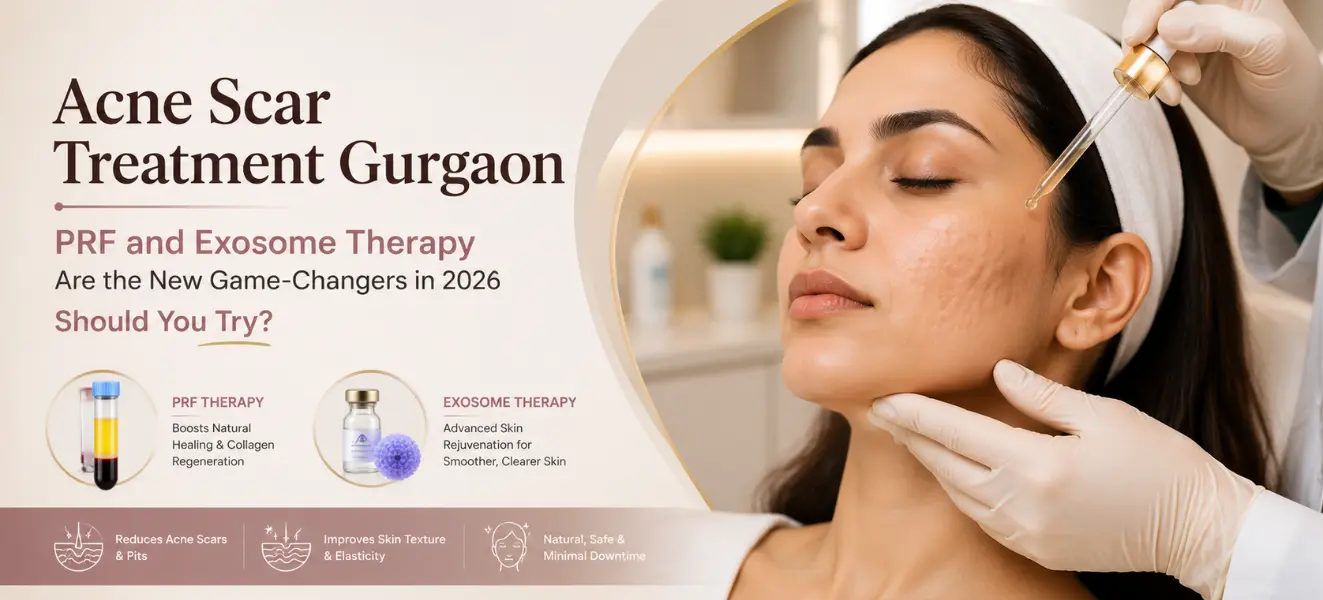
In 2026, two modalities are generating significant interest in acne scar treatment in Gurgaon and across India: platelet-rich fibrin (PRF) therapy and exosome therapy. Both are being positioned as upgrades over platelet-rich plasma (PRP), which has been used in acne scar treatment programmes for over a decade. Both have published clinical evidence. And both require a clear-eyed assessment of what that evidence actually shows before a patient commits to a treatment programme built around either. This guide provides that assessment.
To have your scars classified and the most evidence-appropriate treatment recommended for 2026, call +91 82879 23924 or arrange a consultation at Artemis Hospital, Gurugram.
What Is PRF Therapy for Acne Scars, and How Is It Different From PRP?
Both platelet-rich plasma (PRP) and platelet-rich fibrin (PRF) are autologous treatments, meaning they are derived from the patient’s own blood. Both concentrate the platelet growth factors that stimulate collagen synthesis, fibroblast activity, and angiogenesis in the treated dermis. The difference lies in the preparation method and the resulting biological properties.
PRP is produced by centrifuging the patient’s blood at high speed with an anticoagulant, separating the platelet-rich plasma layer from the red blood cells. The resulting PRP contains concentrated platelets suspended in liquid plasma, which is then injected into the skin. The liquid consistency means PRP disperses from the injection site relatively quickly after administration.
PRF is produced by centrifuging blood at a lower speed without an anticoagulant. This produces a fibrin clot matrix that contains not only concentrated platelets but also white blood cells (leucocytes) and stem cell-like progenitor cells that PRP preparations largely exclude. The fibrin matrix acts as a natural scaffold that retains the growth factors at the injection site over a longer period, providing a more sustained release of the biological signals that promote tissue repair.
Published comparative studies show that PRF consistently produces higher concentrations of key growth factors, including PDGF, TGF-beta, VEGF, and EGF, than standard PRP preparations from the same patient. A 2024 randomised controlled trial published in the Journal of Cosmetic Dermatology compared PRF with PRP for atrophic acne scar treatment in 60 patients with Fitzpatrick Types III to V skin (consistent with the majority of Indian patients). The PRF group showed statistically significantly greater improvement in scar depth at three months compared with the PRP group, with mean improvement of 41 per cent vs 28 per cent using the ECCA grading scale. The PRF group also showed significantly less post-treatment erythema, suggesting a more favourable inflammatory profile in darker skin types.
For Indian patients specifically, the reduced inflammatory response associated with PRF is clinically meaningful because post-inflammatory hyperpigmentation (PIH) from treatment-related inflammation is a recognised risk in Fitzpatrick Types III to V skin. Any treatment that achieves equivalent or superior scar improvement with less treatment-related inflammation is preferable for Indian skin.
Are Exosomes Better Than PRP for Acne Scar Treatment in Gurgaon?
Exosome therapy is the newest and most debated addition to the acne scar treatment toolkit in 2026. Exosomes are nano-sized extracellular vesicles, typically 30 to 150 nanometres in diameter, secreted by cells throughout the body. They function as intercellular communication vehicles, carrying proteins, lipids, RNA, and signalling molecules between cells. When exosomes derived from mesenchymal stem cells (MSC-derived exosomes) are applied topically to the skin or injected intradermally, they deliver a rich payload of growth factors and regulatory signals that promote fibroblast activity, collagen synthesis, and angiogenesis without the inflammatory response that injection of cells or blood-derived products can produce.
The clinical evidence for exosome therapy in acne scar treatment in Gurgaon and globally is early but promising. A 2025 systematic review examining eight published studies on MSC-derived exosome application for skin repair and scarring reported consistent improvement in markers of collagen synthesis and fibroblast activity in all eight studies, with three studies examining atrophic acne scars specifically showing clinical improvement scores comparable with or superior to PRP at equivalent session counts. The authors noted that the evidence base, while positive, is still limited by small sample sizes and short follow-up periods, and that further well-designed randomised trials are needed before exosome therapy can be positioned as a first-line treatment over established modalities.
At Artemis Hospital, the honest clinical position on exosome therapy for acne scar treatment in Gurgaon in 2026 is this: the mechanism is scientifically credible, the early evidence is encouraging, and the safety profile in published studies is excellent. However, the current evidence base does not yet support exosome therapy as a replacement for fractional laser or MNRF in the treatment of significant atrophic acne scarring. It is most appropriately positioned as an adjunct to energy-based treatments, applied alongside or immediately after fractional laser or MNRF to enhance the collagen-stimulating response, rather than as a standalone treatment for structural scarring.
What Is the Right Time to Get Acne Scar Treatment in Gurgaon?
The right time to begin acne scar treatment in Gurgaon is when two conditions are simultaneously met: active acne is controlled, and the patient has realistic expectations about what the treatment programme will achieve. Starting acne scar treatment while active acne lesions are still producing new post-inflammatory marks and structural scarring is counterproductive, because each new active lesion adds to the scar burden that treatment is trying to reduce. A skin care programme that achieves at least 80 per cent control of active acne should precede the start of any acne scar treatment programme.
In 2026, the addition of PRF as a clinically superior adjunct to PRP and the emerging role of exosome therapy mean that the treatment programme available for acne scar patients in Gurgaon is more comprehensive and better-evidenced than it was two or three years ago. Patients who have been waiting to begin treatment because they felt the available options were insufficient may find that the 2026 treatment toolkit, combining subcision for tethered rolling scars, fractional laser or MNRF for atrophic texture, PRF as a growth factor adjunct, and exosome therapy where appropriate, offers a more compelling programme than the one they researched previously. Patients from Tughlaqabad and Sarita Vihar who consult at Artemis Hospital, Sector 51, Gurugram, receive a scar-type classification and a full review of the 2026 treatment options before any programme is recommended.
How Much Does Advanced Acne Scar Treatment Cost in Gurgaon in 2026?
Advanced acne scar treatment cost in Gurgaon in 2026 reflects the multi-modality nature of the most effective programmes. A combined programme incorporating subcision, fractional CO2 or MNRF sessions, PRF adjunct therapy, and exosome application has a higher total cost than a single-modality programme, but produces meaningfully better outcomes for patients with moderate to severe atrophic scarring. The total cost of the programme is discussed at the consultation after the scar type assessment determines the appropriate sequence and number of sessions. A personalised estimate for acne scar treatment in Gurgaon is provided at the initial assessment appointment. Call +91 82879 23924 to arrange a consultation at Artemis Hospital.
Frequently Asked Questions
What is PRF therapy for acne scars, and how effective is it?
PRF (platelet-rich fibrin) is an autologous treatment prepared from the patient’s own blood by centrifugation without anticoagulant, producing a fibrin matrix rich in platelets, leucocytes, and growth factors. Its fibrin scaffold provides a more sustained release of growth factors at the injection site than standard PRP. A 2024 randomised controlled trial in Indian skin types III to V showed 41 per cent scar improvement with PRF versus 28 per cent with PRP at three months, with less post-treatment inflammation in the PRF group, making it a clinically preferable adjunct to energy-based acne scar treatment in Gurgaon for Indian skin.
Are exosomes better than PRP for acne scar treatment in Gurgaon?
The early evidence for MSC-derived exosome therapy is encouraging, with a 2025 systematic review of eight studies showing consistent improvement in collagen synthesis markers and clinical scar scores comparable with PRP. However, the current evidence base is not yet strong enough to position exosomes as a replacement for established modalities such as fractional laser or MNRF. At Artemis Hospital, exosome therapy for acne scar treatment in Gurgaon is offered as an adjunct to energy-based treatments rather than as a standalone programme for significant atrophic scarring.
Is this the right time to get acne scar treatment in Gurgaon?
Yes, if active acne is controlled to at least 80 per cent and treatment expectations are realistic. The 2026 treatment toolkit, combining subcision, fractional laser or MNRF, PRF adjunct, and exosome therapy where appropriate, is the most comprehensive and best-evidenced available. Patients who previously researched acne scar treatment and found the options limited may find the current programme more compelling.
How much does advanced acne scar treatment cost in Gurgaon in 2026?
Advanced acne scar treatment cost in Gurgaon in 2026 reflects the multi-modality nature of the most effective programmes. A personalised cost estimate is provided at the initial assessment consultation at Artemis Hospital after the scar types and the appropriate treatment sequence are determined. Call +91 82879 23924.
How many sessions are needed for complete acne scar removal in Gurgaon?
Significant atrophic acne scarring is improved, not completely removed, by treatment. A comprehensive programme typically involves three to five fractional laser or MNRF sessions over six to nine months, subcision for tethered rolling scars before laser sessions begin, PRF adjunct therapy at selected sessions to enhance the collagen response, and maintenance peels for PIH management between laser sessions. Most patients with moderate to severe scarring achieve 50 to 70 per cent improvement in scar depth and texture over a twelve to eighteen-month programme.
Is acne scar treatment with PRF or exosomes safe for dark Indian skin in Gurgaon?
Yes. Both PRF and exosome therapy use autologous or cell-secreted biological material that carries a negligible PIH risk in Indian skin, making them among the safest adjuncts available for darker Fitzpatrick types. PRF in particular shows a reduced inflammatory profile compared with standard PRP in Indian skin, as documented in the 2024 randomised controlled trial in Fitzpatrick Types III to V. Energy-based treatments combined with PRF or exosomes must still be delivered at conservative settings appropriate for Indian skin, but the adjunct therapies themselves do not add PIH risk.
The 2026 acne scar treatment toolkit in Gurgaon is the strongest it has ever been. To have your scars classified and the right combination of evidence-based modalities recommended for your specific presentation and skin tone, call +91 82879 23924 or visit Artemis Hospital, Sector 51, Gurugram, Haryana 122001.
Reviews: Dr. Pradeep Kumar Singh on Google.
Dr. Pradeep Kumar Singh: MCh Plastic Surgery, Fellowship Paris, APSI Member: Head of Plastic Surgery, Artemis Hospital, Sector 51, Gurugram.