Delhi NCR has one of the highest concentrations of hair transplant clinics in India, and the range of quality within that market is extreme. At one end, established plastic surgery and dermatology departments within accredited hospitals perform hair transplant procedures with trained surgical teams, documented protocols, and verified before-and-after outcomes. At the other end, single-room clinics advertise unlimited grafts, guaranteed hairlines, and before-and-after photographs that may not belong to patients treated at the clinic at all. Patients researching a hair transplant surgeon in Gurgaon frequently cannot distinguish between these extremes from a clinic’s website and marketing materials alone.
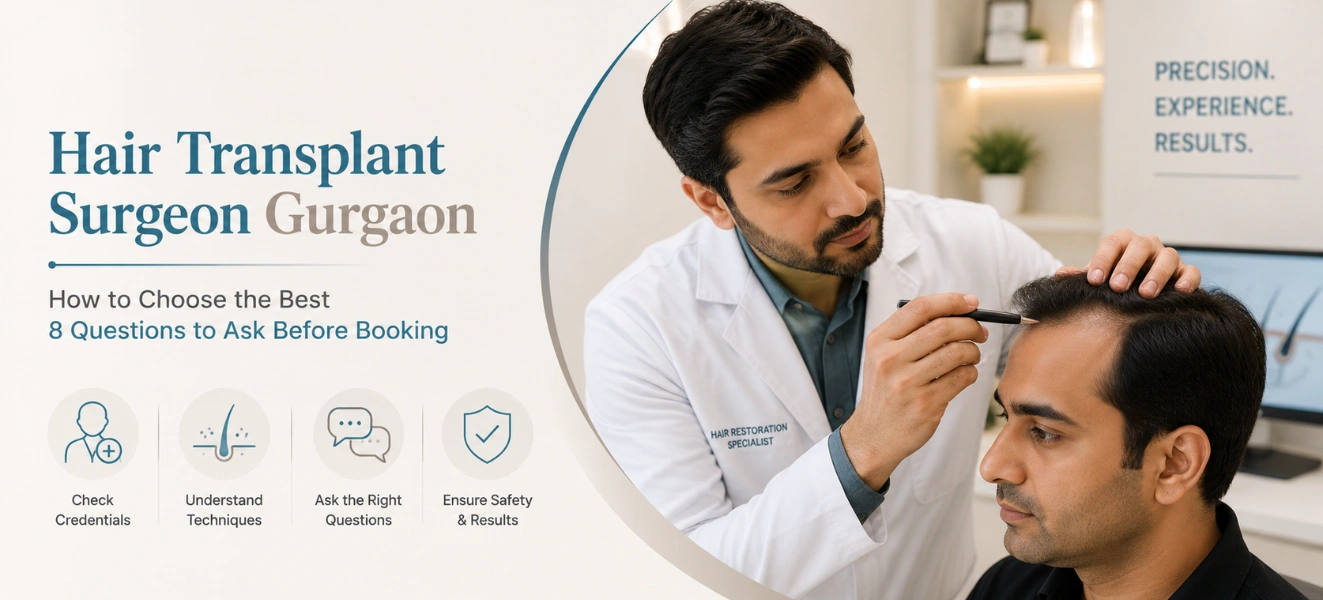
This guide provides eight specific questions that every patient should ask before booking a hair transplant consultation in Gurgaon, with an explanation of what the answers reveal about the clinic’s actual quality and the practitioner’s real credentials. Asking these questions does not require any medical knowledge. It requires only the willingness to ask directly and to treat the answers as the primary basis for your decision rather than before-and-after photographs or online reviews.
To consult a hair transplant surgeon in Gurgaon whose credentials, outcomes, and protocols are transparent, call +91 82879 23924 or arrange a consultation at Artemis Hospital, Gurugram.
Question 1: What Is Your Formal Qualification in Hair Transplant Surgery?
Hair transplant surgery sits at the intersection of plastic surgery and dermatology. A formal qualification in either MCh Plastic Surgery, MD Dermatology, or DNB Plastic Surgery from an NMC-recognised institution provides the foundational surgical and medical training appropriate for a practitioner performing hair transplant procedures. These are the qualifications to look for in a hair transplant surgeon in Gurgaon.
Many clinics promote their hair transplant practitioners as ‘hair transplant specialists’ or ‘trichologists’ without specifying the underlying medical qualification. Trichology is not an NMC-recognised medical specialisation in India. A hair transplant practitioner whose only listed qualification is a trichology diploma or a certificate from a private hair restoration training course has not received the medical training that a qualified surgeon or dermatologist holds. Ask the practitioner to specify their NMC-registered medical qualification, not their hair-specific training certificates.
Important Read: Hair Transplant Surgery Gurgaon: FUE vs FUT vs DHI, Which Method Gives the Best Natural Results?
Question 2: Who Performs the Graft Extraction and Implantation?
In many hair transplant clinics, including some that present a senior surgeon or doctor as the lead practitioner, the actual graft extraction and implantation work is performed by trained technicians rather than by the consulting doctor. Technicians can be highly skilled at mechanical graft extraction and implantation, and in well-supervised clinical settings they contribute to an efficient, high-quality procedure. The issue is transparency: a patient who books a procedure expecting the consulting doctor to perform it has a right to know if technicians will be carrying out the majority of the surgical work.
Ask specifically: ‘Who will perform the graft extraction, and who will implant the grafts?’ The answer will reveal whether the consulting surgeon is present and supervising throughout the procedure, present only for part of it, or primarily a front-of-clinic figure whose role is consultation and marketing rather than hands-on surgical work. At Artemis Hospital, the extent of the surgeon’s direct involvement in the procedure is disclosed at the consultation before any booking is made.
Question 3: How Many Hair Transplant Procedures Do You Perform per Month?
Volume is not a guarantee of quality, but very low volume is a reliable indicator of insufficient case experience to manage the full range of presentations. A hair transplant surgeon in Gurgaon or anywhere in Delhi NCR performing fewer than five to ten procedures per month has limited case exposure compared with a high-volume practice performing twenty or more. Ask for an approximate monthly case volume and ask whether the practitioner has specific experience with your hair loss pattern: diffuse thinning is managed differently from Norwood V frontal and vertex loss, which differs again from scar alopecia after trauma. Relevant experience in your specific presentation is more meaningful than overall case volume.
Question 4: What Is Your Average Graft Survival Rate, and How Do You Measure It?
Graft survival rate, the proportion of transplanted follicles that successfully grow in the recipient area, is the single most clinically important performance metric for a hair transplant surgeon in Gurgaon. Published data from high-volume hair transplant centres report graft survival rates of 90 to 95 per cent with optimal technique. A survival rate below 85 per cent is considered suboptimal and reflects problems with graft handling, ischaemic time, storage conditions, implantation depth, or angle.
Ask the surgeon how they measure their graft survival rate and how they know this number. A clinic that monitors twelve-month post-procedure photographs and counts the density achieved relative to the planned density has data. A clinic that states a survival rate without any description of how it was measured is stating a marketing figure rather than a clinical one.
Question 5: How Do You Verify That Your Before-and-After Photos Are From Your Own Patients?
The use of before-and-after photographs from other clinics, other countries, or stock photograph sources is a documented and widespread problem in the cosmetic surgery marketing landscape in India, and hair transplant clinics are particularly commonly implicated. A patient choosing a hair transplant surgeon in Gurgaon based on dramatically impressive before-and-after photographs may be making their decision on evidence that does not reflect the work of the clinic they are visiting.
Ask the clinic whether the photographs shown are from their own patients, treated by their own team, at their own facility. Ask whether the patient in the photograph can be contacted for a reference. Ask to see dated photographs with consistent background, lighting, and camera angle that indicate a clinical photography protocol rather than a curated marketing selection. A practitioner confident in their own outcomes welcomes this scrutiny. A practitioner who deflects these questions is not providing the transparency that an informed decision requires.
Question 6: What Happens If the Result Is Not What Was Discussed?
No ethical hair transplant surgeon in Gurgaon can guarantee a specific density outcome. Graft survival varies between patients based on recipient site vascularity, the patient’s wound healing biology, the specific hair characteristics, and the surgical technique. What a clinic can guarantee is a process: that the grafts are handled with optimal technique, stored correctly, placed at the right angle and depth, and that the result is reviewed at twelve months with a documented assessment of the outcome relative to the plan.
Ask the clinic specifically: ‘What is your policy if the density achieved at twelve months is significantly below what we discussed?’ A clinic with a clear policy for complimentary additional grafts where a documented shortfall in the planned density is confirmed provides a meaningful commitment to the outcome. A clinic that states results cannot be guaranteed without any further commitment is not providing the post-procedure accountability that patients reasonably expect.
Question 7: Is the Facility Accredited, and What Sterilisation Standards Are Used?
Hair transplant procedures involve multiple skin entry points through the recipient area implantation sites and the donor area extraction sites. Infection control and sterile technique are as relevant for hair transplant surgery as for any other minimally invasive procedure. Ask whether the facility where the procedure is performed is accredited (NABH or equivalent), what sterilisation protocol is used for the extraction punches and implantation devices, and whether the procedure is performed in a clean room environment or in a standard clinic room. A hair transplant surgeon in Gurgaon operating in a NABH-accredited facility has the procedure covered by institutional infection control standards that standalone clinics may not enforce.
Important Read: Hair Transplant in Gurgaon (FUE vs FUT): Best Method for You
Question 8: What Is Included in the Post-Procedure Follow-Up?
The result of a hair transplant procedure is not assessable until twelve months after surgery, as graft growth emerges from three to four months and continues to thicken and mature through the end of the first year. What happens between the procedure date and the twelve-month assessment matters: the post-operative instructions for the first four to seven days (washing protocol, sun avoidance, sleep position) directly affect graft survival, and the one-month, three-month, six-month, and twelve-month follow-up appointments allow the surgeon to monitor progress and identify any concerns early.
Ask what the post-procedure follow-up includes: how many appointments are included, over what timeline, and what the protocol is for concerns between appointments. Patients from Ashok Vihar and Model Town who consult at Artemis Hospital, Sector 51, Gurugram, for a hair transplant surgeon in Gurgaon receive a written post-procedure care protocol and a scheduled follow-up programme as part of the procedure package.
Frequently Asked Questions
What should I ask a hair transplant surgeon before booking in Gurgaon?
The eight essential questions are: What is your NMC-recognised formal qualification? Who performs graft extraction and implantation? What is your monthly case volume? What is your graft survival rate and how is it measured? Can you verify that your before-and-after photos are from your own patients? What happens if the result is below what was planned? Is the facility accredited? And what post-procedure follow-up is included? These questions address the dimensions of quality that matter most and cannot be assessed from marketing materials alone.
How do I know if a hair transplant clinic in Gurgaon is genuine?
Check the surgeon’s NMC registration to confirm their medical qualification. Ask who performs the actual graft work. Request dated before-and-after photographs with consistent photography standards. Ask about the graft survival measurement protocol. Confirm that the procedure facility is NABH-accredited or equivalent. A genuine hair transplant clinic in Gurgaon welcomes these questions. A clinic that deflects, redirects to testimonials, or applies pressure to book immediately provides a signal about its transparency standards.
What qualifications should a hair transplant surgeon in Gurgaon have?
An MCh in Plastic Surgery, MD in Dermatology, or DNB in Plastic Surgery are the NMC-recognised medical qualifications that provide appropriate foundational training for a hair transplant surgeon in Gurgaon. Hair restoration certificates and trichology diplomas from private training organisations are not NMC-recognised specialisations and do not substitute for formal medical training. The NMC register confirms what qualification any practitioner actually holds.
Why do hair transplant results vary so much between clinics in Gurgaon?
The primary sources of variation are graft survival rate differences (driven by technique, graft handling, and ischaemic time management), the skill of the implantation team in matching the natural hair direction and angle, the accuracy of recipient site density planning, and the quality of post-procedure care instructions. A clinic with a 92 per cent graft survival rate produces significantly denser results from the same graft count as one with a 78 per cent survival rate. These differences are invisible from the outside of the clinic and require direct questioning to assess.
How can I verify that before-and-after photos are real in Gurgaon?
Ask whether the photographs are from the clinic’s own patients. Request to see photographs with consistent clinical photography standards (consistent background, lighting, and camera angle across the before and after images). Ask whether the patient can be contacted as a reference. A clinic with genuine, high-quality outcomes has no reason to deflect these questions. Inconsistent photography standards, photographs with different lighting or angles between before and after images, or evasiveness about the source of the photographs are reliable indicators of concern.
What is the difference between a hair transplant surgeon and a dermatologist performing hair transplants in Gurgaon?
A hair transplant surgeon in Gurgaon holding an MCh in Plastic Surgery has formal surgical training covering the full range of scalp and facial anatomy. A dermatologist holding an MD DVL has training in hair and scalp conditions and may also perform hair transplant procedures within their expanded scope of practice. Both can perform technically competent hair transplant procedures. The practical distinction matters most where complications arise: an MCh-qualified hair transplant surgeon in Gurgaon has the surgical breadth to manage wound complications, vascular issues, and complex donor zone management that falls outside a purely dermatological scope of practice.
Hair transplant surgery in Gurgaon at Artemis Hospital is transparent about credentials, technique, and expected outcomes. Call +91 82879 23924 or visit Artemis Hospital, Sector 51, Gurugram, Haryana 122001.
Reviews: Dr. Pradeep Kumar Singh on Google.
Dr. Pradeep Kumar Singh: MCh Plastic Surgery, Fellowship Paris, APSI Member: Head of Plastic Surgery, Artemis Hospital, Sector 51, Gurugram.