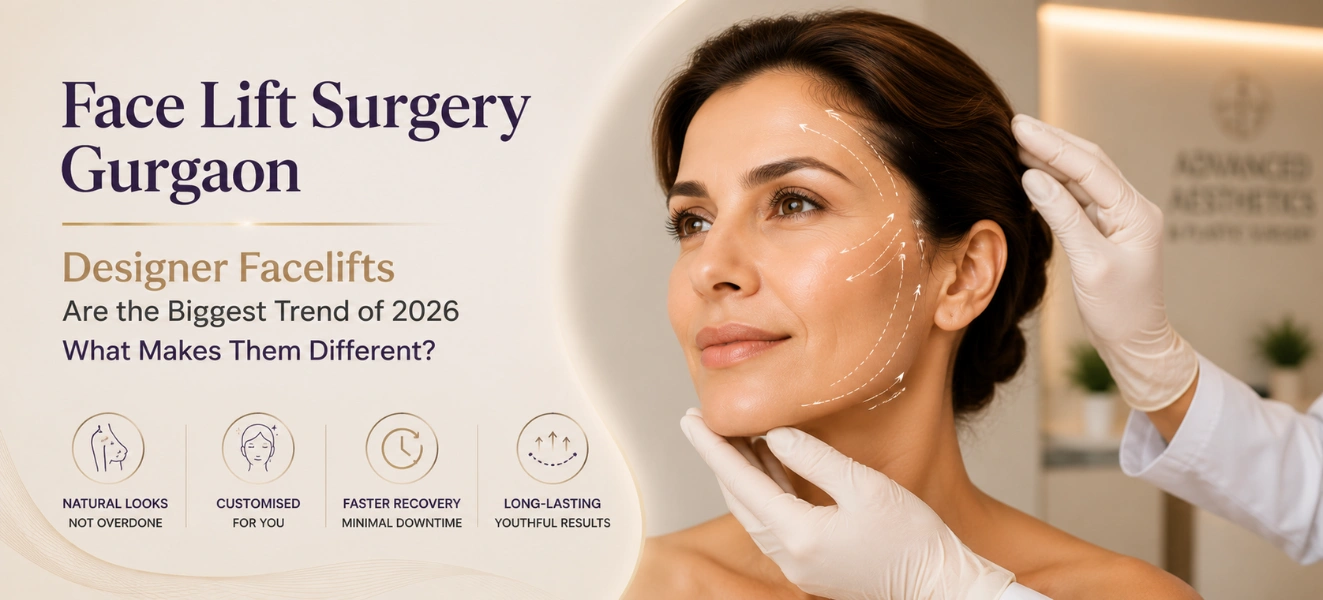
The term ‘designer facelift’ has appeared in multiple 2026 aesthetic surgery trend reports, including analyses from the American Society of Plastic Surgeons, the British Association of Aesthetic Plastic Surgeons, and several leading Indian aesthetic medicine platforms. It describes a philosophical and technical shift in how facelift surgery is planned and executed, not a new surgical technique. What the designer facelift represents is the departure from the standardised approach of the previous generation of face lifting, where the same tension vectors and the same anatomical layers were addressed in more or less the same sequence for most patients, toward a genuinely personalised approach where the surgeon maps the individual patient’s facial ageing pattern before surgery and designs the procedure specifically around those findings.
If you are considering face lift surgery in Gurgaon in 2026, understanding what a designer or personalised facelift actually involves, what makes it produce results that look refreshed rather than operated, and how the integration of fat grafting has changed what facelift surgery can deliver will help you evaluate what you are being offered at the consultation and whether the approach being proposed matches contemporary best practice. This guide covers all three dimensions.
To arrange a personalised facelift consultation with Dr. Pradeep Kumar Singh at Artemis Hospital, Gurugram, call +91 82879 23924.
What Is a Designer Facelift, and How Is It Different From a Traditional Facelift?
The traditional facelift of the 1980s and 1990s operated primarily on the skin: the skin was pulled taut in a superior and lateral direction and the excess was excised. The result was a temporary improvement that lasted four to six years and produced, in many patients, a telltale tightened, windswept appearance that signalled surgery rather than natural ageing reversal. The problem was architectural: pulling the skin without repositioning the underlying facial structures that have descended produces a tightened surface over an unchanged foundation, and the tension recurs as the repositioned skin stretches again under the weight of the underlying descended tissue.
The designer or anatomy-first facelift, as practised at Artemis Hospital, begins with an analysis of the individual patient’s specific facial ageing pattern before any incision is planned. Different patients age in different structural ways. Some have primarily jowling with relatively preserved midface support. Others have significant midface descent with a flattened cheek and nasolabial fold deepening as the primary feature. Others have neck changes with platysmal banding as the dominant concern. The designer facelift maps these patterns at the consultation and designs the surgical approach, the depth of dissection, the tissue vectors, and the adjunct procedures, specifically around what this patient’s anatomy actually shows rather than from a single standard approach applied to all presentations.
Technically, face lift surgery in Gurgaon at Artemis Hospital in 2026 is primarily deep plane or SMAS-based: the facial soft tissues are repositioned at the structural layer rather than only at the skin surface. This produces a more complete and longer-lasting repositioning because the descended tissues are moved to their correct anatomical position rather than the overlying skin being stretched to create the appearance of repositioning. The skin is then re-draped over the repositioned structural layer without tension, which is what produces the natural, rested appearance that characterises the best contemporary facelift results.
Why Is Fat Grafting Being Combined With Facelift Surgery in 2026?
The most significant technical development in facelift surgery in Gurgaon and globally in the past decade is the integration of autologous fat grafting as a routine component of the procedure rather than an optional add-on. The reason is clinical: facial ageing involves two concurrent processes, not one. The first is gravitational descent and soft tissue laxity, which facelift surgery corrects by repositioning the descended tissue. The second is facial volume loss, the gradual reduction in the fat compartments of the midface, temple, periorbital region, and lips that produces the hollowed, deflated appearance that characterises aged faces alongside the descended one. Facelift surgery without fat grafting addresses the first process but not the second. The result is a tightened face with persistent hollowing, which looks like a tightened, hollowed face rather than a naturally younger one.
Fat grafting at the time of face lift surgery in Gurgaon restores the volume that has been lost from the specific facial compartments that have deflated, simultaneously with the repositioning of the tissue that has descended. The combination produces the result that patients and surgeons consistently describe as the most natural-looking: a face that appears rested, rejuvenated, and proportionately full, without the tightened or stretched appearance that signals surgery. At Artemis Hospital, fat grafting for volume restoration is offered at every facelift consultation as an integral component of the personalised plan, with the specific volumes and target zones determined by the individual patient’s volumetric analysis at the consultation.
The fat for grafting is harvested through a small liposuction cannula from the abdomen or inner thighs under the same general anaesthesia as the facelift, adding minimal additional operative time. The harvested fat is processed and injected in small parcels into the identified volume-deficient zones using the Coleman technique, which maximises graft survival by ensuring each parcel is surrounded by vascularised tissue. The fat that integrates is permanent and ages naturally with the face, producing no additional maintenance requirement.
Are More Men Getting Facelift Surgery in India in 2026?
Yes. Male facelift patients have increased as a proportion of total facelift consultations at Artemis Hospital over the past three years, a trend consistent with national and international data. Male facelift surgery in Gurgaon in 2026 is planned with specific attention to the features that distinguish a natural-looking male facelift from one that looks operated or feminised:
- Scar placement: Male patients have less hair coverage to conceal periauricular scars, and the sideburn and beard hair areas require specific incision positioning to avoid distortion of natural hair growth patterns. At Artemis Hospital, male facelift incisions are planned to preserve the natural sideburn position and the beard hair-bearing skin distribution.
- Skin tension: Male skin is thicker and heavier than female skin at equivalent ages. Redraping male facial skin requires slightly different tension management to avoid the tightened appearance that shows more prominently through heavier male skin.
- Masculine anatomical proportion: A masculine face has a stronger, more angular jaw and a wider neck than a feminine face. The facelift vectors and the degree of neck contouring are planned to enhance rather than soften the angular masculine lower facial structure.
- Conservative volume restoration: While fat grafting is beneficial for male patients to restore deflated temple and midface volume, the volumes used are typically more conservative than in female patients to preserve the leaner, more angular quality of the masculine facial aesthetic.
How Long Do Designer Facelift Results Last in Gurgaon?
The deep plane or SMAS-based facelift with fat grafting that constitutes the designer facelift approach at Artemis Hospital produces results lasting seven to twelve years in the majority of patients, based on published long-term follow-up data. The 2025 systematic review comparing deep plane and SMAS facelift outcomes at five years confirmed that deep plane techniques produced significantly higher patient satisfaction (94.4 per cent) than SMAS plication approaches (87.8 per cent), and that the natural-looking quality of the result was the primary differentiator between the two technique groups in patient self-assessment.
The fat grafting component of the result is permanent in the proportion of fat that successfully integrates, typically 60 to 70 per cent of the injected volume. This permanent volume restoration means the combined lifting and volumising result is sustained beyond the period of the soft tissue repositioning alone, because the volume component does not descend or recur in the way that soft tissue can relax over time. Patients from Greater Kailash and Hauz Khas who attend the face lift surgery consultation in Gurgaon at Artemis Hospital, Sector 51, receive a full longevity discussion including the distinction between the lifting component (seven to twelve years) and the volume component (permanent for integrated fat).
How Much Does Face Lift Surgery Cost in Gurgaon in 2026?
Face lift surgery cost in Gurgaon at Artemis Hospital in 2026 depends on the depth of dissection (SMAS vs deep plane), whether fat grafting is included and the volume required, whether concurrent procedures such as upper blepharoplasty or neck liposuction are combined, and the anaesthesia and facility fees. The combined face lift and fat grafting procedure has a higher cost than face lifting alone, reflecting the additional operative time of the fat harvest and grafting steps. A personalised face lift cost estimate is provided at the consultation after the facial analysis determines the appropriate procedure scope. Contact Artemis Hospital to arrange a consultation.
Frequently Asked Questions
What is a designer facelift, and how is it different from a traditional facelift?
A designer facelift is a personalised, anatomy-first approach to face lift surgery where the surgical plan is specifically mapped to the individual patient’s facial ageing pattern rather than applied from a standard template. Technically, it is deep plane or SMAS-based, repositioning the facial structural layer rather than only tightening the skin. The result looks naturally refreshed rather than tightened, because the foundation is repositioned rather than the surface stretched. Fat grafting to restore concurrent volume loss is integrated as a routine component.
Why is fat grafting now being combined with facelift surgery in Gurgaon in 2026?
Facial ageing involves both tissue descent and volume loss simultaneously. Facelift surgery without fat grafting addresses descent but not volume deflation, producing a tightened but still hollow face. Fat grafting at the time of facelift surgery in Gurgaon restores volume to deflated midface, temple, and periorbital compartments simultaneously with the structural repositioning, producing a result that appears naturally younger rather than surgically tightened.
How much does face lift surgery cost in Gurgaon in 2026?
Face lift surgery cost in Gurgaon at Artemis Hospital depends on the depth of dissection, whether fat grafting is included, concurrent procedures, and facility fees. A personalised estimate is provided at the consultation. Call +91 82879 23924.
Are more men getting facelift surgery in India in 2026?
Yes. Male facelift patients represent a growing proportion of consultations at Artemis Hospital. Male facelift surgery in Gurgaon is planned with specific attention to masculine scar placement, skin tension management for heavier male skin, preservation of angular masculine jaw and neck proportions, and conservative fat grafting volumes that maintain the leaner male facial aesthetic.
How long do facelift results last in Gurgaon?
Deep plane or SMAS-based facelift surgery in Gurgaon produces results lasting seven to twelve years in the majority of patients based on published long-term data. Fat grafting integrated at the same session provides permanent volume restoration for the 60 to 70 per cent of fat that successfully integrates, extending the combined natural appearance of the result beyond the longevity of the lifting component alone.
Can facelift surgery be combined with other procedures in Gurgaon?
Yes. The most commonly combined additions at Artemis Hospital are upper blepharoplasty for concurrent upper eyelid hooding, endoscopic brow lift for significant brow descent, neck liposuction for submental fat alongside the platysmaplasty component, and fat grafting for volume restoration, as described above. All of these are assessed at the facelift consultation because addressing the jowl and neck without treating significant midface volume loss or brow descent produces a partially improved rather than naturally refreshed result.
A personalised facelift surgery in Gurgaon plan starts with mapping what your face specifically shows, not with selecting from a menu. Call +91 82879 23924 or visit Artemis Hospital, Sector 51, Gurugram, Haryana 122001.
Reviews: Dr. Pradeep Kumar Singh on Google.
Dr. Pradeep Kumar Singh: MCh Plastic Surgery, Fellowship Paris, APSI Member: Head of Plastic Surgery, Artemis Hospital, Sector 51, Gurugram.