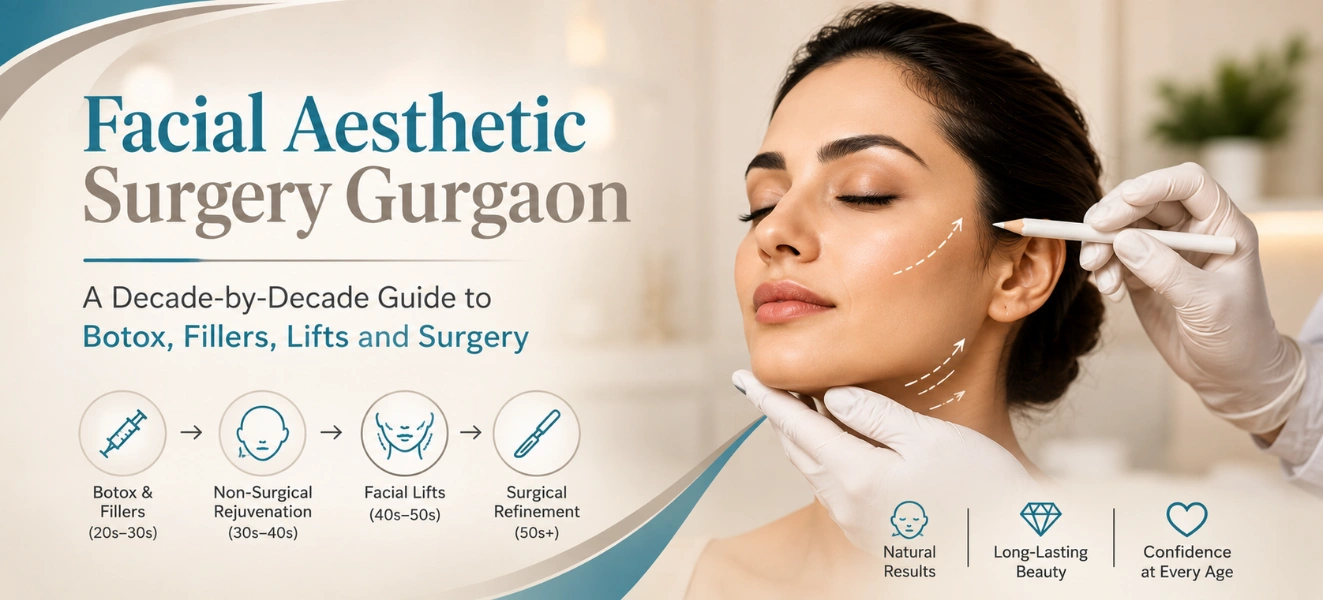
Facial aesthetic surgery in Gurgaon and the non-surgical treatments that precede and complement it follow a decade-specific logic. Facial ageing does not happen in a single event. It accumulates across decades through a combination of processes, each dominant at a different stage: dynamic wrinkle formation from repeated muscle activity, gradual volume deflation from fat compartment atrophy, descent of soft tissue through gravitational laxity, and progressive skin quality changes from cumulative sun exposure and dermal thinning. The appropriate facial aesthetic surgery and treatment plan in Gurgaon for a patient in their thirties is substantially different from the appropriate plan for the same patient in their fifties, because the dominant ageing process at each decade is different.
This guide maps the decade-by-decade progression of facial ageing to the treatments that are most clinically appropriate at each stage, with an honest account of what non-surgical treatments can achieve, where their limits are, and at what point the clinical evidence supports making the shift from maintenance treatments to surgical correction. It is not a product catalogue but a framework for thinking about facial rejuvenation as a long-term programme rather than a series of disconnected interventions.
To have your specific facial ageing pattern assessed and an appropriate programme recommended, call +91 82879 23924 or arrange a consultation at Artemis Hospital, Gurugram.
In Your 30s: Prevention and Early Management
The dominant change driving facial aesthetic treatment decisions in Gurgaon in the thirties is the transition from purely dynamic wrinkles (lines visible only during expression) to early static wrinkles (lines visible at rest). The forehead, glabella, and periorbital zones typically show this transition first, because these are the areas with the highest frequency of expressive muscle activity. Volume change in the thirties is usually subtle, with the earliest signs appearing as minor hollowing beneath the eyes and a slight reduction in the fullness of the lateral cheek in the late thirties.
What Facial Aesthetic Treatments Are Recommended in Your 30s?
- Botulinum toxin: The most clinically defensible intervention in the thirties. Regular botulinum toxin treatment in the glabella, forehead, and crow’s feet prevents the repeated folding of the skin along the dynamic wrinkle lines, slowing the conversion from dynamic to static lines. Published data show that patients who begin regular botulinum toxin treatment in their thirties develop fewer and shallower static wrinkles in these zones by their forties than matched patients who did not treat. This is the primary evidence for preventative Botox as a strategy rather than a trend.
- SPF protection and retinol: Not a medical treatment but the highest-impact lifestyle intervention available for facial skin quality in the thirties. Daily SPF 50 application reduces ultraviolet-driven collagen degradation and pigmentation accumulation. Topical retinoids (retinol or prescription retinoids) stimulate dermal collagen production and accelerate skin cell turnover, maintaining skin thickness and surface quality during the decade when these processes begin their long-term decline.
- Light HA filler: In the late thirties, early under-eye hollowing and minor midface volume reduction may benefit from conservative hyaluronic acid filler placement. The volumes appropriate in the thirties are modest: half to one millilitre per side in the midface produces the natural result; more produces the pillow face that characterises over-treated patients in this decade.
In Your 40s: Volume and Early Structure
The forties represent the decade when facial ageing transitions from primarily surface-based (wrinkles) to primarily structural (volume and position). The midface fat compartments deflate progressively, producing the hollowed cheek and deepening nasolabial fold that are hallmarks of the forties face. Jowling typically begins in the mid to late forties as the deep facial retaining ligaments that suspend the facial fat compartments weaken under cumulative gravitational load and the ageing effects on collagen and elastin.
What Facial Aesthetic Treatments Are Recommended in Your 40s?
- Midface volume restoration with HA filler: The most appropriate primary intervention in the forties. Strategic midface filler placement, using a dense, high-cohesivity filler like Juvederm Voluma or Restylane Lyft in the deep medial and lateral cheek fat compartments, lifts the descended midface tissue and secondarily improves the nasolabial fold. One to two millilitres per side in the midface produces a natural volumising result. Combined with botulinum toxin for dynamic lines, this programme maintains the face effectively through the early to mid-forties.
- Skin quality maintenance: Medical-grade chemical peels, fractional laser resurfacing for pigmentation and fine texture, and radiofrequency microneedling for early skin laxity are appropriate additions to the non-surgical programme in the forties. These address the surface quality changes that volume correction alone does not manage.
- Early facelift consideration in the late forties: For patients in the late forties with established jowling that exceeds what filler correction can address, an early mini facelift or SMAS facelift may be more appropriate than continued filler escalation. Adding more filler to an already deflated and descended face produces a heavy, puffy result rather than the lifted, restored result that a surgical intervention achieves. The transition from non-surgical to surgical consideration is assessed at the facial aesthetic surgery consultation in Gurgaon based on the degree of descent, not on the patient’s age alone.
In Your 50s: Surgical Correction
In the fifties, the accumulated descent of facial soft tissue, the skin laxity from decades of gravitational effect and intrinsic ageing, and the volume changes across all facial compartments typically reach the threshold at which surgical correction produces the most meaningful and longest-lasting improvement. Non-surgical treatments continue to play a supporting role, but they are no longer the primary intervention for the structural concerns that dominate this decade.
What Facial Aesthetic Surgery Is Recommended in Gurgaon in Your 50s?
- Deep plane or SMAS facelift: The primary surgical intervention for moderate to significant jowling, midface descent, and neck laxity. A well-performed deep plane facial aesthetic surgery facelift in Gurgaon in the fifties produces results lasting seven to twelve years in most patients, turning back the clock rather than stopping it and providing a rejuvenated baseline from which non-surgical maintenance continues.
- Upper blepharoplasty: Commonly combined with the facelift or performed as an independent procedure in the fifties when upper eyelid hooding has accumulated to a functionally or aesthetically significant degree. Most patients in their fifties have some degree of upper eyelid involvement and benefit from addressing it simultaneously with facial surgery.
- Fat grafting: Integrated into the facelift procedure to restore the volume that surgery repositions but does not add. Fat grafting to the midface, temples, and periorbital area alongside the facelift produces the most naturally rejuvenated result.
In Your 60s and Beyond: Maintenance and Recalibration
Patients in their sixties and beyond who have undergone well-planned facial aesthetic surgery in their fifties are typically in a maintenance phase: the surgical correction remains active, and the programme of non-surgical treatments (botulinum toxin, conservative filler, skin quality maintenance) supports the surgical result and manages the continuing ageing process from a more youthful baseline than would have been present without surgery.
For patients in their sixties who have not had prior facial surgery, the surgical approach remains appropriate and clinically valid. Results in sixties patients are consistently satisfying across published series. The recovery takes somewhat longer than in younger patients, and the surgical planning is more comprehensive because the degree of ageing to be addressed is greater, but age alone is not a contraindication to facial aesthetic surgery in Gurgaon at Artemis Hospital where the patient’s general health is adequate for surgery under anaesthesia.
Patients from Nirvana Country and South Gurgaon who consult at Artemis Hospital, Sector 51, Gurugram, for facial aesthetic surgery in Gurgaon receive a decade-appropriate facial assessment at the consultation that maps the specific ageing changes present to the treatments that are most clinically appropriate at their current stage, rather than applying a standard programme regardless of what the anatomy actually shows.
Frequently Asked Questions
What facial treatments are recommended in your 30s in Gurgaon?
Preventative botulinum toxin in the forehead, glabella, and crow’s feet is the most clinically defensible intervention in the thirties. Published data confirm that regular treatment from the thirties produces fewer and shallower static wrinkles in these zones by the forties. Daily SPF 50 and topical retinoids are the highest-impact lifestyle interventions. Conservative HA filler for early under-eye hollowing or subtle midface support is appropriate in the late thirties where volume change has begun.
When should someone consider a facelift instead of fillers in Gurgaon?
The transition from fillers to facelift consideration is driven by anatomy, not age. When jowling has reached the degree that filler placement alone would overvolumise the face without adequately lifting the descended tissue, surgical correction produces a more natural result than continued filler escalation. This threshold is typically reached in the mid to late forties for patients with early facial ageing, and in the fifties for most patients. The facial aesthetic surgery consultation in Gurgaon assesses whether the degree of descent is within filler range or has crossed into surgical indication.
Can Botox and fillers delay the need for facial aesthetic surgery in Gurgaon?
Yes, for the structural changes that non-surgical treatments address: dynamic wrinkles (delayed by Botox) and early volume loss (addressed by filler). Non-surgical treatments cannot delay the tissue descent and skin laxity that ultimately require surgical correction. What they can do is ensure that when the surgical threshold is reached, the patient arrives with better skin quality, fewer static lines, and a more refreshed baseline than if no non-surgical maintenance had been undertaken.
What is the right age to start facial aesthetic treatments in Gurgaon?
The right age to start is when a specific concern is present and identifiable, not a fixed chronological age. Preventative Botox is appropriate from the mid to late twenties where dynamic lines are consistently visible during expression. Conservative filler is appropriate from the late thirties or early forties where volume deflation is visible. Surgical facial aesthetic surgery in Gurgaon is appropriate when the degree of structural change exceeds what non-surgical correction can address, which is an anatomy-based assessment, not an age-based one.
How does facial aging differ by decade in Indian patients?
Indian patients with Fitzpatrick Type III to V skin typically show less photo-ageing (sun-related skin damage) relative to their Caucasian counterparts, because higher melanin content provides more natural UV protection. However, they show equivalent gravitational descent and volume loss patterns across the decades. The clinical implication is that Indian patients at the same age often have better skin surface quality but equivalent structural ageing, meaning that the transition to surgical intervention is driven more by structural change than by skin quality deterioration for this population.
Facial aesthetic surgery in Gurgaon that is right for your decade starts with an honest assessment of your anatomy. Call +91 82879 23924 or visit Artemis Hospital, Sector 51, Gurugram, Haryana 122001.
Reviews: Dr. Pradeep Kumar Singh on Google.
Dr. Pradeep Kumar Singh: MCh Plastic Surgery, Fellowship Paris, APSI Member: Head of Plastic Surgery, Artemis Hospital, Sector 51, Gurugram.