The hairline is the single most visible boundary of the face. It defines where the forehead ends, frames the upper face, and determines how the face reads from a distance. In 2026, patients presenting for hair transplant surgery in Gurgaon are thinking about this boundary with more aesthetic precision than previous generations of hair restoration patients. They are not just asking how many grafts they need or which technique is best. They are asking where the hairline should sit, what shape it should be, and how a well-designed hairline will change the way their face is perceived. These are questions of facial proportion, and answering them correctly is what separates a hair transplant result that transforms the face from one that simply covers the scalp.
This guide addresses hairline design as the central aesthetic discipline of hair transplant surgery in Gurgaon in 2026: the facial proportion principles that determine where a natural hairline should sit, the specific design choices that make a transplanted hairline look grown rather than placed, why hairline lowering surgery is emerging as a distinct procedure alongside standard hair loss restoration, and why women are an increasingly significant proportion of hair transplant patients in India.
Call +91 82879 23924 or arrange a consultation at Artemis Hospital, Gurugram, to have your hairline design assessed by Dr. Pradeep Kumar Singh.
How Does Hair Transplant Surgery Improve Facial Proportions?
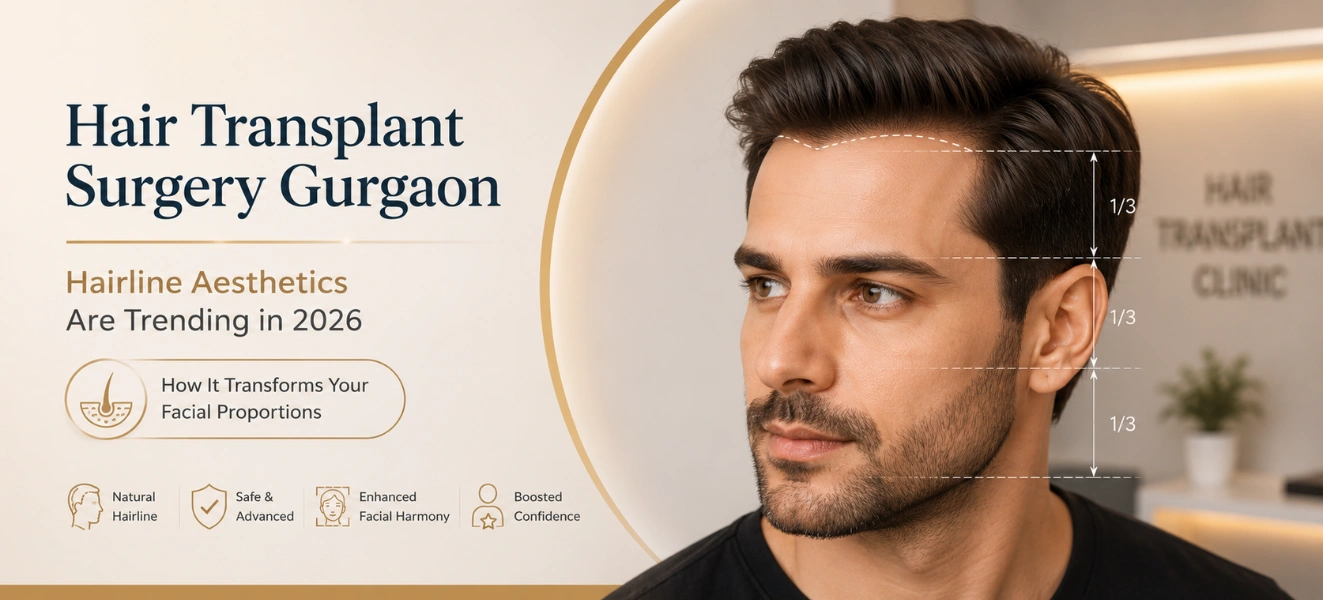
The relationship between hairline position and facial proportion is grounded in the facial thirds theory, a classical proportion framework used in aesthetic surgery, art, and facial analysis. The theory divides the face into three horizontal thirds of approximately equal height:
- Upper third: From the hairline to the glabella (the point between the brows). In a proportionate face, this distance equals approximately one-third of the total face height.
- Middle third: From the glabella to the base of the nose. Equal to the upper third.
- Lower third: From the nasal base to the chin. Equal to the two thirds above.
When male or female pattern hair loss elevates the hairline significantly above its natural position, the upper third of the face lengthens disproportionately relative to the middle and lower thirds. The forehead becomes the dominant visual feature of the face, and the face reads as unbalanced from a distance. Hair transplant surgery that restores the hairline to its appropriate position restores the proportional balance of the facial thirds, making the face appear more harmonious. This is why patients who have undergone a well-designed hairline restoration frequently report that people notice they look better or younger without being able to identify why. The change is structural and proportional, not superficial.
What Makes a Transplanted Hairline Look Natural?
The most common aesthetic failure in hair transplant surgery in Gurgaon and globally is a hairline that looks transplanted: a uniform, dense line of follicles at a defined border that reads as artificial because no natural hairline has that structure. Natural hairlines are characterised by three specific features that a skilled hairline design replicates:
Irregularity at the Frontier Zone
The very front of a natural hairline is not a line. It is a transition zone of approximately one to two centimetres depth where single-hair follicular units emerge sparsely and irregularly before the denser multi-hair follicular units behind them produce the visible density of the hairline. Placing single-hair grafts in an irregular pattern at the hairline frontier, with two and three-hair grafts beginning one to two centimetres behind, replicates this natural transition. A hairline designed with dense multi-hair grafts at the very front produces the uniform, plugged appearance that identifies operated hairlines.
Temple Point Definition
The temporal recessions, the triangular areas at the sides of the hairline just above the temples, are a natural feature of both male and female hairlines. Filling in the temporal recessions completely in a male patient produces a hairline that reads as juvenile rather than naturally mature. The appropriate temple point design preserves a natural, mature recession angle while softening any excessive temporal widening that has occurred with hair loss. This balance, between restoring density and preserving natural adult hairline geometry, is what makes the difference between a hairline that looks restored and one that looks operated.
Single-Hair Placement at the Hairline Border
Single-hair follicular units at the very edge of the hairline must be placed at an acute angle, typically 10 to 20 degrees from the scalp surface, directed consistently forward and slightly downward. Grafts placed at steeper angles or inconsistent directions catch the light differently from natural hair and produce the telltale shine and direction inconsistency that identifies a transplanted front row. Precise angulation of every graft in the hairline frontier zone is one of the most technically demanding aspects of hair transplant surgery in Gurgaon and is where the skill of the surgical team most directly determines the naturalness of the result.
Why Is Hairline Lowering a Growing Trend in Gurgaon in 2026?
Hairline lowering surgery, also called surgical hairline advancement, is a distinct procedure from hair transplant surgery and is currently one of the fastest-growing aesthetic surgical procedures among female patients in India. Unlike hair transplant surgery, which restores hair lost to alopecia, hairline lowering surgery repositions a naturally high hairline, one that is high from birth rather than from hair loss, downward through a surgical incision at the frontal scalp.
The procedure is appropriate for patients who have always had a high forehead with a naturally high hairline and who want to reduce the apparent forehead height. It is not a treatment for hair loss because the patient has adequate density throughout the scalp; the hairline simply sits too high relative to the facial proportions. The surgical technique makes an incision within or just at the hairline, advances the scalp forward by one to three centimetres, and excises the excess forehead skin, positioning the hairline lower on the face. The resulting scar within the hairline is concealed by the hair behind it and typically fades to an imperceptible line at twelve months.
Hair transplant surgery in Gurgaon can also be used for hairline lowering in patients who are not suitable for surgical advancement, by transplanting grafts into the forehead above the existing hairline to create the appearance of a lower hairline without moving the scalp. This approach is appropriate for patients with moderate forehead height and adequate donor hair, and produces a more gradual transition than surgical advancement because individual grafts placed above the existing hairline create an extended frontier zone rather than a repositioned hairline edge.
Are Women Increasingly Getting Hair Transplant Surgery in Gurgaon in 2026?
Yes, significantly. Women now represent approximately 30 per cent of hair transplant consultations at Artemis Hospital, up from under 15 per cent three years ago. Female hair loss in India presents in patterns that differ from male pattern loss, and understanding these differences is essential to appropriate candidacy assessment and surgical planning.
Female pattern hair loss typically presents as diffuse thinning across the crown and vertex, with the frontal hairline often relatively preserved. The Ludwig classification grades diffuse thinning from Grade I (mild, visible widening of the central part) to Grade III (severe diffuse thinning with visible scalp across the crown). Unlike male pattern loss, which has a predictable genetically resistant donor zone at the posterior scalp, female diffuse thinning can affect the posterior scalp as well, which means the donor hair may not be reliably resistant to the hormonal influences producing the thinning.
At Artemis Hospital, female hair transplant candidates in Gurgaon undergo a full hormonal and dermatological assessment before transplant planning, because diffuse female hair loss from thyroid dysfunction, iron deficiency, or androgenetic alopecia in the diffuse pattern requires medical management before or alongside surgery to prevent progressive loss of the transplanted and native hair. Patients from Uttam Nagar and Vikaspuri who attend for hair transplant surgery consultation in Gurgaon receive this comprehensive evaluation as standard.
How Much Does Hair Transplant Surgery Cost in Gurgaon in 2026?
Hair transplant cost in Gurgaon at Artemis Hospital is calculated per graft and depends on the number of grafts required, which is determined by the extent of hair loss, the desired hairline position, and the donor zone density. Hairline lowering cases typically require 1,500 to 2,500 grafts for the frontal zone. Female diffuse thinning cases may require 2,000 to 3,500 grafts for crown coverage. A personalised cost estimate is provided at the consultation after the hair loss staging, donor density assessment, and hairline design are completed. Call +91 82879 23924 to arrange a hair transplant consultation at Artemis Hospital.
Frequently Asked Questions
How does hair transplant surgery improve facial proportions?
Restoring the hairline to its natural position re-establishes the correct proportional balance of the facial thirds (hairline to glabella, glabella to nasal base, nasal base to chin). When hair loss elevates the hairline above its natural position, the upper facial third lengthens disproportionately, and the forehead becomes the dominant facial feature. A well-designed hairline restoration corrects this imbalance and produces the perception of a more harmonious, younger-looking face even before any observer consciously registers the change in hair.
Why is hairline lowering surgery trending in Gurgaon in 2026?
Hairline lowering surgery addresses a naturally high hairline (present from birth, not from hair loss) by surgically advancing the scalp forward by one to three centimetres. It is trending in 2026 because awareness of the procedure has increased significantly among female patients with high foreheads, and because the results, a scar that fades within the hairline at twelve months, are consistently natural-looking. It can also be achieved through hair transplant surgery in Gurgaon for moderate cases, by placing grafts above the existing hairline without surgical scalp advancement.
Are women increasingly getting hair transplant surgery in Gurgaon?
Yes. Women represent approximately 30 per cent of hair transplant consultations at Artemis Hospital. Female hair loss, which typically presents as diffuse thinning across the crown with the frontal hairline preserved, requires a different assessment and planning approach from male pattern loss, including hormonal and dermatological evaluation to identify treatable causes before transplant surgery is recommended.
How much does hair transplant surgery cost in Gurgaon in 2026?
Hair transplant cost in Gurgaon at Artemis Hospital is calculated per graft and depends on the total graft requirement established at the consultation. A personalised estimate is provided after hair loss staging, donor density assessment, and hairline design. Call +91 82879 23924.
What is the difference between hair transplant surgery and hairline lowering surgery?
Hair transplant surgery in Gurgaon restores hair lost to androgenetic alopecia or scarring by transferring follicles from a resistant donor zone to thinning recipient areas. Hairline lowering surgery repositions a naturally high hairline on a patient with no hair loss by surgically advancing the scalp. Both achieve a lower, more proportionate hairline but through different mechanisms and for different patient presentations.
How long do hair transplant surgery results last in Gurgaon?
Transplanted follicles from the genetically resistant posterior donor zone are permanent: they carry the resistance to dihydrotestosterone (DHT) that caused the hair loss elsewhere, and this resistance is maintained in the recipient zone. The transplanted hairs grow, cycle normally, and do not fall out from pattern hair loss. Native hair in the recipient zone that was not covered by the transplant may continue thinning over time, which is why a treatment plan accounting for future hair loss progression is discussed at the initial consultation.
Hair transplant surgery in Gurgaon is designed around your specific hairline aesthetics and facial proportions. Call +91 82879 23924 or visit Artemis Hospital, Sector 51, Gurugram, Haryana 122001.
Reviews: Dr. Pradeep Kumar Singh on Google.
Dr. Pradeep Kumar Singh: MCh Plastic Surgery, Fellowship Paris, APSI Member: Head of Plastic Surgery, Artemis Hospital, Sector 51, Gurugram.