
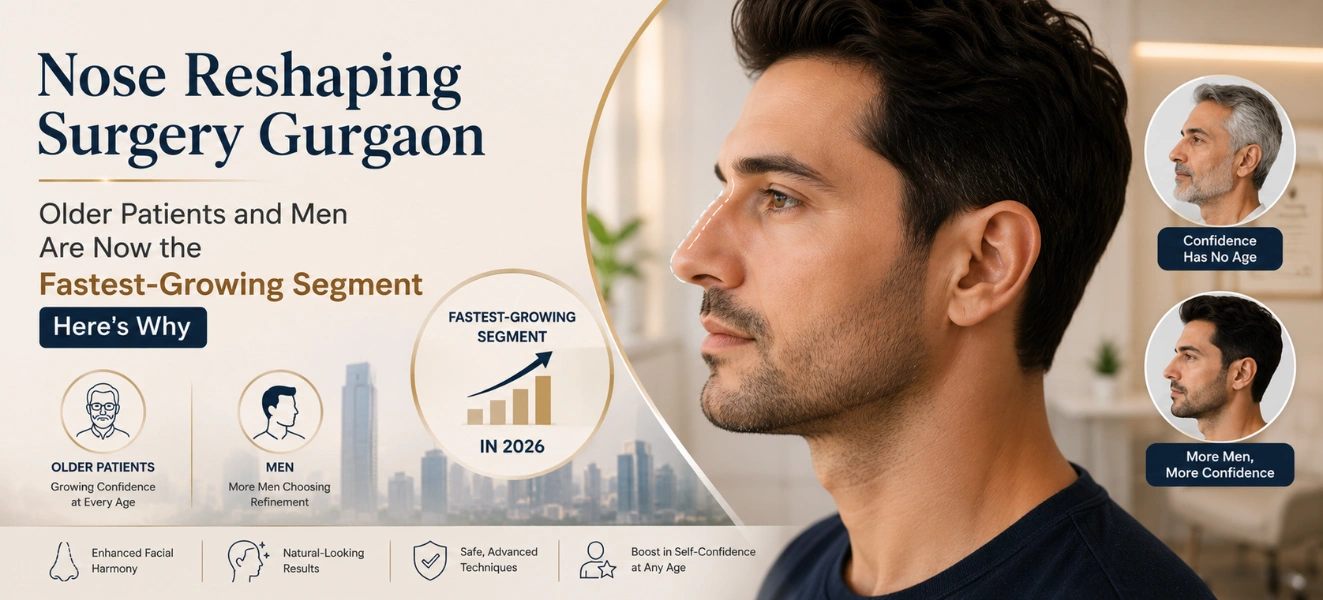
The demographic profile of the rhinoplasty patient has changed substantially in the past three years. The 2025 ISAPS data show that patients over 40 now represent the fastest-growing rhinoplasty demographic in Asia, and that male patients account for an increasing proportion of nose reshaping surgery consultations across India. In Gurgaon specifically, the consultation profile at Artemis Hospital reflects both trends: patients in their forties and fifties presenting for the first time for nose reshaping surgery they have been considering for decades, and male patients seeking subtle structural refinement rather than the dramatic profile changes more commonly requested by younger female patients.
Understanding why these two demographic groups are increasingly choosing nose reshaping surgery in Gurgaon in 2026 is useful for any patient who belongs to either group and has been wondering whether they represent an atypical case. They do not. They represent a clinically coherent and well-motivated patient population whose specific anatomical needs and aesthetic goals differ in specific, addressable ways from the traditional younger female rhinoplasty patient. This guide explains both groups, what their specific considerations are, and what they can realistically expect from nose reshaping surgery in Gurgaon at Artemis Hospital.
Call +91 82879 23924 to arrange a rhinoplasty consultation with Dr. Pradeep Kumar Singh at Artemis Hospital, Gurugram.
Why Are Older Patients Choosing Nose Reshaping Surgery in 2026?
The midlife rhinoplasty patient, typically in their forties or early fifties, is not a new phenomenon, but their numbers are growing. Several factors explain the trend:
A Concern Carried for Decades That Is Now Being Acted On
Many patients in their forties who present for nose reshaping surgery in Gurgaon describe a concern that has been present since adolescence but was either financially inaccessible, socially stigmatised, or deprioritised in the face of career and family demands in their twenties and thirties. In midlife, with greater financial stability, reduced family urgency, and a cultural environment that is significantly more accepting of aesthetic surgery for both genders, the decision to address a long-standing concern becomes easier to act on. The concern itself has not changed; the conditions for acting on it have.
Dual Functional and Cosmetic Motivation
Older rhinoplasty patients more frequently present with a combination of cosmetic and functional concerns than their younger counterparts. A deviated septum that has caused some degree of nasal obstruction for twenty years becomes more clinically relevant in midlife as overall respiratory efficiency and sleep quality assume greater importance. Combined septorhinoplasty, which addresses both the cosmetic and the functional dimensions of the nasal anatomy in a single session, is particularly appropriate for this patient group. The functional component may also support insurance consideration in cases where nasal obstruction is clinically documented.
Age-Related Nasal Changes
The nose changes with age in specific ways that motivate midlife rhinoplasty independently of any long-standing cosmetic concern. The nasal tip loses structural support as the lower lateral cartilages weaken with age, producing a drooping tip that elongates the apparent length of the nose and creates a heavier profile. The skin thickens subtly with age, particularly in the tip and supratip zones of Indian patients. For some patients, the age-related tip droop or the increase in apparent dorsal projection relative to a slightly deflating midface produces a new nasal appearance that they have not previously experienced and that they now wish to address. Tip rotation to correct age-related droop, cartilage grafting to restore structural support, and conservative hump reduction are the technical components most relevant to the midlife rhinoplasty patient.
Why Are More Men Choosing Nose Reshaping Surgery in Gurgaon in 2026?
Male patients now account for approximately 28 per cent of rhinoplasty procedures globally, up from under 15 per cent a decade ago. The increase reflects two converging trends: reduced stigma around aesthetic surgery for men in India, and a specific pattern of male rhinoplasty motivation that differs meaningfully from the female pattern.
Important Read: Nose Reshaping Surgery Gurgaon: Surgical vs Non-Surgical Rhinoplasty, A 2026 Comparison Guide
Masculine Aesthetic Goals Require Different Planning
Male rhinoplasty in Gurgaon is planned around preservation of masculine nasal characteristics, not their elimination. The male nose is structurally different from the female nose: it is larger, has a straighter dorsal line without the slight supratip break that characterises the feminine profile, has a nasolabial angle between 90 and 95 degrees (compared with 100 to 110 degrees in a feminine profile), and has a broader base width relative to the facial width. A rhinoplasty planned from feminine proportion references applied to a male face produces an effeminate result that is immediately apparent and is one of the most common complaints in male rhinoplasty revision cases.
At Artemis Hospital, male nose reshaping surgery in Gurgaon is planned from male-specific proportion references. Hump reduction preserves the natural masculine dorsal line rather than feminising it. Tip refinement reduces the bulbous tip component without the significant upward rotation that is desirable in female rhinoplasty but inappropriate in males. Nasal base width is assessed against male facial proportion norms rather than female ones. Dr. Pradeep Kumar Singh, MCh Plastic Surgery, Fellowship Paris, APSI Member, applies gender-specific planning to every male rhinoplasty consultation at Artemis Hospital.
Functional Motivation Is More Common in Male Patients
Male patients more frequently present with nasal obstruction as a primary or co-primary concern alongside the cosmetic motivation. Deviated septum, enlarged turbinates, and collapsed internal nasal valves, all of which impair nasal airflow, are more commonly identified as significant concerns by male patients, who are more likely to have noticed airflow-related exercise performance reduction and are more likely to have sleep quality concerns from nasal obstruction. The combined septorhinoplasty, which addresses both the functional and cosmetic components in a single session, is the most commonly performed procedure at Artemis Hospital for male nose reshaping surgery patients in Gurgaon.
What Are the Latest Nose Reshaping Techniques in 2026?
The most significant technical developments in nose reshaping surgery in Gurgaon and globally in 2025 to 2026 are in the area of preservation rhinoplasty, a philosophy and set of techniques that prioritise structural preservation over structural removal:
- Preservation rhinoplasty: Rather than the conventional approach of removing dorsal cartilage and bone to reduce a hump, preservation techniques push and lower the dorsal framework as a unit, preserving the native structural continuity of the nasal bones and cartilages while repositioning them to produce the desired profile change. The advantage is a more natural transition at the radix and a reduced incidence of the slight irregularities that can appear at healed osteotomy sites with conventional hump reduction. Preservation rhinoplasty is most appropriate for patients with a moderate hump and a native dorsal framework that is structurally sound.
- Cartilage graft refinement: The use of precisely carved autologous cartilage grafts to add definition, projection, and structure to the nasal tip has become the standard approach for tip refinement in contemporary rhinoplasty, replacing the older technique of cartilage resection. Grafts maintain the long-term structural integrity of the tip framework without the weakening and contraction that follows significant cartilage removal. For older patients and for Indian patients with thick skin, cartilage grafting that provides a structurally robust tip is essential for the refinement to remain visible through the overlying skin envelope.
- Liquid rhinoplasty as a preview tool: Non-surgical filler rhinoplasty, when used as a diagnostic preview rather than as a treatment endpoint, has become a valuable planning tool in 2026. Patients who are uncertain about the degree of hump correction they want can undergo a temporary filler camouflage to see the profile change before committing to surgery. This preview approach, appropriately counselled as temporary, helps crystallise the patient’s goals and reduces post-surgical disappointment from incorrect pre-operative expectations.
How Much Does Nose Reshaping Surgery Cost in Gurgaon in 2026?
Nose reshaping surgery cost in Gurgaon at Artemis Hospital depends on the extent of the corrections, whether the open or closed approach is used, whether septoplasty is performed simultaneously, whether preservation or conventional resection technique is applied, and the anaesthesia and facility fees. A combined septorhinoplasty has a higher cost than a cosmetic-only rhinoplasty because of the additional operative time. A personalised cost estimate for nose reshaping surgery in Gurgaon is provided at the consultation after the nasal anatomy has been assessed and the surgical plan agreed. Call +91 82879 23924 to arrange an appointment with Dr. Pradeep Kumar Singh.
Important Read: Rhinoplasty Surgery Gurgaon: Cost, Best Surgeon Checklist and Types of Nose Surgery
Frequently Asked Questions
Why are older patients choosing nose reshaping surgery in Gurgaon in 2026?
Three factors explain the midlife rhinoplasty trend: long-standing concerns that are now financially and socially more accessible to act on; dual cosmetic and functional motivation (nasal obstruction plus cosmetic concern) that makes the procedure more clinically justified; and age-related tip droop and structural changes that produce new nasal appearance concerns independently of any prior cosmetic interest. The midlife patient is a clinically coherent candidate, not an atypical one.
Is nose reshaping surgery popular among men in India in 2026?
Yes. Male patients now account for approximately 28 per cent of rhinoplasty procedures globally and a significant and growing proportion of nose reshaping surgery consultations in Gurgaon. Male rhinoplasty is planned from gender-specific proportion references that preserve masculine nasal characteristics, with functional concerns (nasal obstruction, sleep quality) more frequently present as co-primary motivations. At Artemis Hospital, male nose reshaping surgery planning uses male-specific dorsal line, nasolabial angle, and base width references.
What is the difference between cosmetic and functional nose reshaping?
Cosmetic nose reshaping addresses the visible nasal shape: dorsal hump, tip definition, nostril width, and profile. Functional nose reshaping (septoplasty) corrects the internal nasal anatomy: deviated septum, enlarged turbinates, or collapsed internal nasal valves that obstruct nasal airflow. Combined septorhinoplasty addresses both dimensions in a single operative session. At Artemis Hospital, every nose reshaping consultation includes nasal airway assessment because functional and cosmetic concerns frequently coexist.
How much does nose reshaping surgery cost in Gurgaon in 2026?
Nose reshaping surgery cost in Gurgaon at Artemis Hospital depends on the extent of corrections, whether septoplasty is included, the surgical technique used, and facility fees. A personalised estimate is provided at the consultation. Call +91 82879 23924.
What is preservation rhinoplasty, and is it available in Gurgaon?
Preservation rhinoplasty is a 2020s surgical philosophy that reduces dorsal humps by repositioning the nasal framework as a unit rather than removing cartilage and bone. The technique preserves the native structural continuity of the nose, producing a more natural dorsal line with reduced risk of post-surgical irregularity at healed osteotomy sites. Dr. Pradeep Kumar Singh applies preservation techniques where anatomically appropriate for nose reshaping surgery in Gurgaon at Artemis Hospital, as part of a contemporary rhinoplasty practice that integrates the best evidence from both traditional and preservation-focused approaches.
How long does recovery take after nose reshaping surgery in Gurgaon?
The nasal splint is worn for seven to ten days, after which most visible bruising has resolved. Most patients are socially presentable within two weeks. Return to office work is within ten to fourteen days. Exercise resumes at four to six weeks. In Indian patients with typical thicker nasal skin, the final result of nose reshaping surgery in Gurgaon is assessed at twelve months, because thick-skin tip swelling resolves over six to twelve months after surgery.
Whether you are in your forties, a male patient, or both, nose reshaping surgery in Gurgaon at Artemis Hospital is planned for your specific anatomy and goals, not from a template. Call +91 82879 23924 or visit Artemis Hospital, Sector 51, Gurugram, Haryana 122001.
Reviews: Dr. Pradeep Kumar Singh on Google.
Dr. Pradeep Kumar Singh: MCh Plastic Surgery, Fellowship Paris, APSI Member: Head of Plastic Surgery, Artemis Hospital, Sector 51, Gurugram.