
A 2022 study published in the International Journal of Trichology, examining 1,840 Indian men presenting with androgenetic alopecia, found that 23 per cent reported onset of hair loss before the age of 25, and 11 per cent reported onset before the age of 21. Among those who presented for hair transplant consultation in India, patients aged 21 to 30 now constitute the fastest-growing consultation cohort, overtaking the 31 to 40 group that historically dominated hair restoration practices.
These numbers reflect a real clinical problem. Early-onset hair loss in Indian men is common, psychologically distressing, and, for many patients, motivating enough to prompt a consultation for surgical restoration well before the hair loss pattern has fully declared itself. This is the central clinical concern with hair transplant surgery in Gurgaon at age 25: not that the surgery cannot be performed, but that the pattern of future hair loss in a 25-year-old is frequently incomplete and not fully predictable, and that surgery planned around an incomplete pattern creates specific, well-documented risks that patients at this age are often not fully informed about.
Call +91 82879 23924 to discuss hair transplant candidacy at any age with Dr. Pradeep Kumar Singh at Artemis Hospital, Gurugram.
Important Read: Hair Transplant Surgery Gurgaon: FUE vs FUT vs DHI, Which Method Gives the Best Natural Results?
The Island Problem: Why Timing Hair Transplant Surgery Matters
Androgenetic alopecia, the most common form of hair loss in Indian men, is a progressive condition. It follows a predictable pattern of loss across the frontal hairline, the temples, and the vertex, classified by the Norwood-Hamilton scale. The progression continues for years or decades after the first signs appear. Transplanted hair from the genetically resistant donor zone at the posterior scalp is permanent because it carries a resistance to dihydrotestosterone (DHT) that the hair in the recipient zone does not. That resistance travels with the follicle when it is moved.
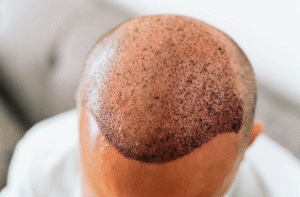
The problem at age 25 is the surrounding native hair. A 25-year-old presenting with Norwood Type II to III hair loss, a receding hairline with moderate temporal recession, has most of his native hair still in place. The transplanted grafts are placed in the area of recession. Over the following five to ten years, the native hair around the transplant continues to fall, because it lacks the DHT resistance of the transplanted follicles. The transplanted area holds. The native hair retreats. The result is an island of dense transplanted hair surrounded by thinning or absent native hair, with the two zones increasingly visually disconnected as the years pass.
This is not a theoretical risk. It is the most common cause of an unsatisfactory hair transplant outcome in young patients globally and in India. Published audit data from large Indian hair restoration practices consistently show that patients who received transplants before age 28 to 30 require revision surgery or additional procedures at a significantly higher rate than patients who received their first transplant after the pattern had fully declared.
What Should a 25-Year-Old with Hair Loss Do Instead?
For a 25-year-old presenting to Artemis Hospital with androgenetic alopecia, the first-line recommendation is medical management, not hair transplant surgery in Gurgaon. The goal of medical management at this stage is stabilisation: slowing or halting the progressive loss until the pattern has declared itself sufficiently to plan a surgical restoration that accounts for what the hair loss will look like in ten years, not just today.
Finasteride, an oral DHT inhibitor, reduces the circulating dihydrotestosterone that drives androgenetic alopecia in genetically susceptible follicles. In published clinical trials, finasteride produces stabilisation of hair loss in approximately 83 per cent of men who take it consistently, and visible regrowth in approximately 65 per cent at two years. It does not restore all lost hair, but it significantly slows the progression that would otherwise make an early transplant look worse over time.
Minoxidil, available as a topical solution or foam, increases blood flow to the follicle and prolongs the anagen (growth) phase of the hair cycle. It does not address the hormonal pathway of androgenetic alopecia, but it produces measurable improvement in follicle size and hair shaft diameter in responding patients. Used alongside finasteride, it provides both the hormonal and the vascular component of medical hair loss management.
Platelet-rich plasma (PRP) injections into the scalp, spaced at four to six week intervals, provide growth factor supplementation that supports native hair follicle survival in the early stages of miniaturisation. PRP does not produce the dramatic results that hair transplant surgery in Gurgaon produces, but in the specific context of a 25-year-old with early-stage loss, it extends the lifespan of miniaturised follicles that might otherwise be lost, preserving more native hair for the surgical plan that will eventually follow.
Important Read: Hair Transplant Cost in Gurgaon: Complete Pricing Guide for 2026
When IS a 25-Year-Old Ready for Hair Transplant Surgery in Gurgaon?
Hair transplant surgery in Gurgaon at 25 is appropriate under three specific conditions, all of which must be met simultaneously:
Documented stability for twelve months: The hair loss pattern has shown no measurable progression on clinical trichoscopy or standardised photography for a minimum of twelve consecutive months, confirming that the pattern at the time of surgery reflects a genuinely stable baseline rather than an actively progressing loss.
Medical management in place: The patient is on appropriate medical management (typically finasteride with or without minoxidil) and the stability has occurred on that management, confirming that the pharmacological component is controlling the progression. Surgery performed without concurrent medical management in a young patient with ongoing progressive loss accelerates the island problem.
Conservative surgical plan accounting for future loss: The donor grafts are allocated not only to the current area of loss but to the pattern that the Norwood-Hamilton scale and the family history suggest the patient will eventually reach. This means a 25-year-old with a father and grandfather who both reached Norwood Type VI should not receive a full-density frontal hairline restoration at 25 using graft numbers that leave insufficient donor reserve for the coverage that the eventual full pattern will require.
At Artemis Hospital, patients under 28 presenting for hair transplant surgery in Gurgaon are assessed against all three conditions at the consultation. Where medical management has not been tried, it is recommended as a mandatory first step before any surgical planning is agreed. Where stability is not documented, a twelve-month observation period on medical management is recommended before the surgical conversation continues.
What Results Can a 25-Year-Old Expect From Hair Transplant Surgery in Gurgaon?
A 25-year-old who meets all three candidacy conditions above and proceeds with a conservatively planned hair transplant surgery in Gurgaon can expect the same quality of result as an older patient: natural hairline design, appropriate graft density for the treated area, and permanent hair in the restored zone. The difference from an older patient is not the quality of the transplanted result but the need for lifelong medical management to protect the surrounding native hair, and the realistic expectation that one or two further transplant procedures may be needed over the following decades as the natural pattern continues to evolve.
Patients from Lajpat Nagar and South Delhi who consult at Artemis Hospital, Sector 51, Gurugram, for hair transplant surgery in Gurgaon at any age receive a thorough candidacy assessment that includes trichoscopy, pattern staging, a review of current medical management, and an honest discussion of what the progression is likely to look like over the next decade before any surgical plan is proposed.
Call +91 82879 23924 or visit Artemis Hospital, Sector 51, Gurugram, Haryana 122001 to arrange a hair transplant consultation at Artemis Hospital.
Patient reviews: Dr. Pradeep Kumar Singh on Google.
Dr. Pradeep Kumar Singh: MCh Plastic Surgery, Fellowship Paris, APSI Member: Head of Plastic Surgery, Artemis Hospital, Sector 51, Gurugram.